Get all your news in one place.
100's of premium titles.
One app.
Start reading
The Economic Times
The Economic Times

NASA discovers Colosseum-sized Moon crater from once-in-132-year impact

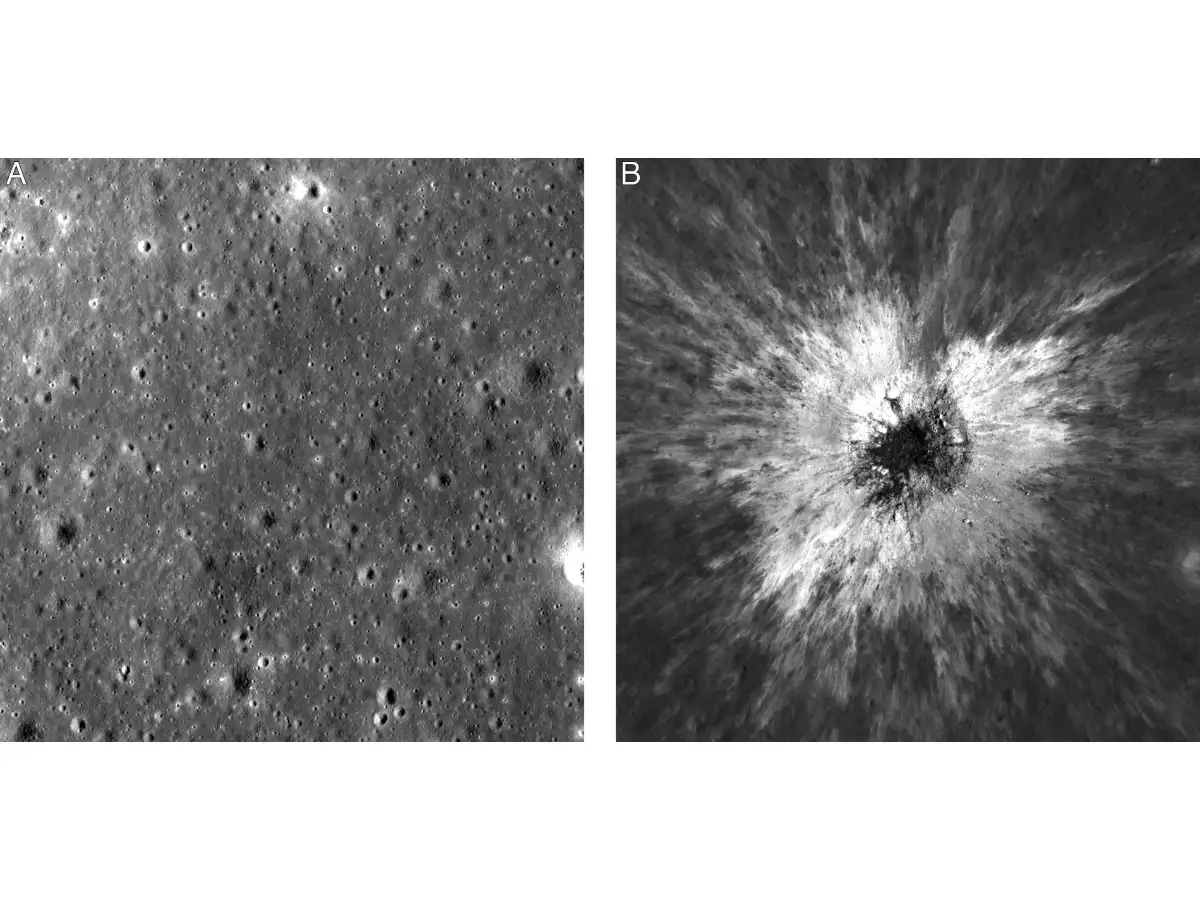
Scientists have uncovered a massive, steep-sided crater on the moon resulting from a powerful impact two years ago that initially went undetected. Measuring approximately 728 feet across and up to 141 feet deep, a size larger than the Roman Colosseum, the hole represents the solar system's largest known impact crater formed in recent times.

Researchers estimate that a large-scale event of this magnitude occurs only once every 132 years.

“This event constitutes a statistically rare, effectively once-in-a-lifetime observation,” the scientists wrote in one of two studies appearing on the subject Wednesday in the journal Science Advances.

Also read: SpaceX prepares for first orbital flight of Starship rocket

NASA's Lunar Reconnaissance Orbiter (LRO) first captured the formation in May 2024, shortly after an incoming fragment of an asteroid or comet struck the lunar surface. The collision escaped real-time detection by telescopes both on Earth and in space. LRO's wide-angle images were not identified in the initial crush of data until August 2025. The spacecraft gathered higher-resolution imagery last fall, leading to formal confirmation of the discovery early this year.

It is named after the late Thomas McGetchin, a former director of Houston's Lunar and Planetary Institute, is three times larger than the previous record-holder discovered by the LRO a decade ago. While the moon features ancient formations stretching up to 2,400 kilometres across, this recent strike churned the surface across an area exceeding 100 kilometres.

According to Mark Robinson, chief scientist for the LRO's cameras at Intuitive Machines and lead author of one study, dust and rocky soil were thrown outward at a higher angle than anticipated.

Also read: Chandrayaan-1 finds clues to a Moon basin lost in time

A companion study documented a 7-kilometre-wide "cold spot" encircling the crater, caused by the loosening of the topsoil. Co-author David Paige of the University of California, Los Angeles, compared the phenomenon to agricultural soil preparation.

“We're now thinking of impacts as a way to garden the regolith, churning the sediments and putting stuff above that's usually below the surface,” Paige said in a statement.

Data gathered by the LRO since its 2009 launch indicates that ejected material overturns the top inch (2 cm) of lunar soil every 80,000 years, a rate significantly faster than past estimates.

Contrary to the popular belief that the Apollo moonwalkers' dusty lunar footprints will last forever, they will “definitely be long gone in that time frame,” Robinson said in an email.

The immediate priority for researchers is calculating the risk posed by high-velocity impact debris to planned lunar infrastructure.

“That information will help engineers harden structures so one won't have to worry about damage, or maybe worry less,” Robinson added.

(With inputs from agency)

Sign up to read this article
Read news from 100's of titles, curated specifically for you.
Already a member? Sign in here
Related Stories
Top stories on inkl right now
One subscription that gives you access to news from hundreds of sites
Already a member? Sign in here
Our Picks
Fourteen days free
Download the app
One app. One membership.
100+ trusted global sources.