
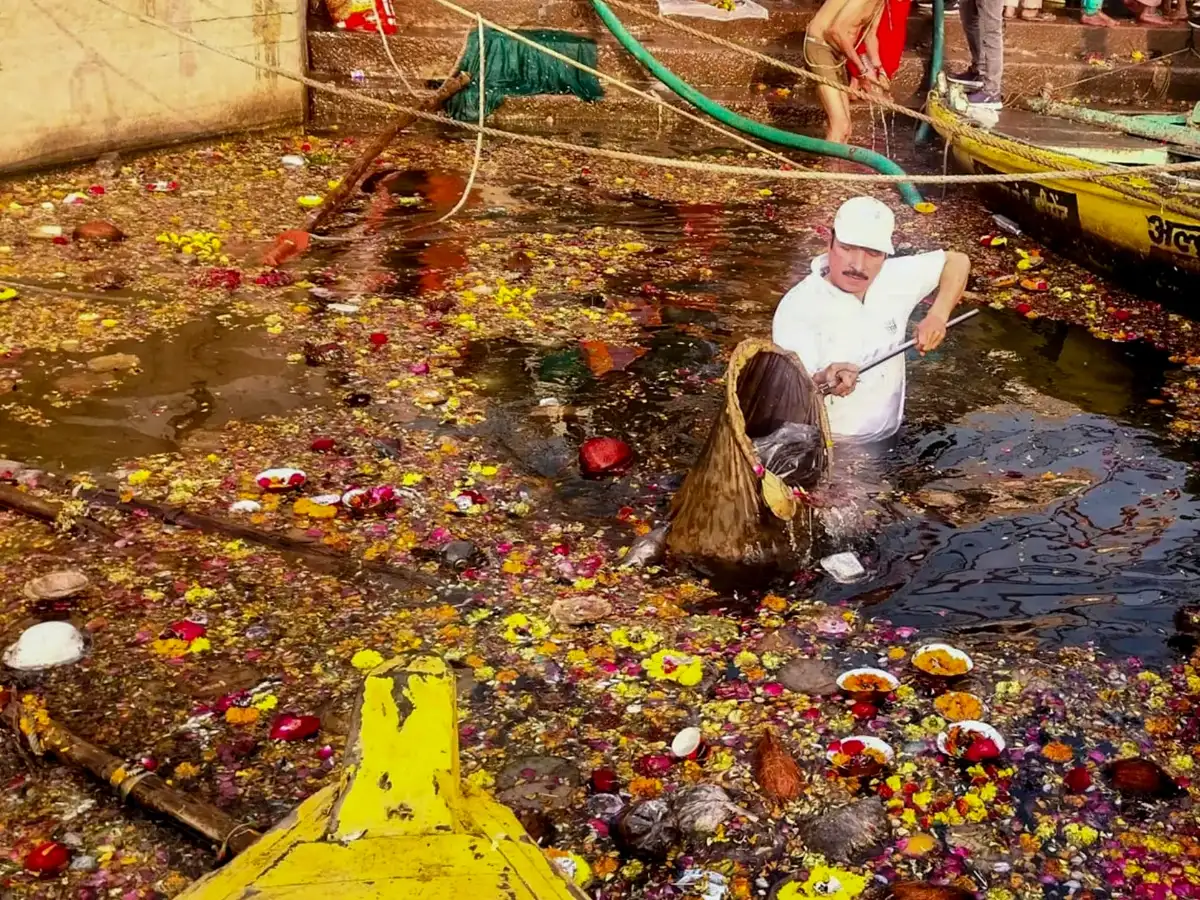
New Delhi: The industrial pollution load entering the Ganga has declined by nearly 60 per cent since 2017, with the biological oxygen demand (BOD) load from grossly polluting industries falling from 26 tonnes per day to 10.75 tonnes per day in 2024, officials associated with the Namami Gange programme said.
They attributed the decline in industrial pollution to a slew of regulatory measures introduced under the Namami Gange, Centre's flagship river conservation programme.

According to officials, the most significant intervention has taken place in Kanpur's Jajmau tannery belt, long regarded as the largest single point source of industrial pollution on the Ganga main stem.
"The Jajmau tannery belt was, for two generations, the most photographed and reported source of Ganga pollution in the country. Images of discoloured water downstream of Kanpur defined the public's understanding of what industrial pollution did to the river," an official said.
The cleanup of the Kanpur stretch involved the construction of the Jajmau common effluent treatment plant (CETP), interception of the Sisamau drain, expansion of municipal sewage treatment infrastructure and enforcement of zero-liquid-discharge norms for larger tanneries.
The officials said the Jajmau CETP, with a treatment capacity of 20 MLD, was inaugurated in December 2023 and is now operational. The facility treats tannery effluent containing chromium, organic load and dyes before discharge. It has been complemented by the interception of the Sisamau drain, which previously discharged around 140 MLD of untreated sewage and industrial effluent directly into the Ganga.
They said water quality in the Kanpur stretch has improved substantially, though challenges remain.
"The Kanpur stretch is a partial success still in progress. BOD levels have fallen significantly but bathing-quality standards have not yet been achieved in the Farrukhabad-to-Purana Rajapur sub-stretch," the official said.
Apart from Kanpur, another major intervention has been carried out in Mathura, where a 6.5 MLD CETP has been completed and is operational.
The project serves industrial units in the area, including those linked to the Mathura Refinery and chemical and dye manufacturing units.
The officials said treated water from the associated Trans Yamuna sewage treatment plant is now being supplied to the refinery, reducing freshwater consumption and limiting wastewater discharge into the river system.
A 4.5 MLD CETP at Banthar in Uttar Pradesh's Unnao district is also under construction and is expected to serve industrial units in the area, including tanneries and chemical manufacturing facilities.
Under the system, every grossly polluting industry (GPI) in the basin undergoes an annual inspection by a third party, with reports submitted to the Central Pollution Control Board (CPCB) and the respective state pollution control boards. Non-compliant units face environmental compensation penalties and, in cases of repeated violations, closure orders.
The officials said the CPCB also conducts surprise inspections, particularly during the monsoon and festivals when industrial discharge spikes have historically gone unrecorded.
The CPCB currently operates 112 water quality monitoring stations across the Ganga's main stem in Uttarakhand, Uttar Pradesh, Bihar, Jharkhand and West Bengal.
Another major component of the strategy has been the online continuous effluent monitoring system, which allows regulators to monitor pollution levels in real time.
Officials said 234 sewage treatment plants out of 275 mapped are currently transmitting live operational data.
"This has shifted enforcement from periodic inspections to continuous accountability and made it far more difficult for industries to increase discharge levels between inspections without detection," another official said.
Sector-specific compliance charters have also been introduced for industries such as tanneries, sugar mills, distilleries, pulp and paper units and chemical manufacturers.
The officials said these charters allow the regulator to apply industry-appropriate yardsticks instead of a one-size-fits-all rule that historically gave the most polluting sectors easy compliance.
Despite the gains, the officials acknowledged that some stretches of the river continue to record BOD levels above prescribed bathing standards.
According to CPCB monitoring data, non-compliance persists in three identified stretches -- Farrukhabad to Purana Rajapur in Kanpur, Dalmau in Raebareli and the downstream stretch from Mirzapur to Tarighat in Ghazipur. Pollution in these locations continues to be driven by a combination of industrial discharge and municipal sewage.
Officials stressed that while industrial pollution is often more toxic, domestic sewage remains the largest source of pollution entering the Ganga by volume.
According to programme data, sewage treatment infrastructure created under Namami Gange has reached 4,260 MLD against a sanctioned target of 6,610 MLD.
Looking ahead, the programme will focus on upgrading existing CETPs and expanding the reuse of treated wastewater by industries.
"Existing CETPS are being upgraded, and advanced biological and chemical treatment technologies are being introduced to improve pollutant removal efficiency. Industries are also being encouraged to reuse and recycle treated wastewater, thereby minimising the volume of waste discharged into the river," the official said.







