Get all your news in one place.
100's of premium titles.
One app.
Start reading
The Conversation
The Conversation
Andrew Svesko, Research Associate of Theoretical Physics, King's College London

Naked singularities: how quantum black holes explain why we don’t see the end of space and time

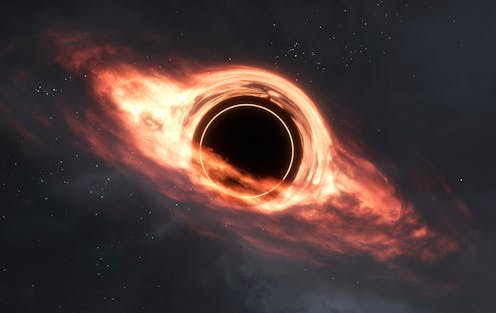
Vadim Sadovski/Shutterstock

Albert Einstein’s theory of gravity, general relativity, is famously incomplete. As proven by physics Nobel laureate Roger Penrose, when matter collapses under its own gravitational pull, the result is a “singularity” – a point of infinite density or curvature.

At a singularity, space, time and matter are crushed and stretched into nonexistence. The laws of physics as we know them suffer a complete breakdown. If we could observe singularities, our physical theories couldn’t be used to predict the future from the past. In other words, science would become an impossibility.

Sign up to read this article
Read news from 100's of titles, curated specifically for you.
Already a member? Sign in here
Related Stories
Top stories on inkl right now
One subscription that gives you access to news from hundreds of sites
Already a member? Sign in here
Our Picks
Fourteen days free
Download the app
One app. One membership.
100+ trusted global sources.