Get all your news in one place.
100’s of premium titles.
One app.
Start reading
The Times of India
The Times of India
World
TOI World Desk

Mysterious stone ‘gates’ discovered across Saudi Arabia’s Harrat Khaybar lava field

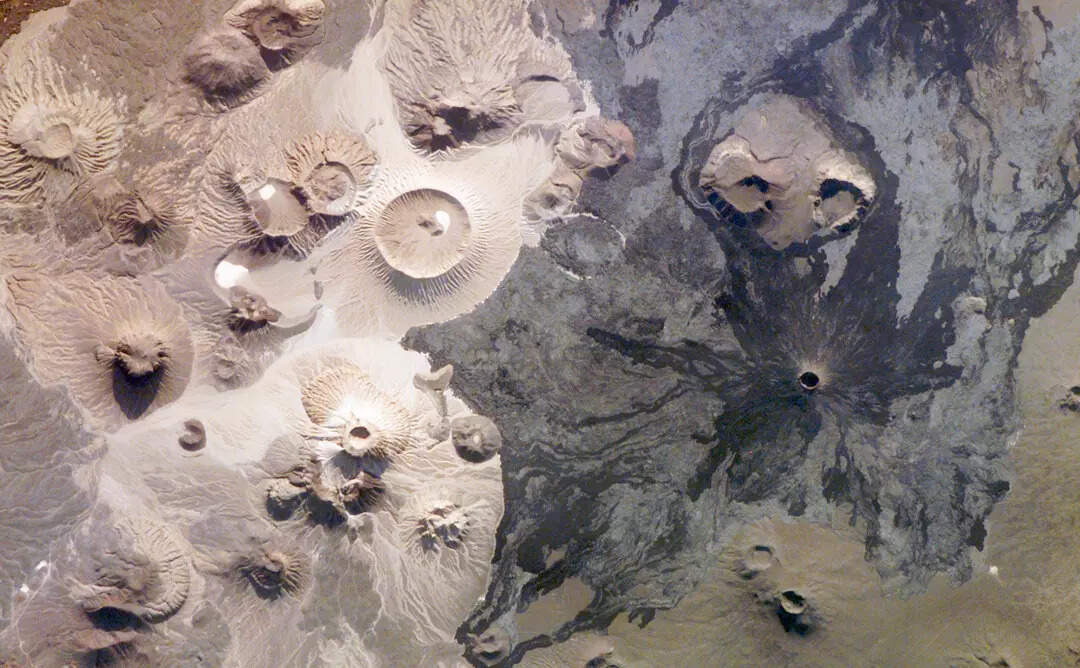
Across the dark lava plains of Harrat Khaybar in northwestern Saudi Arabia, low stone lines and geometric shapes sit quietly against the basalt. What once appeared to be empty volcanic ground is now understood to hold hundreds of large prehistoric structures, identified through satellite imagery and limited field surveys. Archaeologists report a varied landscape of enclosures, cairns, desert kites and long rectangular formations known as gates, spread across roughly 14,000 square kilometres. Many remain undated, though researchers link them broadly to Neolithic communities who lived here during wetter climatic phases. Scientific analysis of surrounding lava flows is underway, offering tentative chronological markers while leaving the precise purpose of several structures unresolved.

Massive Neolithic stone formations documented in Harrat Khaybar lava field

The report refers to a large concentration of prehistoric stone structures found in Harrat Khaybar, a volcanic region in northwestern Saudi Arabia. The area is one of Arabia’s biggest lava fields, formed by ancient volcanic eruptions. For a long time, it was seen mainly as a geological site. Satellite imagery changed that view.

Researchers identified hundreds of large stone constructions scattered across the lava landscape. These include:

  • Circular and rectangular enclosures
  • Long stone walls
  • “Desert kites,” large funnel-shaped stone structures
  • “Gates,” which are rectangular stone outlines that resemble field gates from above
  • Burial features such as cairns and “keyhole” tombs

Many of these structures are visible from the air but difficult to recognise at ground level. The dry climate has preserved them well, creating what researchers describe as a prehistoric landscape frozen in time.

What are desert kitesDesert kites are among the better understood structures. They are large stone walls forming a wide funnel that narrows into an enclosure. Archaeologists believe they were used as animal traps, guiding herds into confined spaces where they could be captured or killed. Some researchers suggest they may also represent early attempts at animal management or proto-domestication.

What are the “gates”The so-called gates are more mysterious. From above, they look like simple rectangular shapes made of low stone walls. They do not resemble houses, pens, or tombs in any obvious way. Their purpose remains unknown. They may have had ritual, territorial, or symbolic functions, but there is no firm evidence yet.

Why satellite imagery mattersAlthough some structures were noted decades ago, systematic identification became possible only with modern satellite imaging. The aerial perspective makes patterns visible, including alignments that stretch for kilometres and suggest ancient travel routes or territorial boundaries.

How old are the structuresResearchers are trying to date them by analysing nearby lava flows that cut across some of the stone features. If a lava flow covers or intersects a structure, the structure must be older than that eruption. Scientific methods such as argon dating and archaeomagnetic analysis are being used to establish a clearer timeline.

The findings suggest that the region supported organised Neolithic communities during a wetter climatic period in the early Holocene. The scale and variety of the stone structures indicate coordinated labour and social organisation.

In short, Harrat Khaybar is no longer viewed as an empty desert. It appears to be a major prehistoric landscape, with many of its largest structures still waiting for explanation.

Sign up to read this article
Read news from 100’s of titles, curated specifically for you.
Already a member? Sign in here
Related Stories
Top stories on inkl right now
One subscription that gives you access to news from hundreds of sites
Already a member? Sign in here
Our Picks
Fourteen days free
Download the app
One app. One membership.
100+ trusted global sources.