
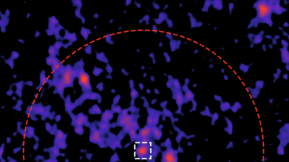
One of the Milky Way's brightest globular clusters is emanating mysterious radio waves from its heart, new observations have revealed. Scientists believe the intriguing signal may be produced by a medium-sized black hole; if true, that'd make this result the first of its kind.
The team discovered the signal while scanning the 47 Tucanae cluster with the Australia Telescope Compact Array (ATCA) in New South Wales. Globular clusters are ancient groupings of stars scattered around the Milky Way galaxy. Stars inside these clusters are packed much more densely than those in other parts of the galaxy. 47 Tucanae, for example, contains more than a million stars in a sphere with a diameter of 120 light-years. This cluster is the second brightest in the sky and can even be observed with the naked eye.