
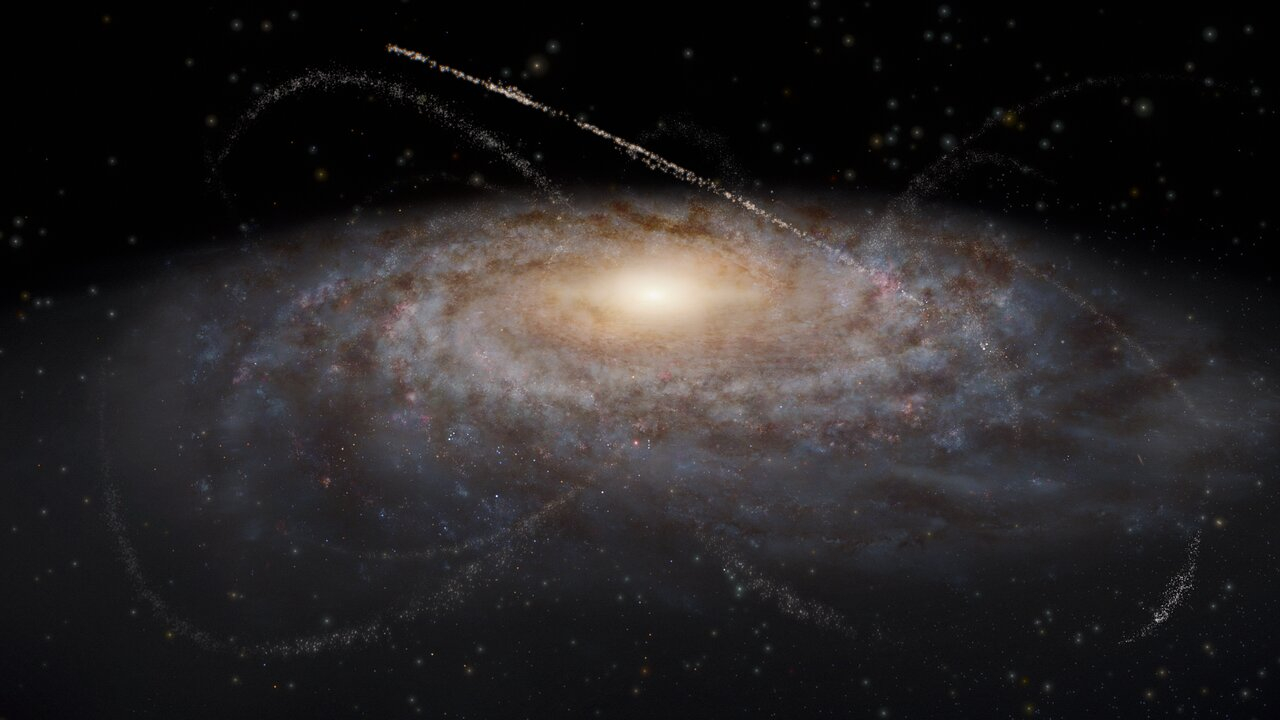
Starting late next year, the Vera C. Rubin observatory, a $700-million telescope nearing completion in northern Chile, plans to gather clues about the nature of dark matter by studying gaps between streams of stars that orbit at the outskirts of our galaxy.
These gaps are found within starry trails left behind after the Milky Way gravitationally shredded nearby galaxies, within which the stellar remnants exist. These are useful tracers of dark matter — the invisible, universe-permeating substance that surrounds most galaxies in halos but is yet to be directly detected. In stellar streams, the influence of dark matter can be inferred "in the same way that twinkle lights can reveal the shape of a tree that they are strung up around, even when we can't see the branches or foliage," scientists say.












