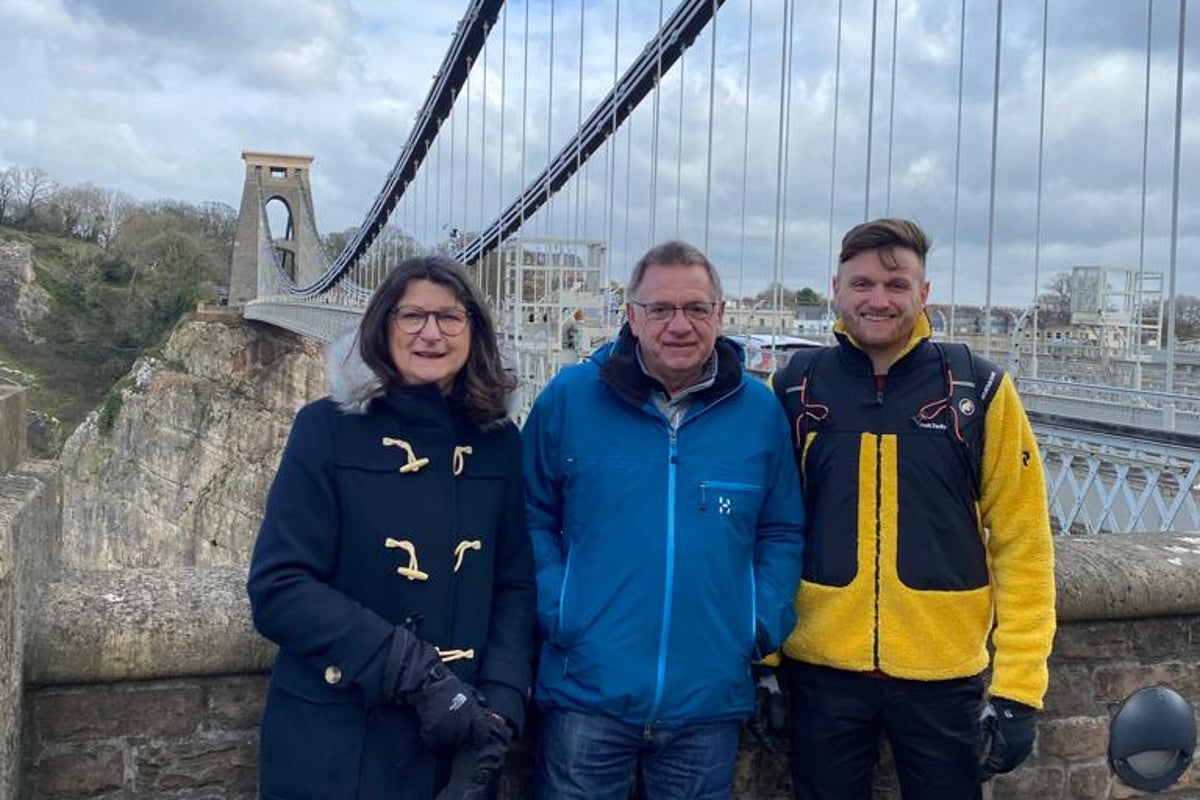
The father of a man killed when he ran into a low-hanging electricity line has described the moment he found his son’s body.
Harry Oates, 29, an aerospace engineer who worked in Bristol, was visiting his parents’ home in Lonsdale, Cumbria, for the weekend, where the family had planned fun activities such as golf and cycling that they never got to do together.
What began as just a “nice, regular kind of day” filled with admin tasks like car servicing turned into a traumatic and grave loss.
Harry decided to go out for a two-hour jog as part of training for a charity half-marathon to mark his upcoming 30th birthday.
When Harry didn’t come home on time, the family began to worry that something had gone wrong. His father, Malcolm Oates, said at first: “One thing that we thought was on his route that he was going on, he would pass two or three houses where old school friends lived.
“So we thought maybe he's bumped into somebody and stopped for a chat, or, you know, he's been waylaid. But after two and a half hours, we started to get concerned, so phoned him.”
.jpg)
He added: “After a while of him not answering, we thought he possibly dropped his phone, and he was backtracking on his run, looking for it, because it was still ringing. It was still active, but not being answered anyway.
“When it got to about 4.15pm his brother Charlie got home from work, and I used ‘Find My iPhone’ on his phone. So we tracked Harry's phone to be in a field fairly close to the house here, only a 10-minute walk away, so Charlie and I set off in Charlie's car to go and see if we could locate his phone.”
That’s when Mr Oates saw his son. He said: “As I got closer and closer, it started to dawn on me that it was Harry lying prone on the floor, face down. And as I got closer and closer, I could see there was an 11,000-volt cable across him.”
He discovered his son’s body just a three-minute drive from their home, in Lupton, near Kirkby Lonsdale.
“That image of him there, is the last thing I see at night and the first thing I see in the morning when I wake up,” Mr Oates said.
The father immediately phoned his wife, Ros, in horror and said: “You've got to get down here right away. It's the worst possible outcome.”
Harry had been electrocuted to death by a low-hanging wire.
He will forever be remembered by his family as a “kind”, “popular”, “caring” and “compassionate” son who was taken from them far too soon. His mother Ros shared that he had the “ambition to visit 30 countries by the time he was 30, and he exceeded the 30 countries, but unfortunately, he didn't reach his 30th birthday”.
Harry’s former colleagues in Cambridge decided to commemorate him with a Harry arts boardroom and hung a plaque in his honour.

An inquest ruled that Harry had died from “rare and complex” circumstances and that the line manager, Electricity North West (ENWL), was not responsible for his death. However, the coroner did ask the Energy Networks Association (ENA) to take action to improve safety practices and prevent future deaths.
In her prevention of future deaths report, coroner Kirsty Gomersal said Harry had come into contact with a line that had come away from its usual position two days previously, but had not touched the ground and remained unreported.
She wrote: “There was no automatic means of detection of the low-hanging line.”
Harry’s family has called for greater accountability, accusing ENWL of “hiding behind their maintenance record, saying that they've carried out all maintenance they should have done, and that the sequence of events was unforeseen”.
Ms Gomersal wrote that the line fell out of position due to a failure of two insulators that suspended the wire. After its investigation, ENWL has stopped using that type of insulator and was planning a programme to replace them at around 8,000 locations.

In the meantime, when maintenance work is required at those locations, the insulators are replaced. The coroner raised concern over a risk of future deaths due to the fact there are still locations across the UK which use the older type of insulators.
Mr Oates called for a mandatory replacement of the older insulators.
He said: “There should be a programme in place now where every single porcelain disc insulator should be removed and replaced. It could happen tomorrow. It could be happening right now. They haven't done anything about it.”
A spokesperson for ENWL said: “Our heartfelt sympathies remain with Harry Oates’ family at this time. This was a tragic incident which both the coroner and Health and Safety Executive noted involved a rare and complex sequence of events that were unforeseeable.
“Safety is our number one value, and we will continue to work with other distribution network operators and the industry trade body, ENA, on learnings from this immensely sad accident.”
A Health and Safety Executive spokesperson said: "We extend our sincere condolences to the Oates family. This was looked at by a coroner who concluded it was a tragic incident caused by a rare and complex sequence of events. No material breach of law was identified by our investigation.”
Lost grave of Viking warlord ‘discovered’ on English coast
Trump says Renee Good and Alex Pretti were ‘no angels’ but shouldn’t have been killed
Coroner warning to pregnant woman over drug used to treat migraines after baby death
Aptamil and Cow & Gate baby formulas recalled over toxin poisoning fears
Autistic and ADHD children to be excluded from disability queue at Alton Towers
Sir Elton John tells court ‘invasion’ into his family’s privacy was ‘abhorrent’