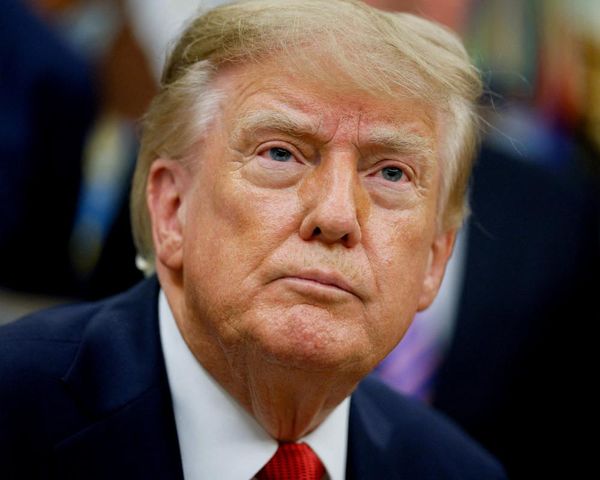
It’s Saturday morning in Florida. The sun is out, the temperature is over 70 degrees, and the President of the United States has spent the last few hours ensconced within the secure perimeter of the West Palm Beach golf club he has owned for three decades.
What was he doing there?

That was the mystery confronting me this past weekend as part of the rotating “pool” of journalists whose job it is to stick close to the commander-in-chief and be ready in case anything might happen.
What we got over the course of the three-day trip was the entire range of what it’s like to be on the road with the 47th president.
He outraged members of both parties by shockingly disparaging a former FBI director and political foe who lost a battle with Parkinson’s Disease, threatened war crimes against Iran — then walked the threats back just before they could tank the markets — before touting his use of the National Guard to combat crime in a major American city and wrapping up his trip with a surreal visit to the home of an American musical icon.
Less than a day earlier, I’d flown with President Donald Trump and a small coterie of staff and advisers aboard Air Force One for one of his frequent weekend sojourns to Mar-a-Lago, the century-old Mediterranean-style villa that has been his primary residence since 2019.
He didn’t stop by the press cabin to chat during the flight from Joint Base Andrews, but we were able to watch a live feed of him speaking to reporters before he departed the White House. Trump appeared to be in a talkative mood on the South Lawn as he dismissed the Iranian government as “thugs and animals and horrible people” who had been hit “awfully hard” by American and Israeli warplanes over the last few weeks. He also claimed “a lot of progress” in back-channel talks with Tehran, though he did not say with whom the U.S. was speaking.
My colleagues and I, each of whom was there to represent a television network, wire service, radio network or print/digital news outlet, had been dismissed for the evening after a brief motorcade from Palm Beach International Airport to drop the president off at his historic estate, with instructions to gather in our hotel lobby at 7:15 the next morning.
Having satisfied the Secret Service that none of us were a threat to anyone’s safety, we piled back into the vans for a brief wait before catching a glimpse of the president’s armored limousine — nicknamed “The Beast” — pull out of his Mar-a-Lago compound.
Where were we going? No one would tell us ahead of time — ostensibly for security reasons. And the president wasn't giving any indication of his destination on his Truth Social feed, which, as usual, was our best window into his mood short of getting within shouting distance.

One source who I knew to be traveling with the president got back to me with a disappearing message on Signal consisting only of a shrugging emoji and a question: “Where else would he go on a Saturday in Florida?”
As Trump and his caravan of law enforcement and support vehicles raced through the streets of Palm Beach, our three press vans followed as part of the lights-and-sirens motorcade until our destination became clear.
We finally peeled off into a library parking lot as the rest of the motorcade turned the opposite way, passing an ornate sign indicating the entrance to the Trump International Golf Club in West Palm Beach.
How long would the president be there? What was on his schedule? I tried asking the White House, but no answers were forthcoming. One source, a senior White House official, glibly suggested that I call Trump to ask what he was up to.
I briefly considered taking them up on the offer, but before I could dial on the off chance that the president would pick up (as he’s been known to do), my phone buzzed with a Truth Social post, threatening to send ICE into American airports to target Somali-Americans unless Democrats did not “immediately sign an agreement to let our Country, in particular, our Airports, be FREE and SAFE again.”
Considering our current location, the answer seemed obvious — but no one would say it.
That’s because the first rule of Donald Trump’s golf habit is to not talk about Donald Trump’s golf habit.

This Tyler Durden-esque code of silence dates back to his first term, when it became clear that journalists were paying attention — in no small part because he frequently criticized his predecessor, Barack Obama, for the amount of time he spent on the links, usually at government-owned courses on the grounds of military bases.
It’s all a bit absurd considering Trump, a lifelong amateur duffer whose eponymous real estate and branding empire includes 18 courses across 12 properties in multiple countries, is probably the world’s most famous practitioner of the game outside of the PGA Tour.
Yet during his time in office dating back to his first term, the White House has been almost pathologically averse to even acknowledging that the leader of the free world might be spending a few hours engaging in one of America’s most popular recreational activities.
Officials almost never respond to questions about whether the president is golfing. They do not provide any information about the identities of anyone with whom he might be playing. And the Secret Service (for good reason) has made it nearly impossible for a long-lensed photographer to find a spot where one might snap a photo showing Trump enjoying what is clearly his favorite activity.
So without any official word on the president’s status, we made our way into a room in the Palm Beach library that had been reserved for us — and we waited, all on the off chance that something might happen that would require our immediate presence.
This hurry-up-and-wait game isn’t what most people imagine when they picture a White House reporter’s duties, but there is an important — and macabre — reason that we were spending our weekend shuttling between vans and empty rooms.
Six decades ago, a UPI wire service reporter named Merriman Smith was riding in a “press pool” car in Dallas, Texas when he heard three shots fired at President John F. Kennedy’s motorcade. It was Nov. 22, 1963. He picked up the primitive radio telephone in the press car and called the company’s Dallas bureau. Minutes later, teletype machines across the country printed out the horrible news: “Three shots fired at President Kennedy’s motorcade in downtown Dallas.”

Seventeen years after that, an NBC News camera crew serving in the press pool captured would-be assassin John Hinckley firing six shots at President Ronald Reagan before being tackled by a swarm of police and Secret Service. Footage from that day shows what the photographer saw as he panned back from the scrum to catch Reagan’s limousine speeding away, then zoomed in on the awful sight of White House Press Secretary James Brady lying facedown as blood seeped from a wound on his head.
And, yes, it was also a “pool” camera that was trained on Trump in July 2024, when a bullet came fractions of an inch from his head as he delivered a campaign speech in Butler, Pennsylvania.
Thankfully, I wasn’t faced with the horrible task of reporting on yet another attempt on Trump’s life. I just wanted to know what he was doing at his golf club. Eventually, a source close to the president’s entourage confirmed the obvious for me. He played nine holes, then skipped past a few to keep him away from the street (at the Secret Service’s request) before playing two more.
But as we were finally told we could pack up our gear and return to our vans, a life-and-death story broke over the wires. Robert Mueller, the former FBI director who’d become a hate object for Trump-world by leading a Justice Department probe into Russia’s efforts to interfere in the 2016 election on Trump’s behalf, had died at age 81.
I texted a White House official about whether we could expect a statement from the president. Within minutes, I got a reply pointing me to a Truth Social post containing the president’s reaction: “Good, I’m glad he’s dead.”
The message was so bizarre and outrageous that the initial reaction to it from some sources was disbelief. One source, a former Trump appointee from his first term, texted me to ask if I’d been duped by an AI-generated screengrab of a fake Truth Social post.

Not long after, our vans joined up with the rest of Trump’s motorcade to follow him back to Mar-a-Lago, at which point we were dismissed for the day. Meanwhile, Trump continued to follow up his denunciation of Mueller with more posts and reposts of opinion pieces and memes denigrating the respected Marine veteran as a partisan hack — a description that would’ve been ridiculous to even consider before he found himself in the president’s crosshairs nearly a decade ago.
But Trump outdid himself five hours later with yet another Truth Social post, this time threatening to attack Iran’s power grid — something he’s condemned Russia for doing in Ukraine — unless Tehran agreed to let oil tankers begin passing through the Strait of Hormuz once more.
It was a brazen threat to carry out attacks that could potentially be considered war crimes, and it was bound to send markets plunging when they opened on Monday.
Or so we thought.
After another day spent at the Palm Beach library while the president played golf (something I managed to find out despite the lack of confirmation from the White House) my colleagues and I were summoned to our hotel lobby early on Monday to drop off our luggage for the return to Washington following a brief law enforcement roundtable event at the Memphis airport.
As we waited to pile into our vehicles to meet up with the president for the drive to the airport, phones buzzed with an all-caps Truth Social missive in which Trump claimed the U.S. was having “very good and productive” talks about a “complete and total resolution” of the month-old war he’d started.
He added that he was calling off — or at least — postponing the power grid air strikes he’d threatened earlier in the weekend.
Iranian officials quickly denied any talks had taken place, but the oil markets — and stock futures — appeared to rebound rapidly.

He repeated some of the same claims an hour later when we gathered under the wing of Air Force One to watch him board, only to see him amble over to take questions for roughly 20 minutes as the iconic Boeing 747’s gigantic engines idled just feet away.
As we found our way to the press cabin at the back of the plane, one of my colleagues from another outlet remarked that the plane-side gaggle might not be our last shot at questioning POTUS.
One senior administration official suggested we’d get possibly one or two more shots at putting queries into Trump’s ear, potentially giving us a chance to press him on more detailed denials of talks coming from Iranian government officials. This was welcome news, since it’s always easier to ask follow-ups and hear his answers from the relative calm of the plane rather than over the roar of the General Electric-built turbines on the tarmac.
We did get within speaking range of Trump again — but not in the way we’d expected.
After a two-hour flight from Palm Beach to a Memphis Air National Guard facility next to the city’s massive airport (home to the FedEx package hub that is the world’s busiest airport between 10:00 pm and 4:00 am each night) we quickly deplaned to witness Trump do the same and get into his limo for a ride that was so short we were told to walk to the same building.

There, we found a cavernous hangar that had been turned into something that looked like a cross between a boardroom and a Trump rally venue.
We were there for an event to celebrate Trump’s use of the National Guard to supplement federal, state and local law enforcement in the city often called the Home of the Blues for its rich musical history.
The stage was piled high with bags apparently filled with drugs, guns, and other supposed proceeds of the anti-crime campaign.
Trump spoke first, but as is his habit, he didn’t stick to the topic. He riffed for nearly an hour between more talking points on Iran, election-related grievances, and what appeared to be the real reason he’d wanted to stop off in Memphis: Elvis Presley.
He told the crowd of national guard soldiers and law enforcement officers who’d come to witness the event that he’d be visiting Graceland, the late rock and roll legend’s iconic estate, now a major tourist attraction.
"Well, I love Elvis, but I never met him. But I'm going to go see Graceland after this. I think I'm sure it's not going to be a very long stay, but I want to see that,” he said.
Not long after, I found myself back in a van for a 10-minute ride along streets that had been completely shut down to permit the president a rapid transit from the airport to Graceland’s famous gates.

We were quickly hustled through the mansion’s front door to capture the president’s arrival. He was greeted by two Graceland executives who clearly knew their audience because the first thing he saw when walking in was the Presidential Medal of Freedom he’d awarded to Presley posthumously during his first term.
“We love Elvis. Who doesn't love Elvis? Everybody loves Elvis, right?” Trump said.
After greeting his tour guides, Trump turned to the cameras we’d brought and immediately began repeating his talking points about his anti-crime efforts.
“We're touting how well it's done with the crime stats and over a period of five months, it's way, way down, and we're proud of it,” he said.
“Elvis would be very happy about that, right?”
Presley, who died in 1977, was not available for comment.
UK faces biggest hit to growth from Iran war of all major economies, OECD warns
Iran-US war live: Trump launches fresh attack on Nato
Pentagon ‘may divert crucial Ukraine weapons to Middle East’
Lebanese fear another occupation as Israel threatens to use Gaza tactics in the south
MAGA comes Jimmy Kimmel again after Markwayne Mullin ‘plumber’ gag
Trump confirms May visit to China after Iran war forces delay to landmark trip