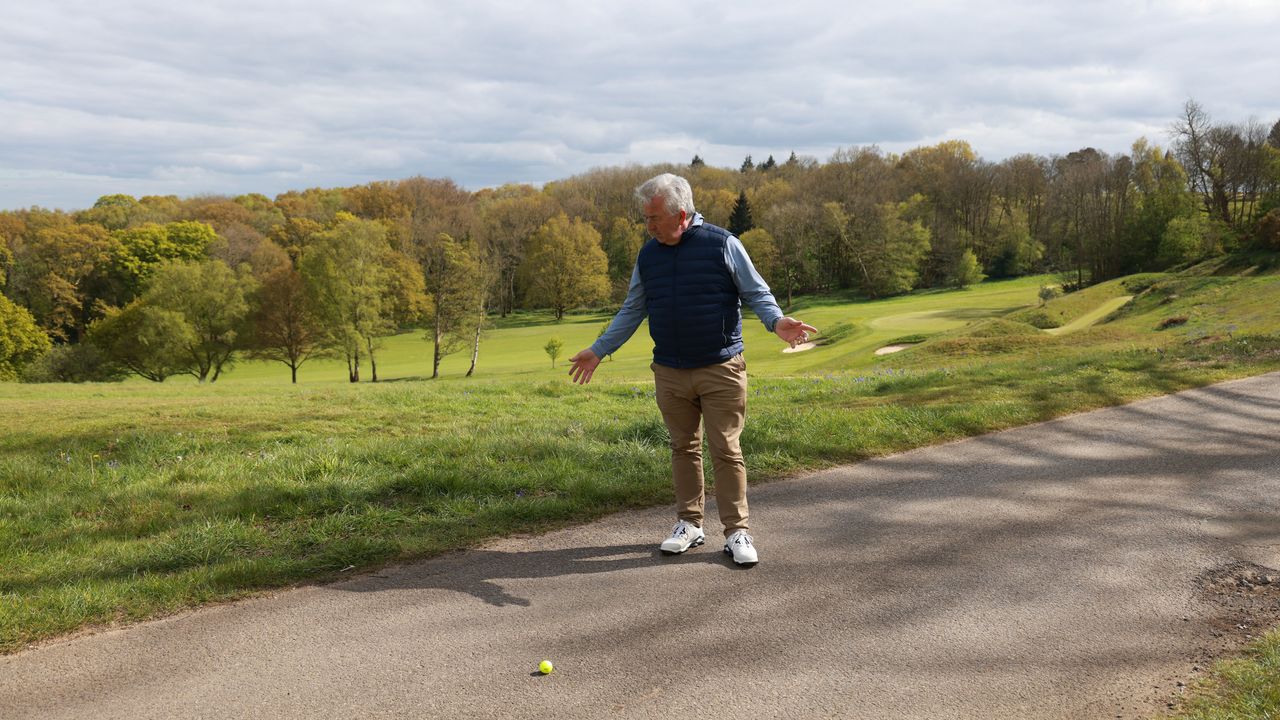
We recently received an email from a reader about taking a drop away from a cart path. This was the gist of it:
“My ball came to rest on a cart path – It’s an immovable obstruction as I could see on the card. So I knew I could take a free drop.
My ball was up against the far curb and there were scrub and bushes on that side. So, I went to measure a club length from a point on the near side, into the semi rough.
My playing partner came over and said, ‘Hey, it’s nearest point of relief, not nicest point of relief.’
I hadn’t heard that before, but I followed his guidance, and he told me I had to drop into the bushes. I reluctantly did so but it meant I had to chip out sideways – that seemed unfair.
I wondered whether he was right and what he had meant by nicest versus nearest?”
Let’s answer that.
When claiming relief from an abnormal course condition, say temporary water or ground under repair, or perhaps from an immovable obstruction like a path, as above, people often misinterpret what to do next.
This is covered by Rule 16. You must establish the nearest point of complete relief, where the condition or obstruction no longer interferes with the stroke the player would make (that means the lie of the ball, the stance and the area of the swing are not affected.)
You have a one club length relief area from that reference point.
In the definitions of the Rules. Nearest point of complete relief is the estimated spot where the ball would lie, nearest to the ball’s original spot (not nearer the hole) in the required area of the course and where there is no interference from the condition relief is being taken from.
In the instance above, the nearest point where the lie, stance or swing was not affected by the path was in the scrubby bushes. Often the nearest point of complete relief may be in an unpleasant spot – in thick rough or on a slope for instance.
That’s just bad luck. It could be that the nearest point of relief puts you in an unplayable ball situation. That would be very bad luck and, if it were the case, you might be better off playing the ball as it lies.
If you took relief and found yourself with an unplayable ball you would have to proceed under the relevant Rule 19.
What a lot of people tend to do is look for the nicest point of complete relief rather than the nearest point of complete relief - a "nice" convenient alternative. That’s what our reader did before being corrected by their playing partner.
If our reader had gone ahead and played from the nicer spot, they would have played from the wrong place and under Rule 14.7 received the general penalty.
If they had been playing stroke play, they would then have had to consider how to proceed.
They would have had to decide whether they’d gained a significant advantage by playing from the wrong place.
If they had, they would have needed to correct their mistake and played from the correct place before teeing off on the next hole. If they hadn’t done that, they would have been disqualified.
So remember – If you’re taking a free drop from an abnormal course condition like a cart path (or taking free relief from another situation under the Rules), be sure to identify your nearest not nicest point of complete relief.
You must measure one club length from there, even if it leaves you in an awkward spot. If you choose nicest point of relief, you face a penalty and possibly disqualification!