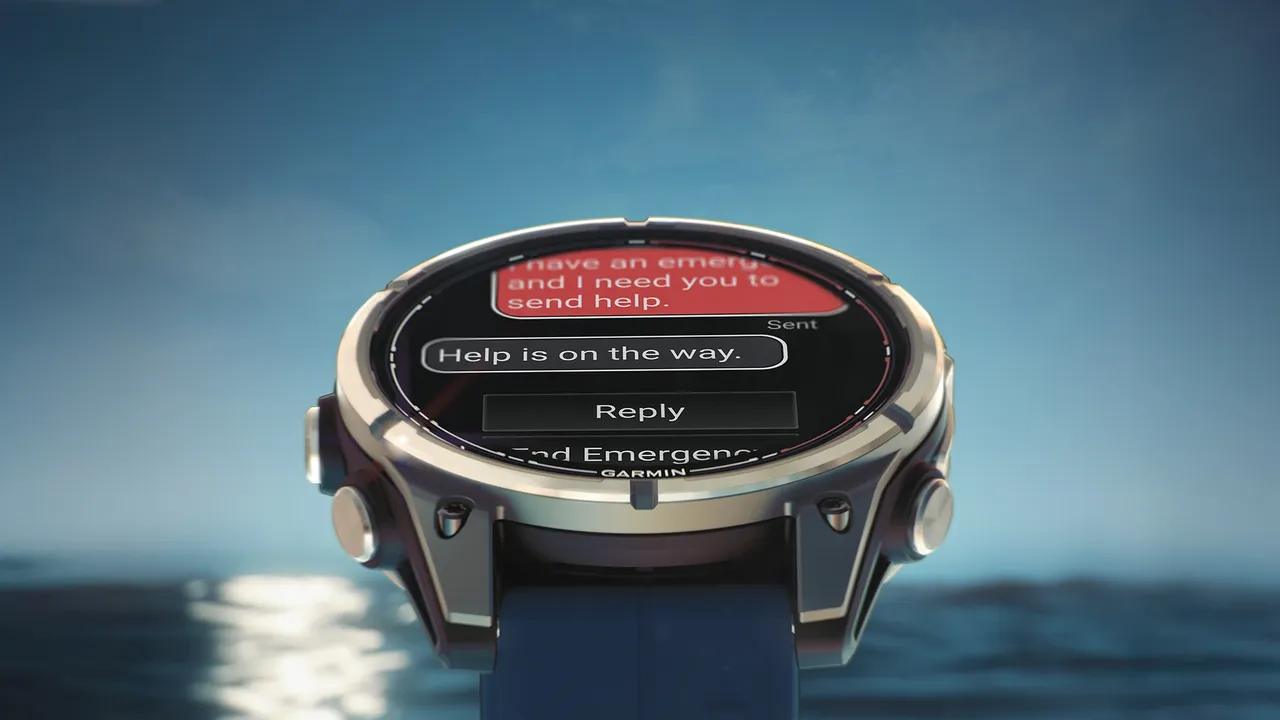
This week, Garmin released the Quatix 8 Pro, a $1,300 Marine GPS watch designed for sailors. Almost no one reading this article would ever buy one. But its arrival, so close on the heels of the Fenix 8 Pro, gives Garmin fans a reason to hope that more affordable "Garmin X Pro" watches will arrive this year.
The first two Pro watches added LTE-M cellular and InReach connectivity to Skylo satellites. Current Garmin watches with messaging or live-tracking capabilities depend on your phone; these new models let you signal an SOS, broadcast your GPS location, or send messages and voice memos.

Satellite on smartwatches is a vital safety feature, one that's increasingly available on mainstream smartwatches like the Apple Watch Ultra 3 and Google Pixel Watch 4. And cellular connectivity ensures you're less dependent upon your phone to stay connected with family on long hikes.
It benefits Garmin to lean into its own satellite option, packed into watches that last significantly longer than competing brands. That's why I'm hoping that Garmin won't limit its satellite or LTE upgrades to its most expensive models, so more people can use them.
Why I expect more Garmin Pro watches this year

If more Garmin Pro watches are coming, the Kansas-based brand will start with its other premium models: a Tactix 8 Pro for soldiers, D2 Mach 2 Pro for pilots, Descent Mk3 Pro for divers, or MARQ Pro series for, well, rich people.
But Garmin's stock crashed last year when not enough people bought the uber-expensive Fenix 8 Pro, and it's unclear if people will spend another $1K–3K for LTE and satellite on top of the same features. The new Fenix 9 and Enduro 4 will prop Garmin profits back up this summer, but that won't be enough for shareholders expecting continued growth in every category.
As I explained in my 2026 fitness watch predictions, Garmin usually releases new models on a two-year cadence, and after a crammed 2025, we can't expect an Instinct 4, Venu 5, Forerunner 980, Vivoactive 7, or other mainline releases.

In the past, Garmin has filled these off years with partial upgrades, such as the Instinct 2X or Venu 2 Plus. Garmin could follow this pattern in 2026 (and attempt to maintain its profits) by re-releasing its best 2025 models with LTE and satellite capabilities, including the Instinct 3 Pro, Venu 4 Pro, and Forerunner 570 Pro, among others.
The Instinct 3 is the most obvious fit, since it's tailored to hikers, but I could just as easily see trail runners preferring a Forerunner 970 spinoff with satellite capabilities. And Garmin could theoretically stick to LTE for the Venu 4 Pro, since its target audience might not benefit as much from satellite connectivity and would prefer a thinner design.
My preference would be a Forerunner 970 Pro or Venu X1 Pro, though the latter might be too skinny to make this work. The wider the selection of Garmin Pros, the safer people will be on long hikes and trail runs — and the more InReach subscriptions Garmin will sell.
The main hurdle to more Garmin Pro watches: The antennas

The Fenix 8 Pro 47mm measures 16mm thick, 2.2mm thicker than the non-Pro model. It's exactly the same for the Quatix 8 (13.8mm) and Quatix 8 Pro (16mm). Both Pro models also weigh slightly more (4g).
When Garmin released the Fenix 8 Pro, it told DCR that it couldn't sell a 43mm model "due to hardware limitations with integrating the LTE antenna." Both it and the InReach antenna were apparently too difficult to incorporate into a smaller design.
This means that a hypothetical Venu 4 Pro would only be available in the larger 45mm model. And since the Venu 4 measures 12.5mm thick, would the Venu 4 Pro need to be about 15mm thick to incorporate Garmin's antennas, or also 16mm? That would certainly detract from its style a bit.
Likewise, since the Garmin Instinct 3 already measures about 14.5–15mm thick, would a Pro version need to measure 17mm, or would its current thickness leave room for the new antennas? These are the design challenges that Garmin engineers are (hopefully) solving right now.
Whatever the case, I think plenty of Garmin fans will accept a thicker design if the Pro models remain relatively lightweight with consistent battery life, and offer them the peace of mind that comes with having satellite for worst-case scenarios.