Let me start by saying that I am a relative newcomer to the game and desperate to reduce my high handicap - but can some home truths from a Top 50 coach stop me being, well, crap?
I’m clearly stating the obvious when I say that golf is hard. You all know this – whether you’ve been playing for decades or have only recently picked up a package set you’ll find the game fantastic and frustrating in equal measure. Quite often in two consecutive shots.

For me – a man who sits bang on the average age for a golfer in England at 53 – I think the ‘hardness’ of golf is exacerbated by the company I keep.
The people who furnish Golf Monthly with words. They are all good golfers. Some are quite simply brilliant players and at least one, I’m sure, was born in a clubhouse and raised by a pack of feral club members.
Even the GM team members who claim that they’re terrible are way, way better than me. My handicap – which I’ve had for just around a year now – is at least 20 points behind the next worst golfer.
When I play a round with them I watch in awe as they do things like hit a ball a long way. And straight.
Many of them have even got better recently. Social Media editor Johnny Percival had lessons after he lost lost 20 yards and his game fell apart, but things have since recovered for him, and Jonny Leighfield who had his first lesson in 20 years with pretty impressive results.
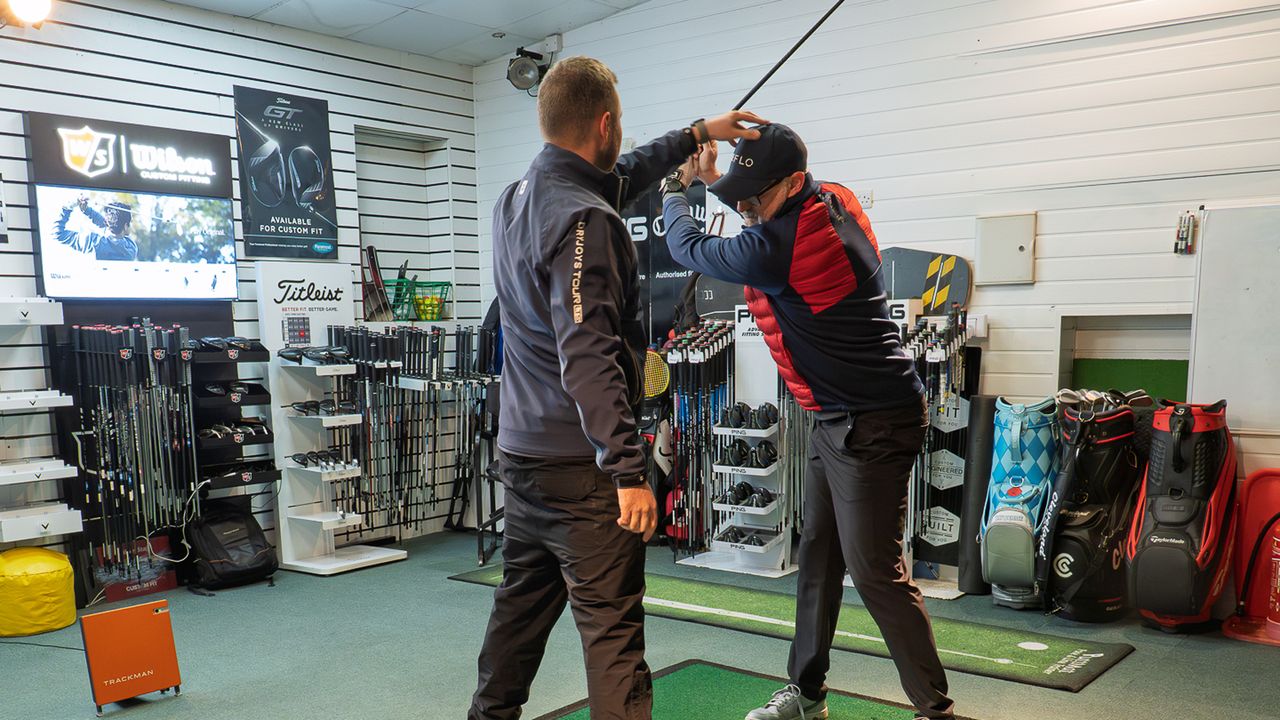
I could let this get me down but, of course, I know that I can do something about it which is why I’ve found myself at Windmill Leisure, on the outskirts of Bristol in south west England, with Golf Monthly Top 50 coach Joshua Mayo gripping my head. Don’t worry, it’s consensual.
Joshua Mayo is a well-respected PGA professional who has helped countless amateur golfers just like me to improve all aspects of their game. He is also recognised as one of the Top 50 Coaches in the UK, so I know I'm in safe hands... literally!
Home Truths From A Top 50 Coach Improved My Golf Swing
The head hold isn’t the first thing that happened, but is a consequence of Joshua spending a good 30-minutes assessing me in the bay.
I’ve been hitting my 8-iron as inconsistently as ever and, it won’t come as a surprise to anyone who’s spent time with a decent coach, my problems start before I’ve even hit the ball.
After watching me address the ball, Joshua takes my place in the bay and replicates how I look as I prepare to hit.
It ain’t pretty – I appear to resemble the hunchback of Notre Dame trying to strangle an iron while stuck inside a box. Hopefully Joshua is exaggerating for effect…
“We definitely need to start with your posture,” explains Joshua. “The goal will be to improve your efficiency, getting your body to work with your clubs and, eventually, seeing you hit balls where you want them to go.”

So, first up is addressing my posture as I address the ball.
Like many of you I’m sure, I find myself tensing up as soon as I start thinking about hitting – my arms lock straight and my shoulders clench together - which is one of 8 common mistakes that many amateurs struggle with.
“Let your arms relax,” says Joshua, “Let them hang naturally. By thinking 'straight', you’re just adding tension.
Now, stand straight, engage your core and then soften your knees with a soft bounce. Finally, hinge forward from the hips and keep your spine neutral.”
It feels different to my usual set up but I feel more stable and, importantly, relaxed. I swing and the 8-iron sends the ball dead straight and 187 yards, Well, maybe not just yet. After a few more hits, we move onto another issue.
Years of running, and resolutely refusing to stretch, mean that I’m more Yogi Bear than yoga.
With the flexibility of freezer-stored Blu Tak my rotation into the back swing is a horror.
Which, at last, explains the head handling. As I rotate, Joshua holds my head in place so that, rather than following the club backwards, I keep looking at the ball. He then pulls the club further behind my shoulders than I thought was humanly possible.

My back and shoulder muscles complain a little, but being physically manipulated in this way does hit home how timid I usually am with my backswing. Note to self - do some of the best golf exercises to help with that.
Joshua eventually lets go of my noggin and I’m allowed to sit down. Admittedly, this is for another golf drill.
Joshua gets me to sit with a club across my shoulders as I rotate my upper body as far as possible, keeping my head still and my lower body pinned down.
This seated rotation drill, he says, isolates and engages my large torso muscles needed for a powerful swing. And, of course, I can do it at home.
Finally, Joshua gets me to swing the club backwards and forwards rapidly, aiming to clip the top of the rubber tee, all the time concentrating on my posture, keeping my head in position and really pushing the backswing.
“Carrying out this drill means that you’re practising your full swing,” explains Joshua.

“I want your swing to become a big, smooth full circle. You need to reframe your thought process to ‘swing the club well’, rather than ‘just try and hit the ball’.
Trying to control the impact point causes the errors. Trust the physics of the swing to return the club to the ball. The more we do this, you’ll move from being a timid, tap-tap-tap down the fairway golfer to a player who hits with confidence.”
After my first hour with Joshua, I feel like I’ve discovered a lot more about my golf and, of course, realised I’ve got a lot of hard work ahead of me if I’m going to improve even just a little.
I do hit a few more balls with the 8-iron and we look at the results on the Trackman screen. I catch one just right.
“Not bad, you’ve hit that two clubs further than the average club golfer,” says Joshua. I’m not sure I believe him, but obviously I’ll be going back for more as there's a lot more he's going to have to do help me improve.