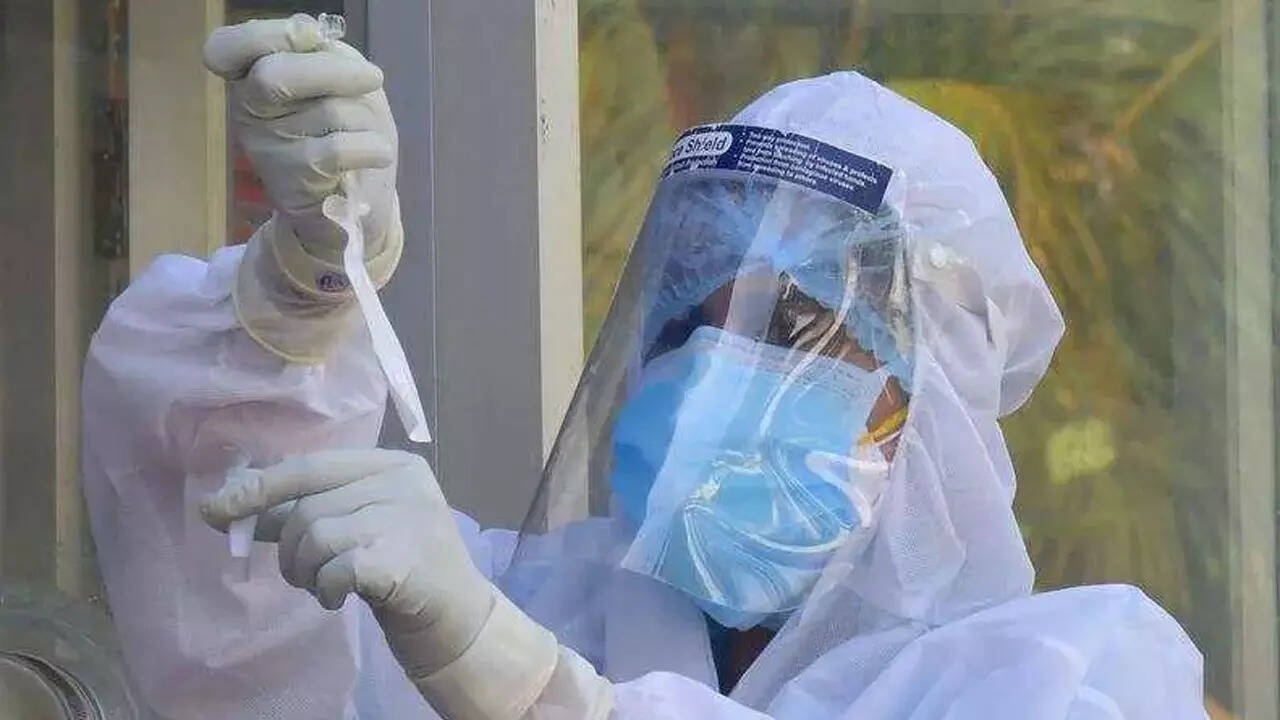
MUMBAI: The city’s contact tracing program wound down to a phone-call based system from door-to-door visits as the massive Omicron-driven third wave swamped civic teams with an exponential rise in cases.
Experts say with coronavirus increasing its spread rapidly in a short period, contact tracing was no longer as relevant nor as practicable.
In January, barely two-three contacts were traced per positive patient. An analysis of civic numbers revealed that contact tracing ratio dropped as daily cases gradually mounted to five digits. From January 6 to January 8, when Mumbai reported more than 20,000 cases every day, less than two contacts were traced per positive case. The ratio, though, has improved in the past few days as cases dip.
According to the norms, teams are supposed to trace 15 high and low risk contacts for every patient. “However, it was impossible to visit all positive households, screen and prepare reports by evening when there were so many of them. Hence, we contacted most on phone, took details of their conditions and checked if family members have symptoms,” said Vedika Samjiskar, a health volunteer posted with a south Mumbai ward.
The BMC’s epidemiology cell gets a list of positive patients, which is shared with all 24 wards. In each ward, there are dozens of health posts whose staffers do contact tracing. In January, each post suddenly had 90-120 cases to track daily, spiralling up from 7-10 in December. Contract tracing involves visiting the patient’s home, screening high-risk contacts and inquiring about low-risk contacts, which can be neighbours, colleagues, etc.
In the current wave, low risk contacts were taken out of the equation, said Dr Jitendra Jadhav, medical officer of L ward, who added that screening was mainly restricted to immediate family members, unlike previous waves when neighbours were also checked. Other ward officials admitted that contract tracing was hit. Dr Mahendra Khandade of N ward (Ghatkopar) said they received 500-600 positive cases daily at the peak of the third wave.
“Besides an enormous load on the system for ten days, many civic health workers contracted Covid, which shrunk the workforce,” he said. Dr Bhupendra Patel, MOH of M west ward, added that they had received up to 700 cases which was too much for a team of 150-odd volunteers to handle. “We kept an eye on households with senior citizens though,” he said.
Globally, in cities like New York, positive patients no longer receive a call from health authorities. While in South Africa, UK contact tracing has been relaxed.
Epidemiologist Dr C Lahariya said contact tracing at the community level is no longer relevant. “It is done when the pathogen is new, and you want to contain it. At that stage you also need it for the purpose of quarantining. Currently 90% of contacts are asymptomatic, so even if you identify a few, it won’t change or halt the infections,” he said.