
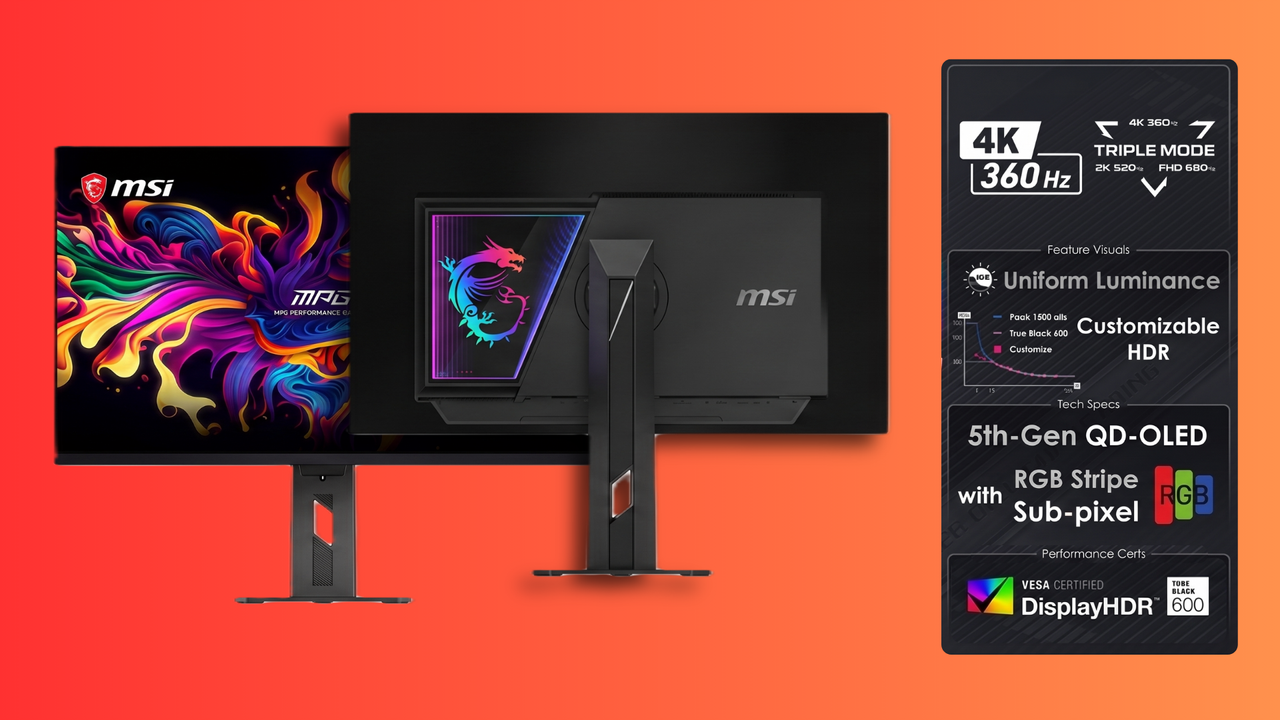
MSI just unveiled a beast of a monitor ahead of Computex 2026, with truly flagship specs in every way — plus a few world firsts. The new MPG OLED 322URDX36 is a 32-inch 4K 360 Hz QD-OLED monitor powered by Samsung's latest dual-mode Penta Tandem QD-OLED panel that MSI has somehow turned into a triple-mode monster, allowing the monitor to ramp up to a whopping 680 Hz at 1080p.
Go deeper with TH Premium: AI and data centers

- Photonics and high-speed data movement is the next big AI bottleneck
- The data center cooling state of play
- Massive AI data center buildouts are squeezing energy supplies
- Ultra Ethernet: The data center interconnection of tomorrow
First, let's talk about the underlying panel, since that was also recently unveiled by Samsung. We're looking at a 32-inch 4K 360 Hz screen with native dual-mode support — a first for QD-OLED monitors — so it can downclock to 1080p resolution at 680 Hz. This is lower than the 720 Hz some WOLED panels offer — but that's at a measly 720p resolution, which makes Samsung's offering better overall.
A few months ago, Samsung Display unveiled its 5th Gen QD-OLED panels featuring the Penta Tandem tech, referring to a five-layer OLED stack that improves brightness. A month before that, at CES 2026, the company also showed off its first-ever V-stripe QD-OLED panel that shifted away from a triangular subpixel layout to a more conventional RGB-stripe config. This new panel combines both of those together.
Not only that, but this seems to be the first panel in the world to achieve a VESA DisplayHDR 600 True Black certification. We haven't seen any OLED monitor go past True Black 500; in fact, Samsung's Penta Tandem technology was unveiled with a TB500 rating. A True Black 600-tier monitor represents 600 nits of peak brightness across a 10% window and 350 nits of brightness across the full screen.
Now that you understand just how impressive this panel is, onto the monitor itself. Between 4K 360 Hz and 1080p 680 Hz, the MPG OLED 322URDX36 adds a third 1440p 520 Hz option. Switching from 4K to 1080p can often feel jarring, so a 1440p middle ground is a great addition, especially when it's still boosting the refresh rate significantly.
To be clear, it's not "2K" as the marketing material emphasizes — it's more like 2.6K (2560x1440) since FHD (1920x1080) technically rounds up to 2K. Regardless, most monitors have stuck to a 1080p dual mode so far — including the native version of this very panel — because 4K scales perfectly to 1080p. Through integer scaling, two pixels combine to simply become a single pixel, and you achieve a lower resolution.
The same math doesn't work with 1440p because you'd have to combine 1.5 pixels into one, which is simply not possible and requires interpolation. Simulating 1440p across a 4K panel will, therefore, result in a blurry mess that looks way worse than a native 1440p panel. Keep in mind, we're talking about a 32" screen here, so pixel density is also a factor. Interpolated 1440p at 32 inches might even look worse than 1080p.
That said, MSI's implementation likely uses a hardware scaler where 1440p is being spatially interpolated at the silicon level. The true RGB stripe subpixel layout also helps here. But that's just a guess and we'll have to wait for reviews to see how the company manages to address this logical fallacy. It's still impressive as hell, though.
The MPG OLED 322URDX36 has a full-fat DisplayPort 2.1 UHBR20 interface allowing for up to 80 Gbps of throughput. Thanks to the Penta Tandem panel, the monitor has a "DarkArmor" film that reduces black level raise and provides 40% deeper blacks. The surface hardness is also improved from 2H to 3H, making the monitor 2.5 times more scratch resistant. If you've owned a QD-OLED monitor before, you'll understand how much of a relief that is.
The HDR specs are also impressive. Beyond the True Black 600 rating, the MPG OLED 322URDX36 can achieve up to 1,500 nits of peak brightness in small windows, matching LG's Tandem OLED panels. There's also a feature called "Uniform Luminance" that will address the ABL (automatic brightness limiter) that most QD-OLED monitors come with. Apparently, you can customize the ABL curve yourself in the OSD.
There are other niceties such as a USB-C port with 98W power delivery, all the OLED care features, and the typical 3-year burn-in warranty that we've come to expect from high-end OLEDs. We're not going to mention the AI features but, of course, there's a "Gaming Intelligence" app and an "AI Care Sensor" that seems like a proximity sensor that'll turn off the display when it detects you've walked away. More details and pricing should be revealed soon on the show floor at Computex 2026.