
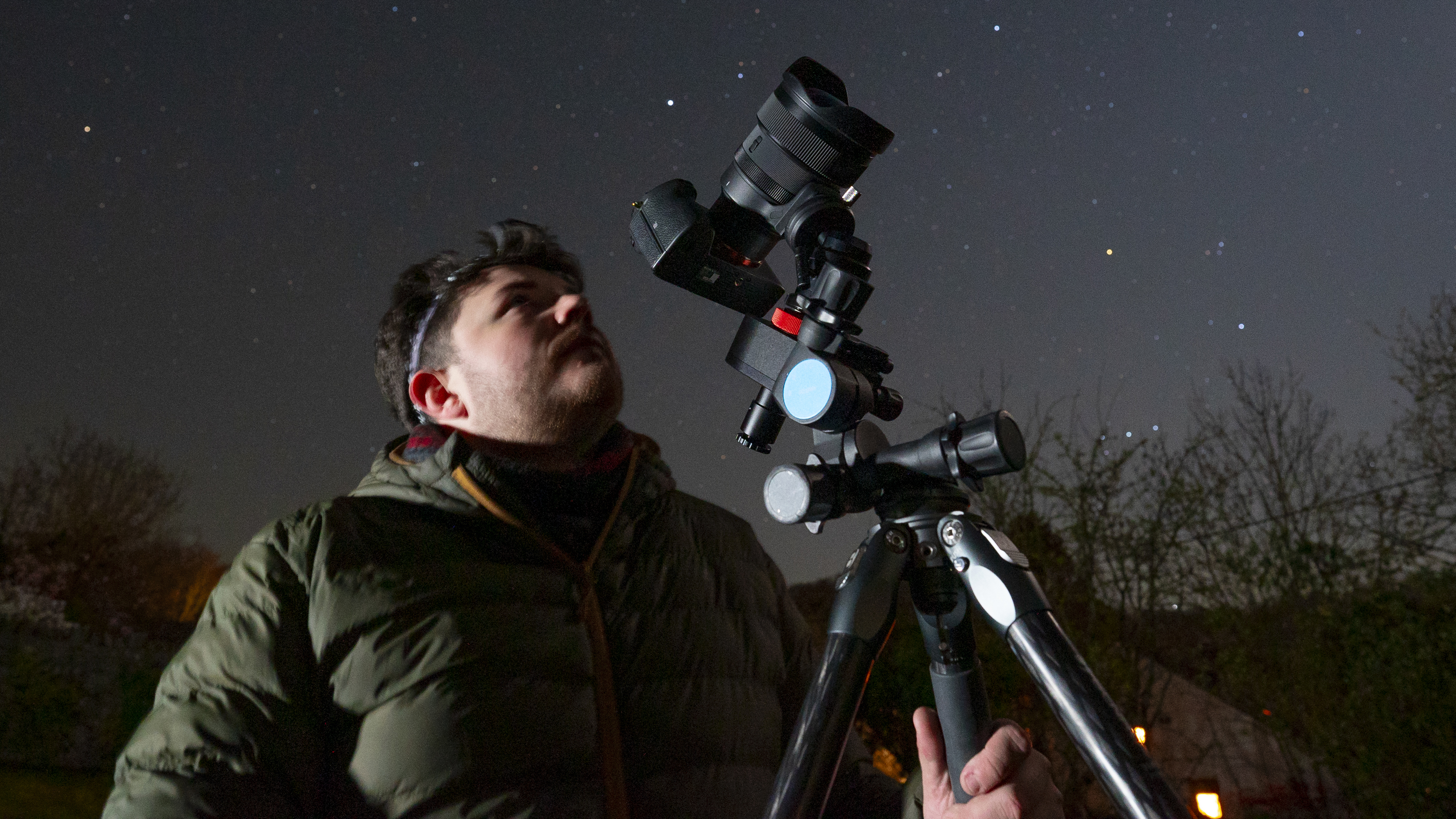
Astrophotographers attach their cameras to star‑tracking mounts to counteract Earth’s rotation. Because the planet turns, stars drift across the field of view; in exposures longer than roughly 30 seconds, they form noticeable trails. A tracker rotates the camera at the same rate as the sky, only in the opposite direction, so the stars stay fixed and sharp.
To achieve this, the tracker must be polar‑aligned. Its axis is aimed at the celestial pole: Polaris (the north celestial pole) for observers in the Northern Hemisphere, or a point near Octantis (the south celestial pole) for those in the Southern Hemisphere. Built‑in polar scopes or mobile‑app overlays help match the reticle to familiar constellations and asterisms.














