Get all your news in one place.
100's of premium titles.
One app.
Start reading
The Independent UK
The Independent UK
National
Binaj Gurubacharya

Mount Everest season opens despite a huge unstable ice block and high travel costs

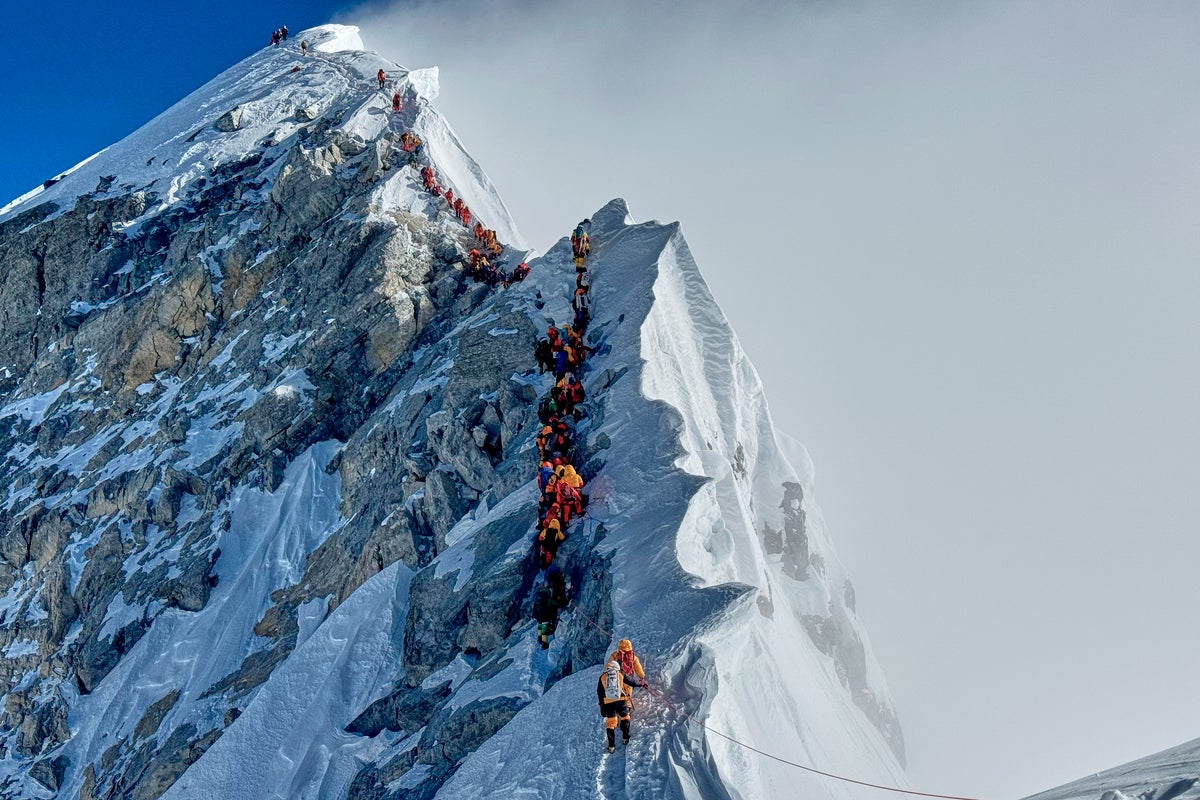
Mountaineers form a queue as they approach the summit of Mount Everest in Nepal, May 18, 2025. (AP Photo/Kunga Sherpa, File) - (Copyright 2025 The Associated Press. All rights reserved.)

Despite a perilous, unstable ice block hanging over a key trail on Mount Everest, and undeterred by high costs and increased permit fees, hundreds of climbers are pressing ahead with their ascent of the world's highest mountain.

Around 410 climbers and an equal number of Nepali guides are currently at base camp, preparing for their attempt on the nearly 8,850-metre (29,000-foot) peak this month, hoping to capitalise on a narrow window of favourable weather.
Climbers gathered last month at the 5,300-metre (17,340-foot) base camp, but a massive, unstable ice block, or serac, stalled progress for over two weeks. The "Icefall doctors" – elite guides from the Sagarmatha Pollution Control Committee (SPCC) who lay the annual route with ropes and ladders – usually finish by mid-April, but were delayed this year.

The Icefall route was only opened on 29 April, accompanied by a severe caution. The SPCC warned: "The serac has multiple cracks and may collapse at any time. SPCC strongly urges all expedition operators and climbers to exercise extreme caution."

Khumbu Icefall is visible between two peaks in the background at the Everest Base Camp in Nepal, April 25, 2025. (AP Photo/Pasang Rinzee Sherpa, File) (Copyright 2025 The Associated Press. All rights reserved.)

The serac was likely to remain, and the new trail dug by the the team passes below the serac.

The serac is part of the Khumbu Icefall, a constantly shifting glacier with deep crevasses and huge overhanging ice that can be as big as 10-story buildings. It's considered one of the most difficult and trickiest sections of the climb to the peak.

Climbers, their guides and expedition outfitters are both eager and cautious about the situation on the mountain.

Renowned mountain guide Lukas Furtenbach, who has 40 international climbers, 11 guides and 90 Sherpas on Mount Everest, said that he was worried.

“Anyone who says they’re not concerned is either inexperienced or not paying attention,” Furtenbach said from the base camp. “The serac is a real, objective hazard.”

He said that the the route was more complex and exposed than last year in one section.

“The Icefall is constantly changing, but right now it’s not just more broken — it’s also forced into a line that passes under unstable features,” he said.

This year, the team is reducing loads, minimizing exposure time, carefully timing movements through the Icefall, and relying on highly experienced Sherpa and guides for risk assessment.

A mountaineer takes part in a training session at Khumbu Icefall before beginning his ascent to the summit of Mount Everest in Nepal, April 27, 2025. (AP Photo/Pasang Rinzee Sherpa, File) (Copyright 2025 The Associated Press. All rights reserved.)

Other expedition operators are also cautioning their members about the risks and closely monitoring the situation.

“If you go in the morning, it might be safer because the ice is frozen, but in the afternoon it becomes dangerous as weather gets warmer, with the risk of ice melting and falling,” said Ang Tshering Sherpa of the Kathmandu-based Asian Trekking. “It is very necessary to be cautious this year.”

A falling serac triggered an avalanche over the Khumbu Icefall in 2014 that killed 16 Nepali guides and workers.

There have been rising concern over the fast melting of the glaciers because of global warming and climate change. U.N. Secretary-General António Guterres flew to a mountain in Nepal in 2023 and warned of the devastating level of melting glaciers in the Himalayan mountains.

According to Ang Tshering Sherpa, there are a good number of climbers on Mount Everest this season, despite the Iran war and increased travel costs. The number of climbers from Western countries like U.S. and Europe has decreased, but Asian climbers have increased.

Mount Everest, which straddles along the Nepal-China border, can be climbed from both sides. China, however, has closed its route this year, leaving all climbers to make their attempt from Nepal on the south side of the peak.

Thousands of people have climbed the peak since it was first scaled on May 29, 1953, by New Zealander Edmund Hillary and Sherpa guide Tenzing Norgay.

Sign up to read this article
Read news from 100's of titles, curated specifically for you.
Already a member? Sign in here
Related Stories
Top stories on inkl right now
One subscription that gives you access to news from hundreds of sites
Already a member? Sign in here
Our Picks
Fourteen days free
Download the app
One app. One membership.
100+ trusted global sources.