
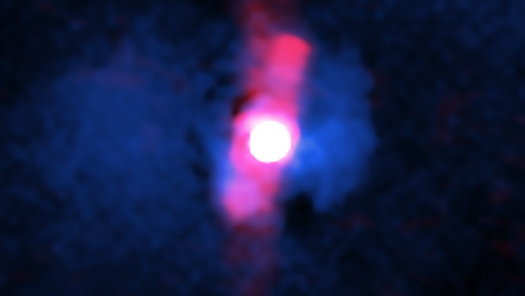
One of the closest quasars to our Milky Way galaxy is behaving in a surprisingly timid fashion when it comes to affecting its surroundings, new observations with the Chandra X-ray Observatory have shown.
A quasar is the bright central region of a galaxy that hosts a highly active supermassive black hole that is consuming large quantities of gas. This gas, while swirling around the black hole, forms an accretion disk that grows hot and luminous. At the same time, magnetic fields within the disk whip up some of that material, shooting it away in twin jets that race at almost the speed of light. The combination of the disk and the jets, when pointed at us, make quasars the brightest objects in the universe, shining especially brightly in X-rays. The particular quasar observed by Chandra, cataloged as H1821+643, is located in a galaxy 3.4 billion light years away.