
/A%20concept%20image%20of%20a%20flying%20car_%20Image%20by%20Phonlamai%20Photo%20via%20Shutterstock_.jpg)
Flying cars are quickly moving from science fiction to real life. That includes Joby Aviation (JOBY), which could fly to higher highs this year. For starters, it’s working with Uber (UBER) and expects to fly their first passengers later this year in Dubai. Secondly, Joby is also working with the Federal Aviation Administration (FAA), which will eventually lead to commercial service in the U.S.
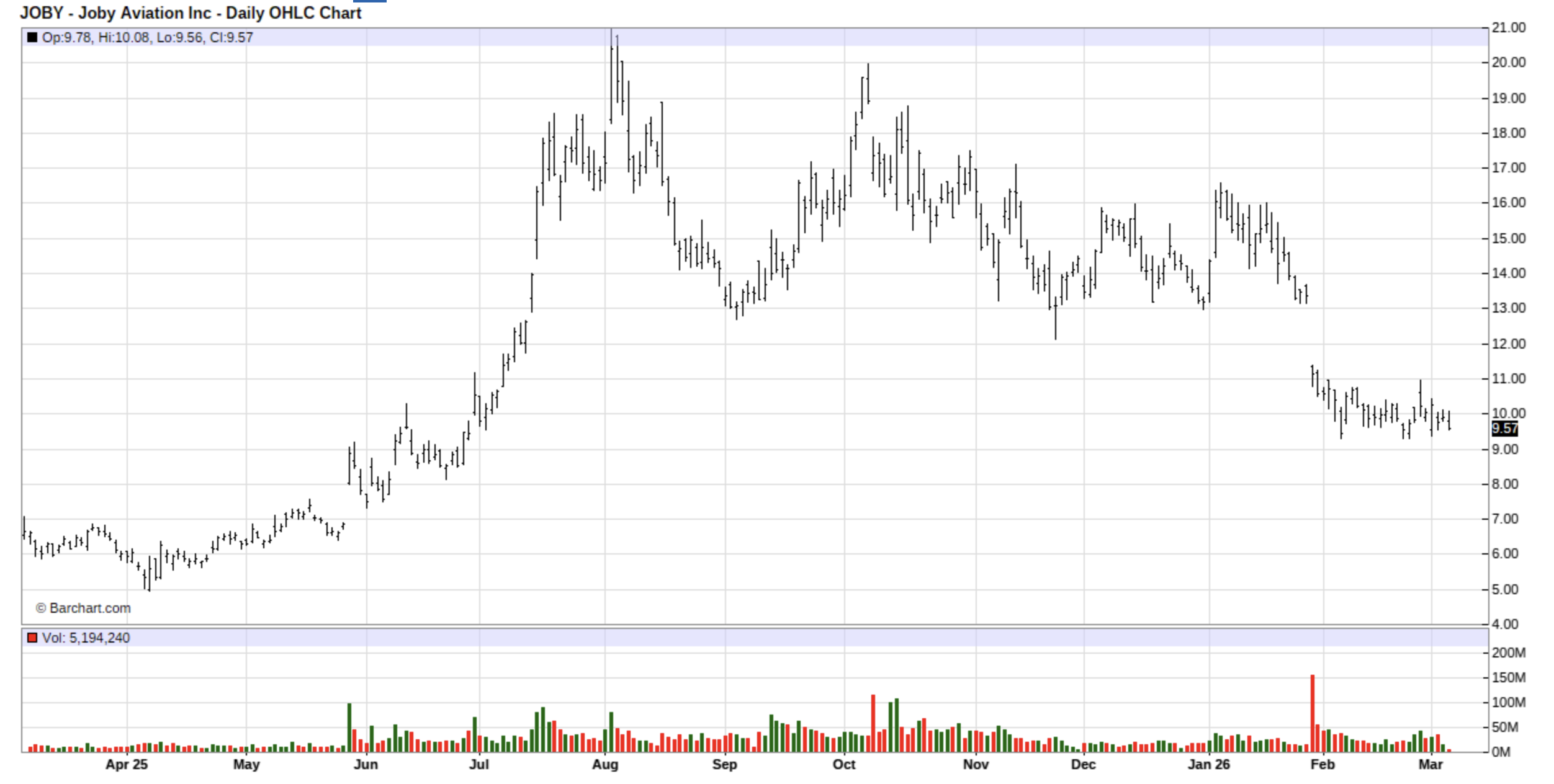
We should also mention that Joby’s $125 million acquisition of Blade Air Mobility’s passenger business will help speed up Joby’s path to commercialization. It also gives Joby valuable infrastructure, including landing terminals and operational expertise in major cities worldwide. Plus, it doesn’t hurt that the White House selected Joby Aviation for its eVTOL pilot program, which serves as major validation of the company’s position as a frontrunner in advanced air mobility.
Joby’s Uber Advantage
Morgan Stanley says risks around certification and adoption remain. But the firm believes Joby has a major edge thanks to its partnership with Uber. Once integrated, users will be able to book Joby flights directly through the Uber app. All of which would give the company instant access to a massive customer base. In addition, Joby’s $125 million acquisition of Blade Mobility’s passenger business accelerates commercialization with access to Blade’s 12+ terminals in key markets, such as New York, Los Angeles, and Europe. It also provides Joby with access to a large customer base. Meanwhile, Joby continues to make progress on certification with the U.S. FAA, which could fuel massive upside once it crosses this hurdle.
Morgan Stanley also says we could be looking at a potential $1.5 trillion flying car market opportunity here by 2040 and up to $9 trillion by 2050. Plus, according to McKinsey, “People are ready for flying taxis. Across geographies, more than 15 to 20 percent of survey respondents say they can definitely imagine switching from their current mode of mobility to a flying-taxi service in the future.” Granted, some analysts argue that JOBY is still in the early innings of growth, but sometimes it pays to get in on the ground floor.
Earnings Are Improving
With Pentagon contracts to develop hybrid-electric eVTOL aircraft for military logistics, corporate partnerships (Uber, for example), and its acquisition of Blade Air Mobility, the company posted better-than-expected earnings and boosted guidance.
In its most recent quarter, JOBY saw revenue of $30.8 million, up significantly from the $55,000 posted a year ago. That was also double what was expected. Also, while the company did see further losses to help support certification and expenses tied to the Blade acquisition, the company’s net loss did narrow to $121.5 million from $246 million year-over-year (YoY). With that, JOBY booked a 14-cent loss, which beat by seven cents and was narrower than the loss of 34 cents YoY. Better, its total cash and cash equivalents jumped 51% to $1.41 billion. As for guidance, JOBY expects to generate $105 million to $115 million in revenue, with Wall Street calling for $111.1 million.
What Are Analysts Saying About JOBY Stock?
Of the 11 analysts covering JOBY stock, one analyst rates the stock as a “Strong Buy,” one rates it as a “Moderate Buy,” six rate it as a “Hold,” and three rate it as a “Strong Sell.”
Presently, the mean target price among analysts is $11.94, which implies 25% potential upside. The high-end target of $18 implies an 88% potential upside from here. The flying car story is here. It’s no longer science fiction but real life. Of course, risks remain—particularly around regulatory approvals, certification timelines, and the pace of consumer adoption—but if JOBY continues executing on its roadmap and the industry develops, early investors could be looking at a massive, long-term opportunity.