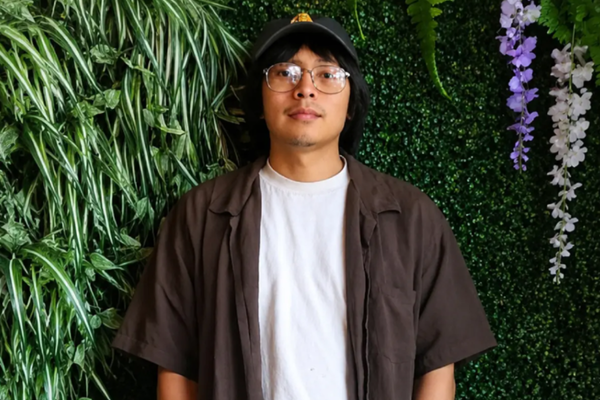
Most days, by the time the first order for Korean fried chicken goes in at Jangdokdae, Yoonhee Jang has already been working for hours.
She has rolled gimbap for Korean grocery stores, checked tubs of kimchi and laid out trays of vegetables for bibimbap and japchae - the unseen routine behind a food truck she and her partner Michael Oliver run outside the Australian Croatian Club.

"I supply kimchi and gimbap," she said. "Every morning I make gimbap ... they [the grocery stores] want more other dishes, but I can't because it is just myself."
The name Jangdokdae comes from a pot.
In Korea, jangdok are the big earthenware vessels that sit outside homes, slowly fermenting soy sauce, chilli paste and kimchi through the seasons.
For the couple, that image of patience and quiet labour has become the symbol of the food - and the life - they are building together.

Her introduction to professional cooking was in a traditional Korean restaurant in Sydney, where she quickly realised how demanding her own cuisine could be.
Nothing illustrated that better than japchae.
In most Korean households, japchae - slippery sweet potato noodles mixed with vegetables and sometimes meat - appears on the table for birthdays, holidays and special gatherings.
Each component is cooked separately; every julienned strand of vegetable is coated carefully in sesame oil and soy. It is not a dish designed for speed.
At Canberra's Old Bus Depot Markets, Ms Jang decided to sell japchae anyway. It was a quiet act of defiance against the idea that proper home-style food does not belong in a market.

"Korean people were very surprised: 'You make japchae at market?'" she said. "I'm thinking a lot, how make it simply, you know ... I'm studying a lot."
The challenge was to make it workable in a stall kitchen without losing the texture and flavour that Korean customers expected.
Her tteokbokki, chewy rice cakes, is made in a simple spicy-sweet sauce without the stew, fish cakes and eggs. It is another way she keeps the truck anchored in the kind of food she grew up with.
Inside Jangdokdae, the division of labour is clear. Mr Oliver stations himself at the fryer and Ms Jang runs almost everything else.

"She does all the fancy stuff, and I just handle the fryer," he said.
For Mr Oliver, the chicken is the easiest way to explain what they do. "The difference between the Korean fried chicken and like Kentucky Fried Chicken, it's a lot crispier," he said.
"It's not oily, and you have those selection of different flavoured toppings on them, which sets it apart."
The products might seem simple, but the routine behind them is not. Like the jangdok pots the truck is named after, the food depends on time and attention more than shortcuts.
During the interview, a regular customer walked up to the window to place yet another order.
She said she visited the food truck at least once a week because her daughter loved the food and would be very excited when she brought it home.
That kind of quiet loyalty matters as much as any online review to them.

Some customers drive from the northern suburbs, passing other Korean restaurants on the way.
"We get people come from all over Canberra for our chicken," Mr Oliver said. "It's nice that we have people come from the northern suburbs and they go past Gungahlin and Dickson and they come here, and there's like, you know, half a dozen Korean places in between."
Those regulars matter more than most people realise.
Big events and markets have become increasingly expensive, with rising base fees and, in some cases, a percentage of turnover on top.
The economics can feel fragile, but the people who return week after week give the couple room to breathe and to plan.
Mr Oliver and Ms Jang met more than a decade ago in Sydney, introduced by friends. Work brought them to Canberra, and eventually they decided to build something of their own.
The food truck, and the small grocery-supply sideline that has grown around it, is the size they can manage together: one fryer, one kitchen, two people and a name that points back to rows of clay pots in another country.
From that compact space, they send out far more than fried chicken and glistening noodles.
They offer a glimpse of the food Ms Jang once watched bubbling away in big restaurant kitchens and family homes, now scaled down to a truck and a fridge full of kimchi - held together, most days, by what really is just one person.