
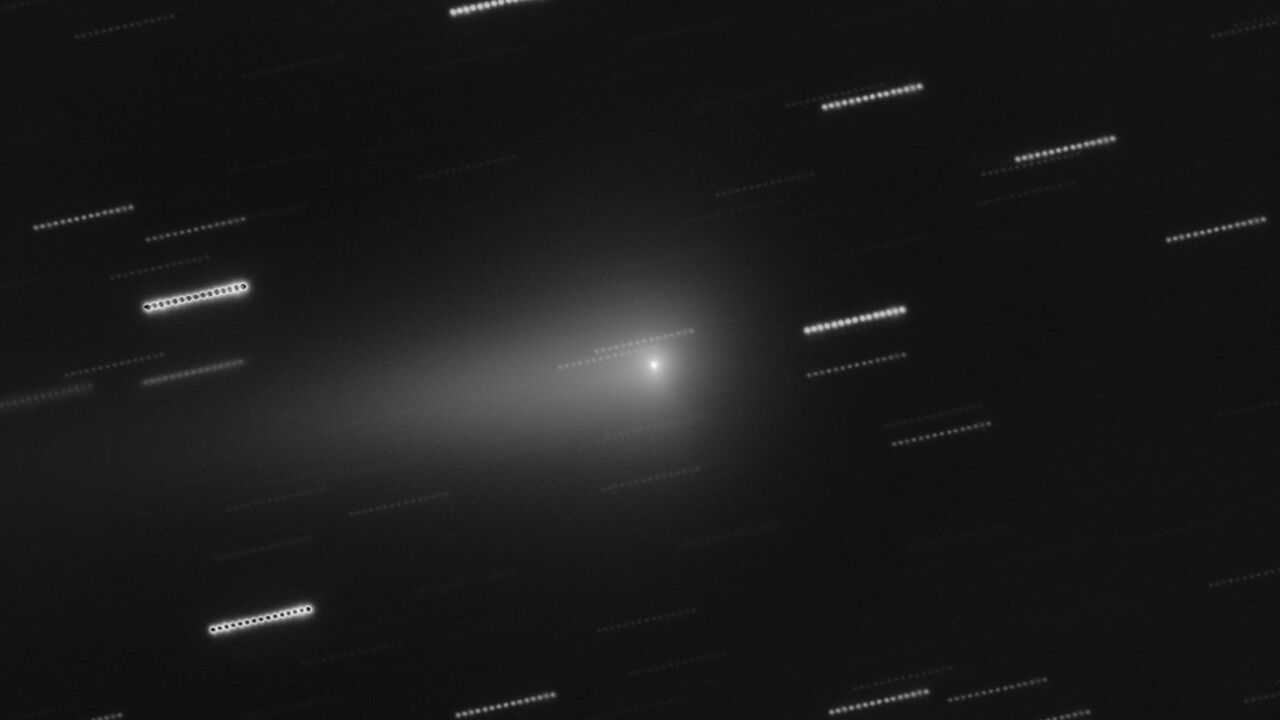
More evidence that the interstellar comet 3I/ATLAS is much older than our solar system has come to light, along with clues that it formed on the outskirts of the protoplanetary disk belonging to its parent star long ago.
Earlier this year, researchers led by Martin Cordiner of NASA's Goddard Space Flight Center revealed that data from the James Webb Space Telescope (JWST) suggested that 3I/ATLAS is between 10 and 12 billion years old, based on the ratios of its carbon and deuterium isotopes. This would make it more than twice the age of our 4.6-billion-year-old solar system. Now, new results from the Ultraviolet and Visual Echelle Spectrograph (UVES) on the European Southern Observatory's Very Large Telescope support the JWST observations of carbon isotopes, and also introduce measurements of nitrogen isotopes that arrive at very interesting conclusions.