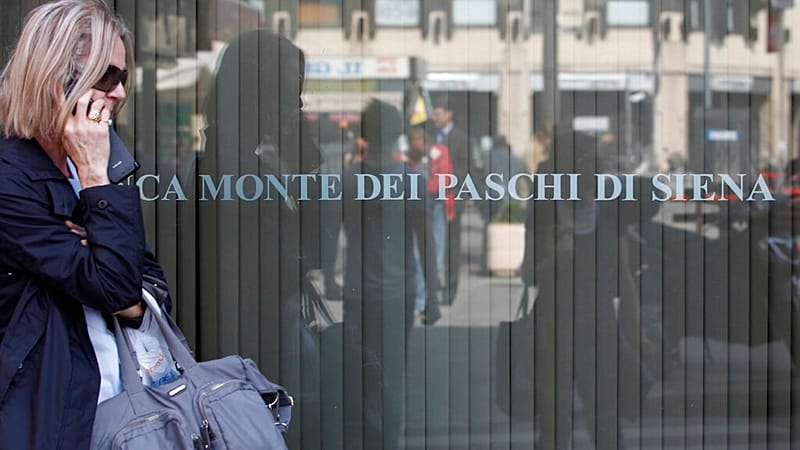
A board member of the Italian bank Monte dei Paschi di Siena (MPS) has resigned after he was placed under investigation on suspicion of insider trading.
Stefano Di Stefano resigned "with immediate effect, for personal reasons and in connection with the commencement of investigations concerning him", the bank said in a statement on Wednesday.
It thanked him “for the service rendered in his capacity as a member of the Board of Directors throughout these years”.
Di Stefano, also a senior official at Italy’s Ministry of Economy, allegedly bought about €100,000 worth of shares based on confidential information — Italian newswire Ansa reported earlier this week.
The case is part of the broader “banking reshuffle” that has dominated headlines for months, centred on MPS takeover of Mediobanca — two major players in Italy’s financial system.
Di Stefano allegedly bought shares in both of the lenders, guided by information obtained through his role on MPS’ board. The scandal broke after Di Stefano’s phone was seized in recent months by Milan prosecutors, according to media reports.
The acquisition of Mediobanca, aimed at creating a “third banking pillar” in Italy, was carried out in September with the blessing of Prime Minister Giorgia Meloni’s government. While Mediobanca expressed concerns about the effects of the takeover on its business model, scaling can allow banks to combine expertise and improve their global influence.
The takeover has placed several key figures under regulatory scrutiny. A separate probe centres around allegations that Monte Paschi CEO Luigi Lovaglio and top MPS investors secretly coordinated the merger without disclosing their movements to the market. All deny wrongdoing.
Role at the finance ministry
Di Stefano heads the finance ministry's directorate for “Corporate Shareholdings and Protection of Strategic Assets,” a department responsible for managing the state’s numerous corporate holdings. The directorate also oversees privatization and divestment processes and handles relations with EU institutions and international bodies.
Importantly, the department is also tasked with preparatory activities related to the government’s “golden power” veto. This legislation grants the government special powers over firms operating in sectors deemed strategically important to national security.
Through this framework, officials may gain access to sensitive information regarding companies subject to golden power scrutiny — including banking operations where the government can review, block, or impose conditions on transactions.
Role on the MPS board
Di Stefano has also served on MPS’ board of directors since April 2022, and related to that role, he is a member of the Risk and Sustainability Committee. The Italian Treasury still holds a 4.86% stake in MPS, following the bank’s state bailout.
Following news of the investigation, Senator Mario Turco of the Five Star Movement submitted a parliamentary question to Economy Minister Giancarlo Giorgetti. Turco is asking the government to clarify Di Stefano’s role in various stages of the sale of MPS share packages, including whether he had any dealings with Banca Akros, the institution appointed to manage the share sale process.
Questions have also been asked about whether Di Stefano played a role in choosing the accelerated placement procedure, thereby influencing the choice to sell shares quickly.
On top of this, Turco asked whether Di Stefano was involved in the government’s decision to apply golden power measures in the UniCredit–Banco BPM operation — an action that has prompted an infringement procedure by the European Union. In July, Italian bank UniCredit dropped its bid for Banco BPM after the government blocked the merger using its golden power veto.
Turco further inquired about internal safeguards to prevent conflicts of interest and whether it is appropriate for Di Stefano to remain in his position while under investigation.
When contacted by Euronews, the Ministry of Economy declined to comment, stating: “We have no observations or comments on the matter.”