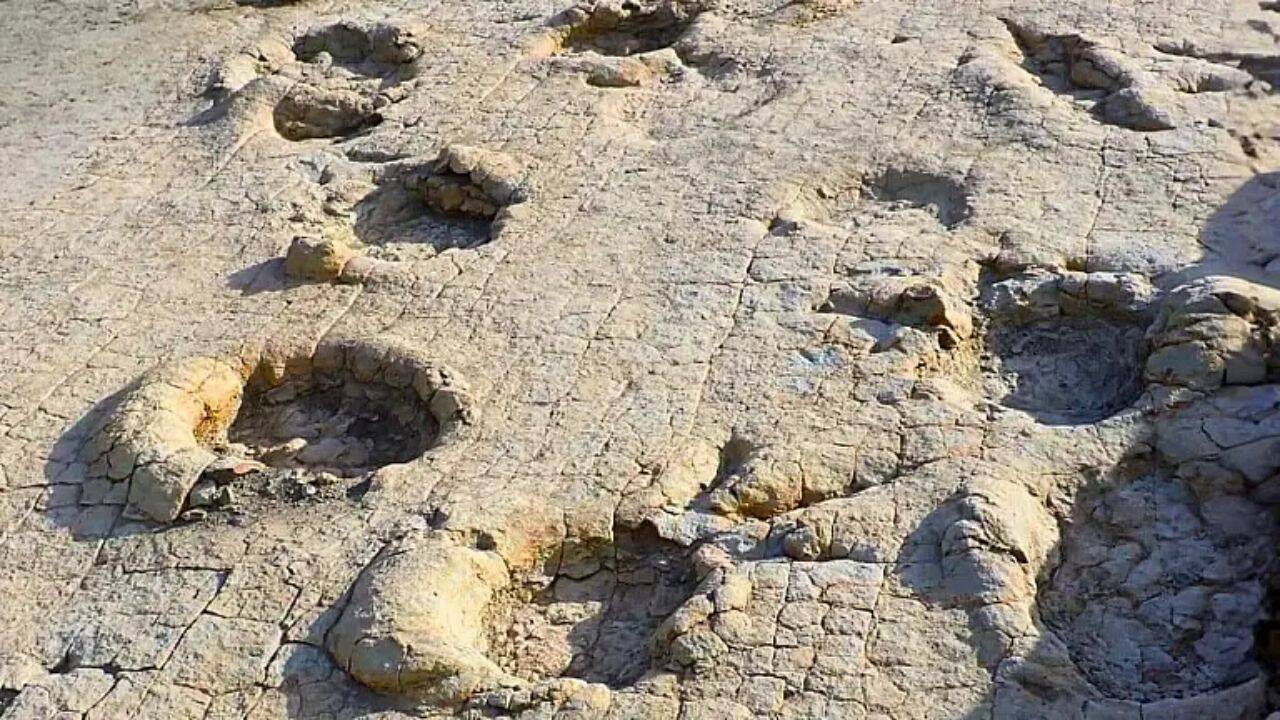
For decades, Mongolia's reputation in dinosaur research has rested largely on its spectacular Late Cretaceous fossils. Famous skeletons from the Gobi Desert have provided some of the most important discoveries in palaeontology, while older dinosaur ecosystems remained far less understood. That imbalance is beginning to change.
A tracksite from the Lower Cretaceous Shinekhudag Formation has opened a rare window into a landscape that existed roughly 120 million years ago. Instead of bones, the evidence comes in the form of footprints preserved in ancient sediments. These tracks capture moments of movement rather than death, offering a different kind of record. According to a study published in Ichnos, titled “ A dinosaur ichnofauna from the Lower Cretaceous Shinekhudag Formation, Mongolia ”, the site preserves multiple trackways left by giant sauropods and large predatory theropods, revealing a surprisingly busy dinosaur landscape in what is now central Mongolia.

Get breaking news anytime, anywhere. Download the TOI app now!
Historic Mongolia dinosaur tracksite reveals repeated use by ancient dinosaurs
The footprints come from the historic Saijrakh locality, a site that attracted attention many decades ago but remained poorly documented for years. Recent fieldwork allowed researchers to excavate and analyse the track-bearing surface in far greater detail.
The result is one of the most significant Lower Cretaceous dinosaur track assemblages yet described from Mongolia. The bedding plane contains numerous overlapping footprints and trackways, indicating that animals repeatedly crossed the same area over an extended period.
Rather than representing a single event, the surface appears to preserve a location that dinosaurs used again and again. Frequent overprinting between tracks suggests sustained activity, turning the site into a rare snapshot of movement patterns within an ancient ecosystem.
Ancient sauropod tracks reveal giant dinosaurs
Among the most striking discoveries are several trackways created by enormous long-necked sauropods. According to the study, the tracks display an unusual combination of features rarely seen together. The front foot impressions preserve a clear thumb, or pollex, mark associated with more primitive sauropod anatomy. At the same time, the footprints also show characteristics linked to more advanced forms, including evidence of specialised soft-tissue structures. The hind footprints are equally distinctive. Their toe impressions point straight forward, creating a footprint shape that differs from many previously known sauropod track types.
Because of this mixture of ancestral and more derived traits, the researchers suggest that the trackmakers were probably basal titanosauriforms. These were members of a major sauropod lineage that would later give rise to some of the largest land animals ever known. The tracks provide fresh information about how locomotion evolved within this group during the Early Cretaceous. Evidence of giant predators in northern Mongolia
Giant predator footprints found in Mongolia
According to the study, these footprints are broad and functionally three-toed, with unusually wide angles between the digits. Some are almost as wide as they are long, creating a footprint shape that differs from many classic theropod tracks.
Their size leaves little doubt that substantial predators inhabited the region. This is particularly important because evidence for giant carnivorous dinosaurs from Mongolia's Early Cretaceous record has remained limited compared with neighbouring parts of Asia.
The tracks show that large meat-eating dinosaurs were present within the Shinekhudag ecosystem, sharing the landscape with giant herbivorous sauropods and adding another layer to a fauna that is still only beginning to be understood.
Ancient footprints reveal dinosaur travel routes
Beyond identifying individual animals, the tracksite offers clues about dinosaur behaviour. As per the study, the concentration of footprints and repeated overlap between trackways indicate that the area functioned as a zone of regular transit. Rather than wandering randomly across the landscape, dinosaurs appear to have favoured particular routes.
Several of the sauropod trackways run in parallel, raising the possibility that these huge animals followed established pathways across the terrain. The researchers note that such behaviour may have helped reduce the energetic cost of movement, drawing comparisons with route-following patterns seen in modern elephants.
During the Early Cretaceous, the region contained lake systems and periodically exposed muddy surfaces that could preserve footprints when conditions were right. Those sediments eventually hardened into rock, preserving evidence of journeys that took place more than 100 million years ago.
The Shinekhudag tracks do not merely add new dinosaur species to a map. They reveal how large animals moved through their environment, how frequently they used certain areas, and how Mongolia's Early Cretaceous ecosystems may have been far richer than previously recognised.