Get all your news in one place.
100's of premium titles.
One app.
Start reading
Euronews
Euronews
Euronews Persian

Missing in action: What we know about Mojtaba Khamenei's condition

Iran's new Ayatollah Mojtaba Khamenei has not appeared publicly since his appointment by the Assembly of Experts, fuelling uncertainty about his health and whereabouts following the attack that killed his father.

Initial reports suggested Mojtaba Khamenei had been killed alongside his father Ayatollah Ali Khamenei in US-Israeli strikes on Tehran last Saturday.
However, it emerged that while his mother, father, wife and possibly other family members all died in the strike, he survived.

The Assembly of Experts then chose Mojtaba Khamenei as his father's successor in a process shrouded in secrecy, with no public details disclosed about deliberations and after further bombing destroyed the assembly's building in Qom, raising questions of whether all 88 members of the body were alive.

Days after his reported appointment, no video messages, written statements or recent photographs of him have been released. At his inauguration, a cardboard cutout with his image was presented instead.

This resulted in a series of speculations on Mojtaba Khamenei's current condition, with some raising the possibility he was severely injured or even incapacitated.

US Defence Secretary Pete Hegseth said Iran's new supreme leader is wounded and "likely disfigured," though he did not provide evidence or elaborate on the nature of the wounds.

On Thursday, Iranian state television broadcast what it described as Mojtaba Khamenei's first public message since assuming the leadership.

The statement, read by a television presenter rather than delivered by Khamenei himself, vowed to continue the war, promised more pain for Gulf states and threatened to open "other fronts" in a conflict that has already disrupted global energy markets, the world economy and international travel.

The fact that the message was delivered indirectly — with no video, audio or recent images of Khamenei — has further deepened speculation about his physical condition.

Reports of injury persist

Iranian opposition figure Mohsen Sazegara — a founding member of the Islamic Revolutionary Guard Corps who later became a prominent critic of the Islamic Republic — told Euronews sources inside Iran said Mojtaba Khamenei is alive but recovering from injuries.

"Some sources say his abdomen and leg required surgery, while others say he may also have sustained injuries to his face," Sazegara said.

He added that he had no independent confirmation of the exact nature of the wounds but that, based on what he had heard, the injuries did not appear to be life-threatening.

In the absence of official information, a range of other claims and rumours has circulated. Some reports have suggested Mojtaba Khamenei suffered injuries to his limbs and face during the strike.

Others have speculated that he may be severely incapacitated or even in a coma, although none of these claims have been confirmed. Iranian authorities have released almost no details about his medical condition or location, with comments from officials scarce.

Prior to the new ayatollah's first public statement, Alireza Salarian, Iran's ambassador to Cyprus, told The Guardian that Mojtaba Khamenei suffered injuries to his legs, arms and hands. "I've heard his legs and arms were injured," Salarian said in an interview at the Iranian embassy in Nicosia. "I think he's in the hospital because he was wounded."

However, Yousef Pezeshkian, son and adviser to President Masoud Pezeshkian, claimed on his Telegram channel that Mojtaba was "safe and in a secure location", according to informed sources.

International media outside of Iran reported Mojtaba suffered a fractured foot and minor facial injuries, including bruising around his left eye and superficial cuts, according to insiders familiar with his condition.

FILE: Policemen stand on top of their car with pictures of late Iranian Ayatollah Ali Khamenei and his son Ayatollah Mojtaba Khamenei, during a rally in Tehran, 9 March 2026 (FILE: Policemen stand on top of their car with pictures of late Iranian Ayatollah Ali Khamenei and his son Ayatollah Mojtaba Khamenei, during a rally in Tehran, 9 March 2026)

Israel's Channel 12 reported last week that Mojtaba Khamenei was injured but alive. Iran's state television briefly acknowledged his injuries after his appointment but provided no further details. However, Tehran-run state media referred to Mojtaba Khamenei as "janbaz" — a term used for Iran's disabled war veterans — further fuelling speculation on the severity of his injuries.

Since his appointment, Mojtaba Khamenei has remained absent from funerals of senior military commanders killed in the initial US-Israeli strikes, which Salarian explained by saying that the new ayatollah is not comfortable with public speaking.

"I don't think he would be comfortable giving speeches in any situation," he said. This is unusual in Iran, where the ayatollah traditionally guides the nation through public addresses.

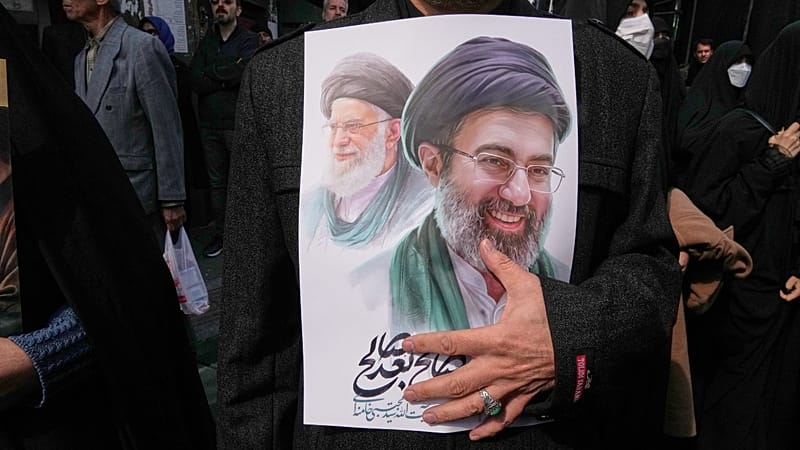
Despite his absence from public view, supporters of the government gathered in Tehran during Quds Day — the annual event held on the last Friday of Ramadan in solidarity with Palestinians — carrying some of the few available photographs of Mojtaba Khamenei.

Among many Iranians, particularly younger generations, his prolonged absence has become the subject of jokes and criticism on social media, with some interpreting it as a sign of fear or weakness.

Students protesting the policies of Ali Khamenei — referring to the fact that he had long avoided ordinary public life for security reasons — mockingly nicknamed him "Mous-Ali" (Rat Ali) and symbolically hung several toy rats from tree branches on campus.

Who is making decisions in Tehran?

Salarian claimed Ali Khamenei had opposed dynastic succession. "Senior clerics asked (Mojtaba Khamenei), but the late leader said no because he didn't want a dynastic system," he said. After the attack, clerics reportedly pressured Mojtaba to accept the role, arguing it was his duty.

This account contrasts with statements from Assembly of Experts members, who told state-affiliated media that Ali Khamenei left no specific instructions regarding his successor.

UK-based Amwaj Media reported the late leader's will set conditions for his successor, including prior experience in high-level governance and electoral legitimacy—criteria Mojtaba allegedly did not meet.

According to Amwaj, Mojtaba's appointment was pushed through by Hossein Taeb, former head of the IRGC' intelligence organisation and a close ally, with the Assembly of Experts reportedly influenced by Guards' pressure.

Opposition to his selection reportedly came from figures including the secretary of the Supreme National Security Council, Ali Larijani.

The uncertainty surrounding Mojtaba Khamenei's condition has raised questions about who is making decisions in Tehran.

According to reports, the growing role of the IRGC since the death of Ali Khamenei suggests the powerful military organisation may now be exercising greater influence over the country's political direction.

Furthermore, there is a belief that Larijani, Tehran's most influential powerbroker, is the "man behind the curtain" — someone who commands the loyalty of both a faction of the IRGC and a portion of the clerics in Qom.

Another rumour circulating among political insiders suggests that the apparent difficulty in maintaining regular communication with senior civilian and military officials, including the new ayatollah — and a perceived slowdown in decision-making — may have prompted discussions within parts of the political establishment and some clerics in Qom about temporarily restoring a collective leadership structure until Mojtaba Khamenei is able to fully assume his duties.

However, such a move would likely face strong resistance from the IRGC.

For now, crucial questions remain unanswered: where Iran's new supreme leader is located, how serious his injuries may be, and whether he is currently able to exercise full authority.

Sign up to read this article
Read news from 100's of titles, curated specifically for you.
Already a member? Sign in here
Related Stories
Top stories on inkl right now
One subscription that gives you access to news from hundreds of sites
Already a member? Sign in here
Our Picks
Fourteen days free
Download the app
One app. One membership.
100+ trusted global sources.