She Was Already Married Before She Met Her Husband
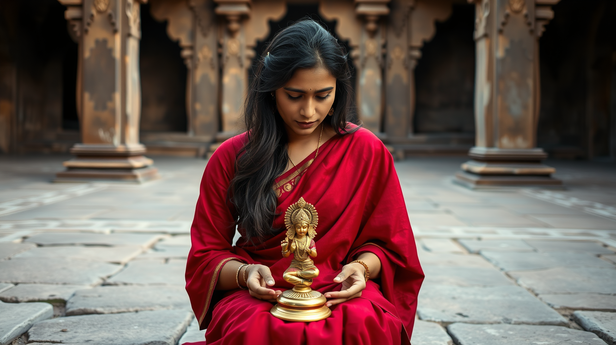
Mirabai was four years old, by most accounts, when a wandering sadhu passed through her family's haveli in Merta, Rajasthan, carrying a small idol of Krishna. She asked her mother who the beautiful figure was. Her mother, half-joking, said: that is your husband. Mirabai took it literally. She spent the rest of her life proving she meant it.

This is not a metaphor. This is the biographical record as her padas, her devotional songs, preserve it, and as the oral tradition of Mewar has carried it for five centuries. By the time she was formally married to Bhoj Raj, the crown prince of Mewar and son of Rana Sanga, she had already organised her inner life around a prior claim. She brought the Krishna idol into her marital home. She refused to worship Rana Sanga's family deity, Durga. She spent her nights in the temple she had built within the palace. The Rajput court of Mewar did not know what to do with a princess who had decided that surrender to the divine was not a private hobby but the central fact of her existence.
What the Court Actually Saw
From inside the Mewar court, Mirabai's behaviour read as a series of escalating insults. She sang and danced in public, which a woman of her rank did not do. She sat with sadhus and low-caste devotees in the temple courtyard, which a Rajput queen absolutely did not do. She refused to veil herself before male relatives. She refused conjugal life with her husband. When Bhoj Raj died in battle, she refused to commit sati.
Each refusal was not a protest. She was not making a political argument. She simply could not locate, inside herself, the part that was supposed to comply. Her padas from this period are not angry. They are almost bewildered, written by someone who genuinely cannot understand why the world keeps asking her to want something she does not want. One of the most repeated lines across her compositions translates roughly as: I have already given myself away. There is nothing left here for you to claim.
Rana Vikramjit, who became king after Rana Sanga, sent her poison in a cup, framing it as prasad. She drank it, singing. The tradition says it did not kill her. Whether you read that as miracle or metaphor, the psychological truth it encodes is real: she had already moved past the place where physical threat could reach her. The cup was a test of whether she could be frightened back into compliance. She could not.
The Theology She Was Living Inside
The Bhakti movement, which was reshaping the religious life of northern and western India from roughly the 12th century onward, held that direct personal devotion to a deity, unmediated by ritual, caste, or priestly hierarchy, was the highest form of spiritual life. Mirabai was its most extreme practitioner, and the one who paid the highest social price for it.
Her devotion was not the soft, decorative kind. It was what the Bhagavata Purana describes as para bhakti: a love so complete it dissolves the boundary between the devotee and the beloved. The Bhagavad Gita, in Chapter 18, verse 66, gives the instruction she seems to have read as a literal directive: abandon all other dharmas and come to me alone. Most people read that verse as spiritual counsel. Mirabai read it as a practical plan and executed it, at the cost of every social structure her life had been built on.
The cost was not abstract. She lost her home. She lost her status. She lost the protection of the Rajput clan system, which in 16th-century Rajasthan was the difference between safety and destitution. She walked out of Mewar and spent years as a wandering bhakta, eventually settling in Dwarka and then Vrindavan, the sacred geography of Krishna's life, where she spent her final years singing.
What Devotion at This Scale Actually Demands
You read Mirabai's story and you feel the pull of it. The freedom she found on the other side of losing everything. But the story only works if you hold the loss clearly, without softening it.
She was not a woman who found a spiritually acceptable way to escape a bad marriage. That reading domesticates her. Bhoj Raj was not, by historical account, cruel. The Mewar court was not uniquely oppressive by the standards of its time. What Mirabai walked away from was not a specific wrong but an entire structure of belonging, the thing that tells you who you are by telling you where you stand in relation to everyone else. Caste. Clan. Wifehood. Queenship. She let all of it go, and she did it not because she was brave but because she had found something that made those categories feel, to her, like a language she no longer spoke.
That is what devotion at this scale looks like. It is not peaceful. It is not graceful. It costs you the people who loved you in the ordinary way, and it costs you their understanding, which is sometimes harder to lose than the people themselves. Her mother-in-law called her a whore. Her brother-in-law tried to have her killed. The women of the zenana, who might have been her allies, kept their distance because proximity to her was dangerous.
She sang anyway. Not because she was indifferent to the loss, but because the alternative, the life she would have had to live to avoid it, was, to her, the real deprivation.
Mirabai's padas are still sung at dawn in temples from Rajasthan to Gujarat. They have survived five centuries not because they offer comfort, but because they name, with devastating accuracy, what it feels like to be so completely claimed by something that the rest of your life rearranges itself around that fact, whether you planned it to or not.