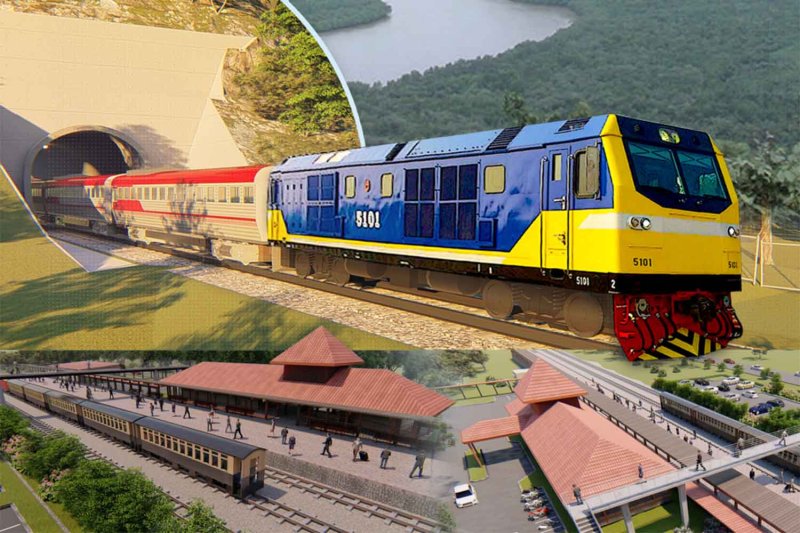
The Transport Ministry has pushed for the Chumphon-Ranong double-track railway project, describing the 110-kilometre route as a missing link needed to connect Thailand's rail network with an Andaman Sea port.
Deputy Transport Minister Sanphet Bunyamanee said the project forms part of the government's plan to develop an integrated transport system under the policies of Prime Minister Anutin Charnvirakul and Transport Minister Phiphat Ratchakitprakarn.

He said Thailand's infrastructure development is entering a new phase, shifting from individual projects towards a connected network in which roads, railways, ports, airports and border checkpoints operate together to strengthen the country's long-term competitiveness.
"The Chumphon-Ranong railway, with a distance of about 110 kilometres and an estimated investment of more than 27 billion baht, is considered a critical missing link because it will allow Thailand's main railway network to connect with a deep-sea port on the Andaman coast for the first time," he said.
Mr Sanphet said the route's strategic importance lies in maximising infrastructure investments made in the rail system over many years by linking separate projects into a single network.
"Once completed, the railway will allow goods from the North, Northeast, Central and South to be transported directly by rail to Ranong Port without having to switch to trucks for the final stage of delivery. This will reduce logistics costs, shorten transport times and improve the competitiveness of Thai exports," he said.
The connection would also provide Thailand with a new trade route linking the Gulf of Thailand and the Andaman Sea. Existing ports, including Laem Chabang, Bangkok and Map Ta Phut, would continue serving the eastern and central regions, while Ranong Port would become a gateway to the Indian Ocean and markets in BIMSTEC countries, the Middle East and Africa, he said.
Government spokeswoman Rachada Dhnadirek said the Missing Link approach would not reduce economic opportunities in the South after opposition parties questioned the government's decision to shift focus away from the Land Bridge megaproject.
She said the railway would strengthen Thailand's logistics capacity and support the country's goal of becoming a regional economic hub. The project would also support the development of Ranong Gateway by linking the port with Thailand's main railway network and routes connecting to Laos, China, Malaysia and Singapore.
Ms Rachada said the project's detailed design has been completed, with an environmental impact assessment required before it can be submitted to the cabinet for consideration. If approved, construction would take about three years.
Meanwhile, Southern Economic Corridor (SEC) Watch has opposed the government's plan to revive the Land Bridge project, saying it will stage a protest against the project on Aug 4 in front of Government House.
The group said Mr Anutin's recent remarks that the Land Bridge project could return in the future showed a previous agreement between SEC Watch and Mr Phiphat had not been honoured.
SEC Watch said the agreement included cancelling the Land Bridge project and establishing a committee to prepare a master plan for southern economic development. The group argued transport development in the South should follow a broader strategy based on economic and environmental considerations rather than political decisions.