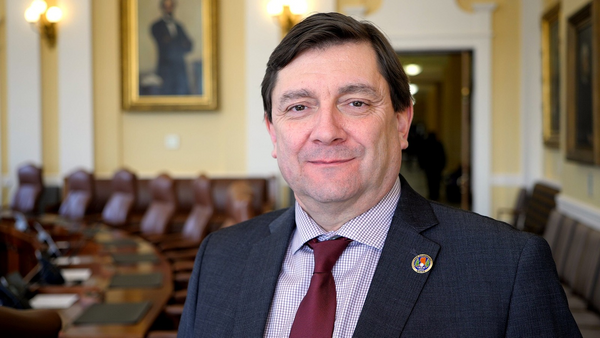
A SCOTTISH Government minister has seemingly signalled the end of an almost two-decade-long ban on compulsory redundancies in the public sector.
Ivan McKee, the Cabinet Secretary for Public Sector Reform, told a Holyrood committee that the measure could be used as a last resort for workers who cannot be redeployed and when “every other avenue has been exhausted”.

A no-compulsory-redundancy policy was introduced by the SNP in 2007, but the Scottish Government is trying to shrink the overall size of the public sector workforce in a bid to tackle a £4.7 billion black hole in the budget.
McKee’s comments come after he was quizzed over a Sunday Times article from last month which reported that 32 civil servants whose roles are no longer needed are still on the government's books, with their wage bills costing at least £2m and could be as high as £2.4m.
Due to the no-compulsory-redundancy policy, the 32 civil servants are left waiting on a “priority movers list” until a suitable vacancy becomes available.
The Sunday Times reported that of the 32 staff on the list, 29 are paid salaries of at least £49,401 per year; meanwhile, 21 are paid between £62,111 and £77,439 and 11 staff earn between £80,172 and £92,533 per year.
The Scottish Government has said that staff on the list always remain at work and that they are not paid to do nothing.
However, Tory MSP Murdo Fraser raised the report at the committee, where he said the no compulsory redundancies policy “comes at a cost” due to people “not performing roles that are necessarily required but still have to be paid,” as first reported by The Herald.
He added: “If you maintain a policy of no compulsory redundancies, which of course is what you're doing, that's going to be multiplied many times as well right across the public sector.”
McKee replied: “I have a couple of things I would say on that. First of all, that 32 number, I've seen it reported, the Permanent Secretary manages that on a day-to-day basis and he's aware of that.
“Then, if you look at that side of that headcount of 19 and a half thousand, he's managing that situation.
“If you look across the wider public sector, there are public bodies that have driven headcount reductions and have worked through the no compulsory redundancy policy to its conclusion. VisitScotland is an example of that.
“So we end up in a situation where there clearly is no role for someone for reasons, and every other avenue has been exhausted, then there's a process in place for that.”
Fraser then asked: “When you say there's a process in place, what are you talking about? You're talking about compulsory redundancy as an endpoint?”
To which McKee replied: “Yes, okay, but there's a very, very extensive process.”
When quizzed again on whether there is a compulsory redundancy in certain circumstances policy, McKee replied: “[The policy] works through all the viable options extensively to prevent that happening as best as can be.”
To which Fraser said he was interested in the extent to which the “issue of having people on a redeployment list will be reflected right across the public sector”.
The Tory MSP added: “Given this committee's interest, particularly right now, in budget, have you got any sense of what the cost is going to be right across the public sector of maintaining people in positions that effectively have become redundant while they're waiting to be redeployed?”
McKee replied: “Well, waiting to be redeployed, people can find redeployment. We've talked about opportunities for people to be able to move between roles.
“That is, it's something that we would, as part of that process we've outlined, we'd seek to work through.
“Clearly I'm not in a position to be able to say what those numbers would be at any point in time at the moment, because we need to work through the detail and it's very much dependent on individual circumstances, never mind just individual organisational approaches to this.”
McKee continued: “But there are, as I say, there are mechanisms that the Scottish Government hasn't, up to now, either a voluntary scheme, for example, so there are mechanisms that can be deployed that help enable people to be able to move from roles, and there's a whole suite of measures that can be deployed in that regard.”
McKee went on to argue that headcount reductions do not need to carry big upfront costs.
He explained that core Scottish Government civil service has cut personnel by 11.5%, or more than 1000 posts, over the last four years through either natural attrition or the ending of contractor arrangements.
Last month, it was revealed by The Herald that Scottish ministers aim to reduce the number of core civil servants by 20% by 2030, meaning almost 1500 jobs would need to be cut to reach the target.
According to the latest official figures published in August, there were 9015 civil servants working in core directorates – a 3% fall from the previous year.
The Scottish Government has recently floated the prospect of offering a voluntary exit scheme to staff.
McKee explained that voluntary severance schemes can also be paid for within a single year's budget, if they are timed at the start of the year and payouts do not exceed a full year's salary.
He went on to tell the committee that plans to cut 14 health boards to two, most NHS staff would see little change.
“If you're working on a ward or working in whatever it is in the health service, then the fact that the management structure has changed isn't going to change the job that you're doing on an ongoing basis,” he said.
However, he added there would be less need for director-level roles, and savings would come over time through merged back-office functions and posts left unfilled as people retire.