Get all your news in one place.
100’s of premium titles.
One app.
Start reading
Tom’s Hardware
Tom’s Hardware
Technology
Luke James

Microsoft expects to commercialize MicroLED datacenter cables by late 2027 — expands Hollow Core Fiber deployment, promising 47% faster data transmission and approximately 33% lower latency

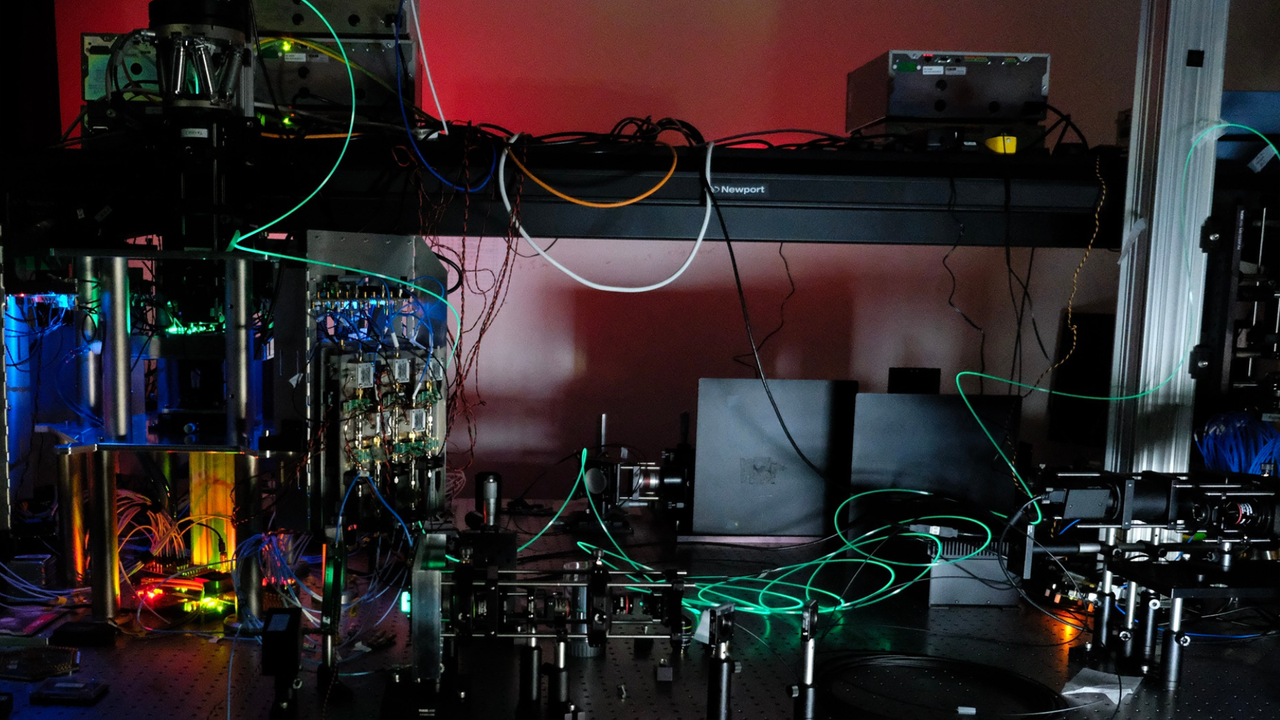
Microsoft MicroLED.

Microsoft announced today that its MicroLED-based optical cable system, developed at Microsoft Research in Cambridge, U.K., is expected to be commercialized with industry partners by late 2027 after the research team completed a proof of concept with MediaTek and other suppliers.

The technology, called MOSAIC, replaces lasers with inexpensive MicroLEDs and uses a fundamentally different architecture to transmit data inside datacenters, cutting energy consumption by roughly 50% compared to mainstream laser-based optical cables, according to the project's lead researcher, Paolo Costa, a Microsoft partner research manager.

Conventional datacenter optical cables use lasers to fire data through a small number of high-speed channels. MOSAIC inverts that by sending data across hundreds of parallel low-speed channels using directly modulated MicroLEDs. Costa compared the data patterns to QR codes, describing the method as "wide and slow" versus the traditional "narrow and fast" model. Both carry the same volume of data.

The cables use commercially available imaging fiber, which contains thousands of individual cores within a single strand. Costa said the fiber was originally developed for medical endoscopy. "That was the missing piece," he said. "We finally had a way to carry thousands of parallel channels in one cable."

MicroLEDs are smaller, cheaper, and more temperature-stable than lasers, which are vulnerable to heat fluctuations and dust. The MOSAIC paper, which won Best Paper at ACM SIGCOMM 2025, reported up to 68% power savings and failure rates up to 100 times lower than conventional optical links. The system can reach up to 50 meters, well beyond the roughly 2-meter limit of copper cabling used for high-bandwidth GPU connections within a single rack.

The proof of concept miniaturized the lab prototype into a standard transceiver form factor compatible with existing datacenter equipment, requiring no changes to servers or switches.

Microsoft is also expanding deployment of Hollow Core Fiber (HCF), which carries light through an air-filled core instead of solid glass. HCF delivers up to 47% faster data transmission and approximately 33% lower latency than conventional single-mode fiber, according to Microsoft's published research. The technology is already live in some Azure regions.

Microsoft acquired HCF developer Lumenisity, a University of Southampton spinout, in 2022 and has since signed manufacturing partnerships with Corning and Heraeus to scale production. Frank Rey, Microsoft's general manager of Azure Hyperscale Networking, said the two technologies are complementary: MOSAIC serves connections inside datacenters, while HCF covers longer distances between datacenters and Azure regions.

Sign up to read this article
Read news from 100’s of titles, curated specifically for you.
Already a member? Sign in here
Related Stories
Top stories on inkl right now
One subscription that gives you access to news from hundreds of sites
Already a member? Sign in here
Our Picks
Fourteen days free
Download the app
One app. One membership.
100+ trusted global sources.