Get all your news in one place.
100's of premium titles.
One app.
Start reading
The Times of India
The Times of India
World
TOI World Desk

Meteorite Crash Through Roof: family turns space rock into museum star; scientists probe its secrets

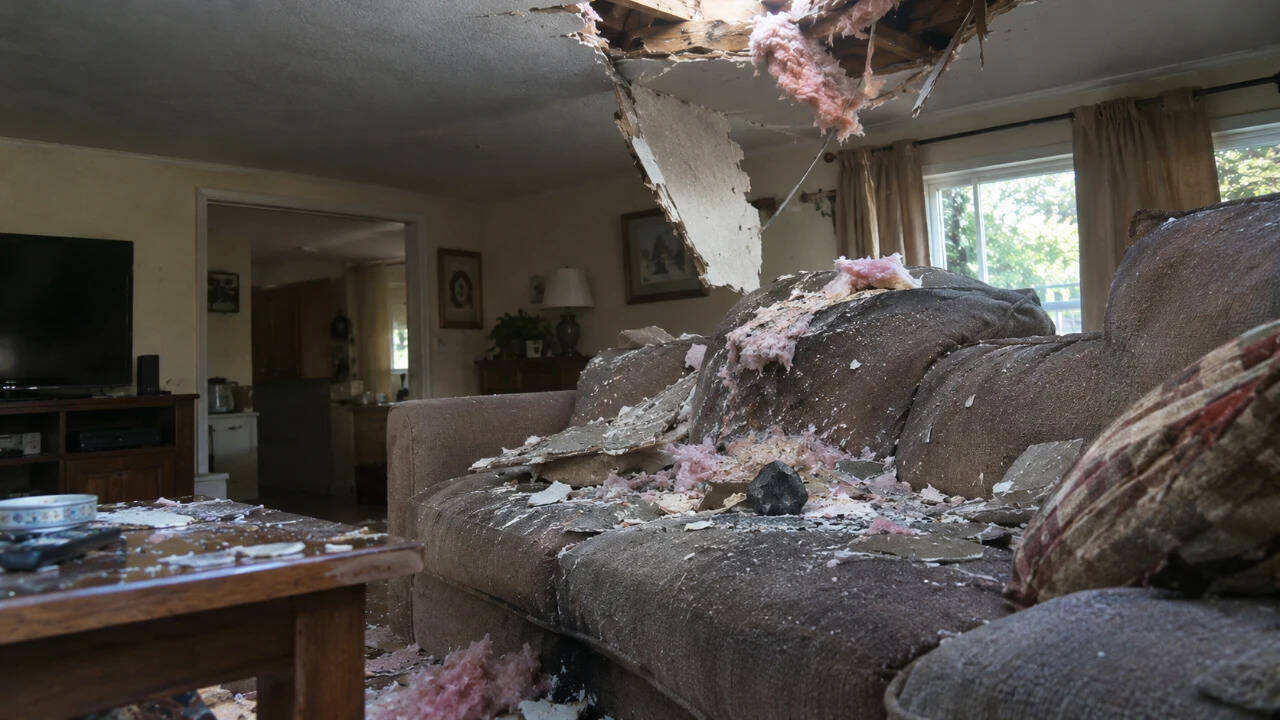
A quiet Saturday morning in Auckland took an extraordinary turn in June 2004 when a piece of rock from space punched through the roof of a suburban home. The meteorite struck the living room of Brenda and Phil Archer's house in Ellerslie, bounced off a leather sofa and hit the ceiling before coming to rest on the floor. Nobody was injured, but the impact left a hole in the roof and a family suddenly in possession of one of New Zealand's rarest natural objects. According to the New Zealand Herald, the Archers received a NZ$50,000 offer for the meteorite but chose not to sell it to an overseas buyer, preferring to keep the rock in New Zealand. The meteorite was eventually acquired by Auckland Museum for NZ$40,000.

Get breaking news anytime, anywhere. Download the TOI app now!

The morning a rock came through the roof

The meteorite fell around 9.30 am on 12 June 2004. At that time, Brenda Archer was inside the house when she witnessed an enormous explosion. The room was full of dust, and they did not know what to do in the moment. According to the Meteoritical Bulletin , the recovered stone had a mass of about 1.3 kilograms and was officially recorded as the Auckland meteorite. It was classified in the database as an L5 ordinary chondrite and became the ninth meteorite recovered in New Zealand. The official record also identified the Archer family home in Ellerslie as its fall location and recorded the time as 9.30 am.

The circumstances of the fall made the specimen unique, as meteorites did not often make it to Earth, and an even rarer occurrence was that of recovering the meteorite immediately upon hitting the ground. This meteorite did not fall into an empty field where it would be found only years later by chance; it declared itself with a crash through a family's roof.

From living-room wreckage to scientific specimen

The stone was initially described in news reports as roughly grapefruit-sized and around four billion years old. Scientists at the University of Auckland examined it soon after the fall, confirming that it was extraterrestrial material. Its value was not simply because it had come from space, but because the circumstances of its arrival provided a well-documented example of a meteorite fall.

More detailed scientific work came much later. Research published in Meteoritics & Planetary Science examined fragments supplied by Auckland Museum and used mineral chemistry, electron microscopy and oxygen-isotope measurements to investigate the stone's history. The researchers classified it as an L5 ordinary chondrite that had experienced severe shock metamorphism, while also finding that its fusion crust had been chemically altered as the meteorite passed through Earth's atmosphere. This research provided more details about the state in which the meteorite arrived in Auckland. The inside of the rock was well preserved, while the outside had been heated and melted as it entered Earth's atmosphere. Researchers found that oxygen from the atmosphere was incorporated into the fusion crust.

The offer the family refused

The scientific identification quickly turned the meteorite into a collector's item. Offers arrived from overseas, including one reported offer of NZ$50,000. The Archers rejected it. They said they wanted the meteorite to remain in New Zealand and to be displayed publicly rather than disappear into a private collection. That decision eventually led to the Auckland War Memorial Museum acquiring the stone for NZ$40,000. The museum displayed it from July 2004, and the meteorite was subsequently included in exhibitions elsewhere in New Zealand.

The Auckland meteorite, apart from its scientific significance, is known today due to the unique manner in which it was discovered. New Zealand had documented only a few meteorites before this fall, which was unusual because it landed on an inhabited house. The meteorite created an unusual collision between everyday life and astronomy. One moment the Archers were having a normal Saturday at home; the next, a rock from an ancient asteroid had crashed through their roof and onto their couch. The damaged house was repaired. The sofa was replaced. But the 1.3-kilogram stone was rare: a piece of the Solar System with a documented path from space to suburban Auckland. The end result was its placement in a museum, making sure that the spectacular event was part of the country’s scientific legacy.

Sign up to read this article
Read news from 100's of titles, curated specifically for you.
Already a member? Sign in here
Related Stories
Top stories on inkl right now
One subscription that gives you access to news from hundreds of sites
Already a member? Sign in here
Our Picks
Fourteen days free
Download the app
One app. One membership.
100+ trusted global sources.