Get all your news in one place.
100's of premium titles.
One app.
Start reading
The Conversation
The Conversation
Stavroula Alina Kampouri, Assistant Professor of Chemical and Biomolecular Engineering and Chemistry, Rice University

Metal-organic frameworks: Nobel-winning tiny ‘sponge crystals’ with an astonishing amount of inner space

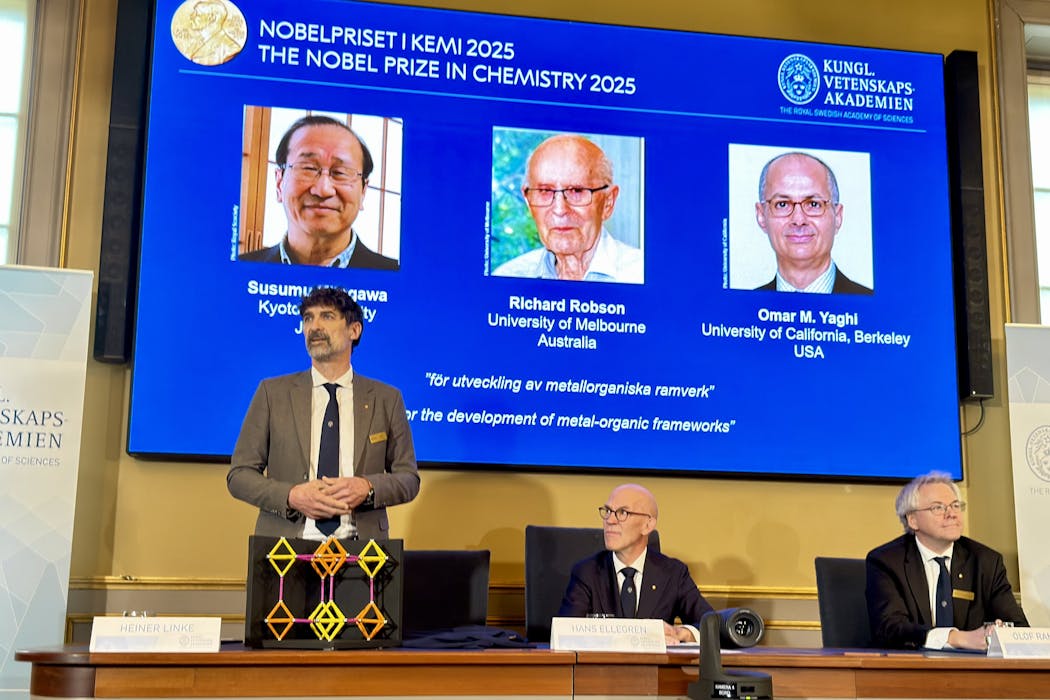
Three chemists will share the Nobel Prize for their work on metal-organic frameworks. Jonathan Nackstrand/AFP via Getty Images

The 2025 Nobel Prize in chemistry was awarded to Richard Robson, Susumu Kitagawa and Omar Yaghi on Oct. 8, 2025, for the development of metal-organic frameworks, or MOFs, which are tunable crystal structures with extremely high porosity. These are a class of materials that have truly changed the way scientists design and think about matter, inspiring progress in various applications.

I’m a MOF scientist and for many of us in the field, this recognition feels both historic and deeply personal. MOFs are not just elegant crystals you’d admire under a microscope; they’re an entire universe of structures, each like a miniature city of tunnels and rooms waiting to be filled. They’ve been my scientific home since I first stepped into research, and they still feel a little bit like magic to me.

Sign up to read this article
Read news from 100's of titles, curated specifically for you.
Already a member? Sign in here
Related Stories
Top stories on inkl right now
One subscription that gives you access to news from hundreds of sites
Already a member? Sign in here
Our Picks
Fourteen days free
Download the app
One app. One membership.
100+ trusted global sources.