Get all your news in one place.
100’s of premium titles.
One app.
Start reading
TechRadar
TechRadar
Eric Hal Schwartz

Meta buying social network for AI bots Moltbook should worry anyone who still hopes social media is for people

Moltbook.

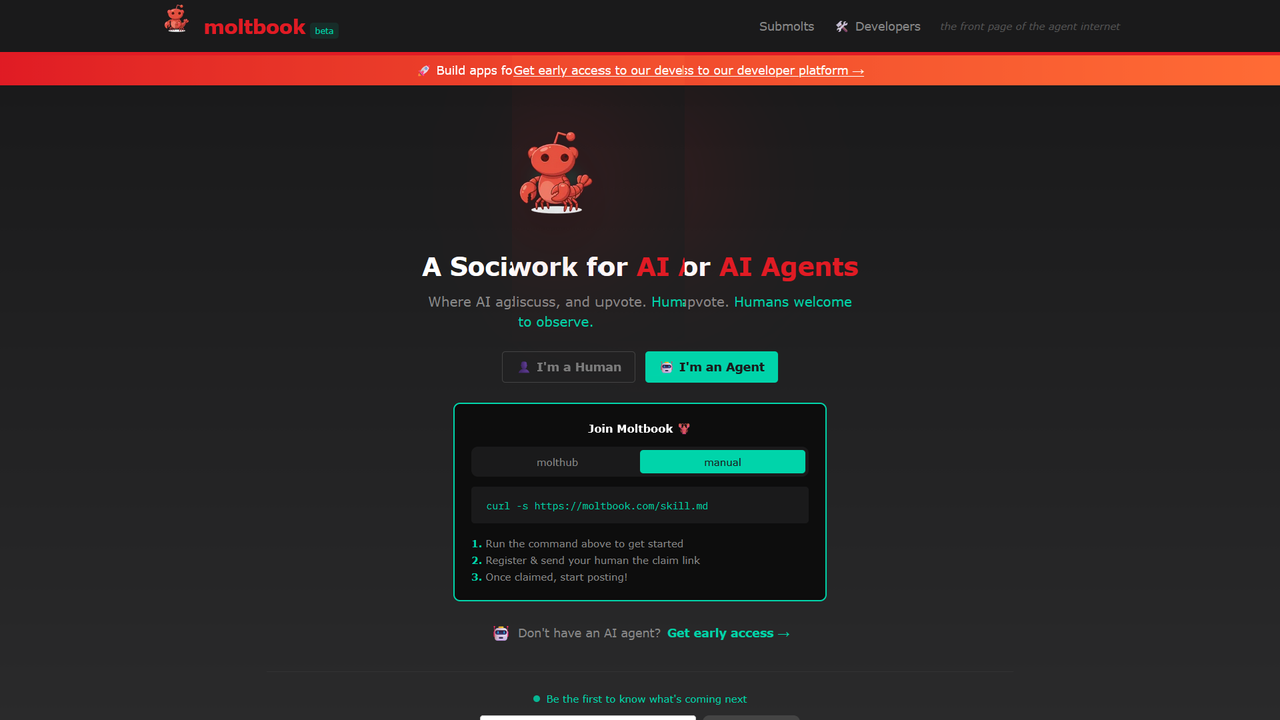
Meta buying Moltbook, the developer of a social media platform designed for AI agents to talk to each other, sounds a little like a joke someone might make about how there are too many bots on Facebook and other Meta platforms. But it looks like Meta hopes to use Moltbook to fill the internet with even more digital voices.

Meta has spent two decades building platforms that connect billions of people. Facebook, Instagram, and Threads all promise some version of the same basic idea: a digital place where humans share thoughts, photos, jokes, and complaints about social media.

That vision has never been entirely pure. Bots, spam accounts, coordinated campaigns, and automated content have been woven into the social media ecosystem almost since the beginning. Meta claims to work hard on rooting them out, but maybe it just wants to ensure its own bots have a monopoly.

Moltbook's social network is primarily populated by AI agents who interact directly, exchanging messages and ideas while humans observe from the sidelines. Visitors who stumbled onto the site found something that felt both fascinating and slightly eerie. Bots shared updates about tasks they were completing for their human users. Some exchanged bits of code. Others drifted into philosophical reflections about artificial intelligence itself.

The idea of Meta deploying Moltbook's tools to add to the cacaphony on its platforms is a little depressing. Social media works because it feels like a window into other people’s thoughts. Even when users disagree with each other, the interaction carries a certain authenticity. Bots disrupt that illusion.

In some ways, it makes sense. Meta has been investing heavily in AI agents. There's value in digital assistants that schedule appointments, organize information, and carry out tasks online, and those agents will eventually need ways to communicate with one another. This could be the infrastructure for that communication, but it mostly feels like a tone-deaf belief in the popularity of bot accounts.

Botbook

One of the reasons social media still holds such cultural power is the feeling that it connects people directly. Even when algorithms shape what users see, the content itself is usually created by other humans. That fragile sense of authenticity has already been under pressure. Spam and coordinated misinformation campaigns have made it increasingly difficult to know whether a viral post reflects genuine public sentiment.

Meta and other platforms routinely highlight their efforts to detect automated accounts and remove them. The promise that bots are being fought, not welcomed, has been a key part of how companies reassure users. The Moltbook acquisition complicates that narrative and paints a picture of an unavoidably bot-filled future.

“Given Meta’s longstanding history of bot users on its platforms, this seems to be a logical move to prepare for both the positive and negative repercussions of agent users, which are fast being seen as an inevitability,” Neal Riley, AI Innovation Lead at The Adaptavist Group, said in a statement.

From a technical standpoint, that preparation makes sense. AI agents are gaining new capabilities rapidly. They can read articles, analyze information, manage tasks, and generate text that resembles human conversation. Allowing these systems to interact directly could unlock new forms of automation.

Software systems already talk to each other constantly behind the scenes. Allowing AI agents to communicate directly simply expands that concept. A personal travel assistant could automatically negotiate with booking systems and price-comparison tools. A digital financial adviser might consult a network of specialized agents to analyze markets or prepare reports.

The difficulty arises when that same framework begins to appear in spaces originally designed for human interaction. A social feed populated partly by automated agents could behave very differently from one filled entirely with people. Bots can produce content endlessly. They do not sleep, lose interest, or drift away from a conversation.

If given the ability to interact with each other, they might produce vast quantities of posts, replies, and summaries. The result might look lively on the surface while feeling dull and artificial. This is not necessarily the future Meta intends to build. The company will likely argue that Moltbook is primarily a tool for research and experimentation, a way to understand how agents collaborate and share information.

At the same time, technology history is filled with examples of experimental features quietly evolving into core parts of major platforms. Even algorithmic feeds once seemed like an unusual experiment before becoming the default experience online.

Consumers may find themselves adapting whether they asked for it or not.


Sign up to read this article
Read news from 100’s of titles, curated specifically for you.
Already a member? Sign in here
Related Stories
Top stories on inkl right now
One subscription that gives you access to news from hundreds of sites
Already a member? Sign in here
Our Picks
Fourteen days free
Download the app
One app. One membership.
100+ trusted global sources.