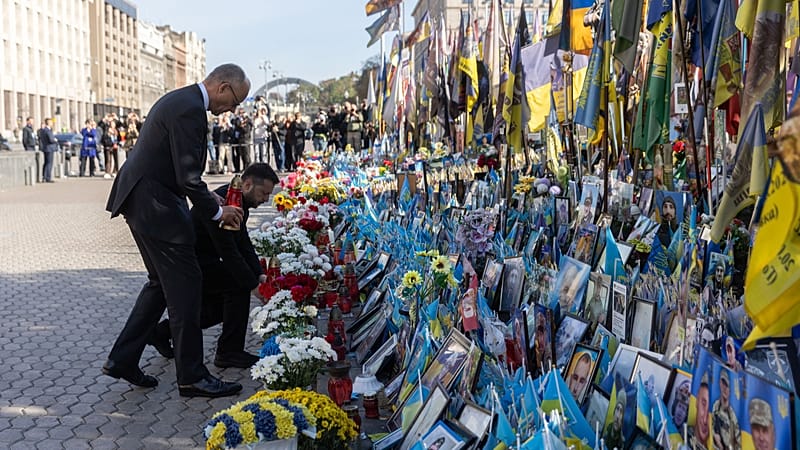
Das ist eine gute Idee: German Chancellor Friedrich Merz arrived in Kyiv Sunday in a show of support as Russia escalated its attacks on Ukrainian cities. Merz said he traveled to the Ukrainian capital on his second trip as chancellor to demonstrate his country's continued solidarity for Ukraine, underscored by a recently announced €1.3 billion support package for the country's defence and energy needs.
“If Russia is not stopped, its war machine will sooner or later turn against us,” Merz said in a statement Sunday, adding that he told Ukrainian President Volodymyr Zelenskyy: “You can continue to count on our help.”
The A-Team: Zelenskyy thanked the German chancellor for his visit and his words, reiterating that Ukraine is not fighting alone. “Russia must be stopped together,” he said in a post on social media platform X.
Former European Council President Charles Michel just told Europe Today that Germany's recently announced €1.3 billion package for Kyiv does not just support Ukraine on the battlefield. "It is for our common future," he said. Watch.
The visit comes as the aerial war has intensified, with Moscow pounding cities across Ukraine with difficult-to-down ballistic missiles and jet-powered drones. In retaliation — drawing the ire of US President Donald Trump amid escalating energy shocks — Kyiv has been striking Russia’s oil industry and businesses. (More on the energy crisis later.)
After Russia once again warned diplomats to leave Ukraine or continue to put their lives at risk from Moscow’s continued bombardment, the world’s ambassadors stood defiant. This includes the EU’s Ambassador to Ukraine Katarína Mathernová who offered a firm riposte: “We are staying,” Mathernová said.
Da haben wir den Salat: But some on the sidelines of Merz’s visit have wondered whether it aims to overshadow a recent acrimonious meeting between Germany’s Foreign Minister Johann Wadephul and Russian Foreign Minister Sergey Lavrov in New York City.
The meeting was perceived as contentious by some in Brussels: although the thrust of Wadephul’s message during the bilateral was for Russia to stop the invasion and go to the negotiating table with Ukraine, it represented a potential thawing of isolation around senior leadership in the Kremlin.
Shuttlecock diplomacy: The meeting comes as the war in Iran and reduced refining capacity have squeezed supply, driving a sharp rise in prices for companies and consumers. US Treasury SecretaryScott Bessent previously urged Europe to make new stocks available “immediately” to ease costs, saying US "farmers, truckers, and businesses should not be left carrying the burden".
A virtual G7 meeting on Friday, attended by IEA Executive Director Fatih Birol at the invitation of French President Emmanuel Macron, brought the energy crunch to a head. As a result, the G7 announced the release of 100 million barrels of diesel and crude oil after Trump threatened a ban of diesel exports.
Charles Michel just said on Europe Today that it is "absolutely important" for Europe to have "more ambition" when it comes to boosting diplomatic efforts in the Middle East, particularly when it comes to Iran. "We are not seen as a decisive player, as a decisive actor," he said.
His call comes as 20 senior international figures call on the EU to explore "new options" when it comes to the war in Iran. "We have tried appeasement and diplomatic engagement," Michel said.
"We are observing that a military intervention is tried by the United States and Israel. We think that other options should be developed with the ambition to put the people of Iran at the heart." Watch.
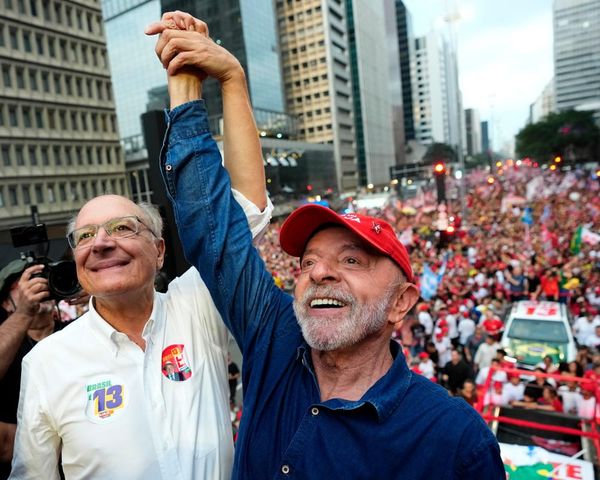
Lula versus Bolsonaro: Nearly 159 million eligible Brazilians voted Sunday in a pivotal presidential election dominated by incumbent Luiz Inácio Lula da Silva and his ideological contender, Flávio Bolsonaro. Neither contender proved strong enough to win a majority, meaning the duo will head to a runoff vote on 25 October.
Bolsonaro is an ally of US President Donald Trump and son of ex-leader Jair Bolsonaro, and said he was “very happy” to lead the first round.
What does this mean for Europe? A victory by Bolsonaro would mean Brazil, Latin America's largest economy, would join Argentina, Chile, Colombia, Costa Rica and Peru in electing Trump-friendly governments in recent years. Lula has made Brazil’s sovereignty a major campaign issue.
João Albuquerque is a former Member of the European Parliament, who served as vice-chair of the EU-Brazil delegation. He is now the Director for Advocacy and Political Affairs at lobby group EuroCommerce. He just told Europe Today that this is a "sad morning" for Brazilian politics.
"Lula has had a very significant impact in approving the Mercosur (trade) agreement, but also in making sure that we have — on cultural issues, on progressive and democratic issues — an approximation between the two sides. I think it was very important that the two sides managed to come together. I think this is at risk now". Watch.
Election fever has not only gripped Rio de Janeiro — it has rattled Paris. After three days of silence, National Rally's French presidential candidate Marine Le Pen has responded to media reports of new alleged evidence of antisemitic remarks by the party leader, Jordan Bardella.
“Just madness”: The presidential hopeful told La Tribune Dimanche she has "total confidence" in the man tipped to become her prime minister if she wins the 2027 presidential election.
Le Pen had already defended Bardella when French outlet Mediapart first published the allegations. "You won't get anyone to believe that," she told reporters during a walkabout at a trade fair, cutting the exchange short. “It's just madness," she added.
Sarajevo to Riga: Elections also occurred in Bosnia and Herzegovina and Latvia over the weekend, with the presence of Russia-backed parties looming large across both ballots.
Latvia's Prime Minister Andris Kulbergs' centre-right United List party won the Baltic state's parliamentary election in an election dominated by Russia’s war of aggression against Ukraine, preliminary results showed Sunday. Jeremiah Fisayo-Bambi has the latest on that story.
Bosnian Serb nationalist politician Milorad Dodik declared victory for his party in an election in Bosnia on Sunday that was shaped by economic pressures and the prospect of the Balkan nation joining the European Union. It was underscored by ethnic tensions that have divided the country since the 1990s war.
‘We don't feel a sense of worry’ in Europe, says the head of the Muslim World League
Dialogue. That was the word repeated by the Secretary-General of the Muslim World League, Sheikh Dr Mohammad bin Abdulkarim Al-Issa, during his visit to Brussels on Friday.
During his stay in the Belgian capital, the Saudi religious leader met political figures and representatives of the country’s religious communities and civil society who gathered for a high-level meeting on dialogue and social cohesion.
Al-Issa stressed the importance of dialogue in resolving conflicts, saying it needed sincere intentions and effective leadership. “Of course, we always believe in dialogue and place great faith in it,” he said, adding that “dialogue is the language of reason and wisdom.”
Gregoire Lory has the scoop.
More from our newsrooms
Spanish police begin clearing Ceuta's largest migrant camp ahead of King and Queen's visit. Police began 'Operation Trampolín' on Sunday to clear a makeshift settlement on Ceuta's Trampolín beach, home to about 3,000 people living in poor conditions for more than two months. More on-the-ground reporting from Jesús Maturana.
Has the plague returned to Siberia? Panic in Russia after death of lab worker. Residents of Russia's Irkutsk region are deeply worried by rumours of a possible outbreak of pneumonic plague in this Siberian area. Alexei Doval reports on whether there is something more sinister to the allegations.
Student protests in France: 400–500 schools fully or partially closed on Monday. Up to 500 secondary schools in France are expected to be fully or partially closed on Monday due to protesting pupils. The demonstrations — fuelled over poor schoolroom conditions and a lack of teachers — follows several days of protests marked by clashes with police. Nina Borowski and Alexander Kazakevich have more to this story.
We're also keeping an eye on
- The EU’s top diplomat Kaja Kallas co-hosts the EU-Moldova Association Council meeting with Moldovan Prime Minister Vasile Tofan in Brussels.
- European Commissioner for Trade Maroš Šefčovič holds a video conference call with BMW Group CEO Milan Nedeljković.
- European Commissioner for Climate Wopke Hoekstra attends a pre-COP31 Ministerial Meeting and Leaders' Event in Fiji.
- European Commissioner for Energy Dan Jørgensen receives the Securing Energy for Europe CEO Egbert Laege.
- European Commission President Ursula von der Leyen meets European Parliament President Roberta Metsola in Strasbourg for the first day of this week’s plenary.
- European Council President António Costa meets Polish Prime Minister Donald Tusk in Warsaw.
That’s it for today.