
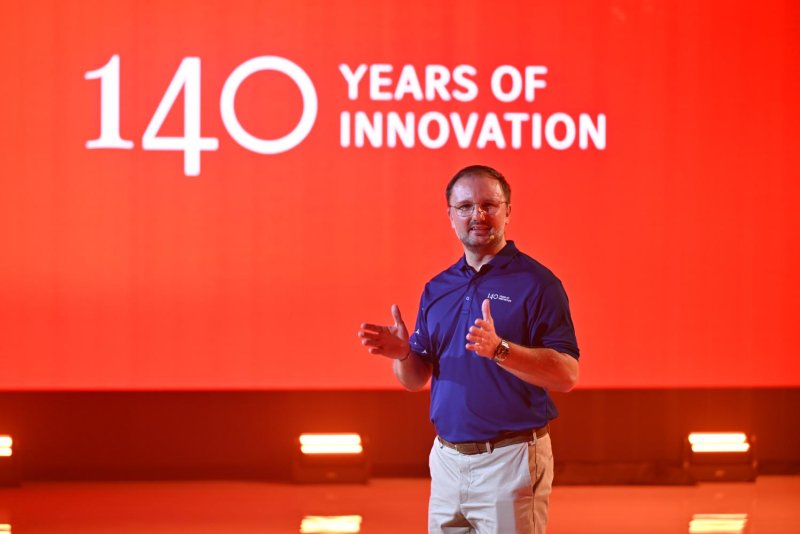
Mercedes-Benz (Thailand) expects demand for battery electric vehicles (BEVs) to continue rising as global energy prices climb and geopolitical tensions in the Middle East create uncertainty.
Christian Schell, president and chief executive of Mercedes-Benz (Thailand), said new registrations of Mercedes-Benz cars in Thailand reached 1,949 units in the first quarter of 2026, with total sales of 1,304 units for passenger and commercial vehicles.

Concerns over crude oil prices and instability in the Middle East are tilting consumer interest towards EVs, he noted.
Industry analysts agree that higher oil prices are pushing prospective buyers to consider BEVs.
However, Thailand's automotive sector still faces challenges, including global economic uncertainty, the high level of household debt, and delayed purchasing decisions amid sluggish domestic growth.
Mercedes-Benz (Thailand) reported a 140% sales increase at the 2026 Bangkok International Motor Show, with sales rising from 870 units last year to 2,111 units this year.
"It's a seven-year high, surpassing the 2,000-unit mark for the first time since 2019. We expect 2026 to be a record year for BEV sales," Mr Schell said.
Globally, Mercedes-Benz sold 499,700 units in the first quarter of 2026, including vans, with double-digit BEV growth.
In Europe, BEV demand surged 107%, driven by strong market response to new models such as the CLA, GLC, and GLB.
The company plans to launch more than 40 new models between 2025 and 2027, spanning BEVs and advanced electrified combustion engines.
To mark its 140th anniversary, Mercedes-Benz recently introduced the Mercedes-Maybach S 580 e Night Series in Thailand, priced at 14 million baht, with only 16 units available.
Meanwhile, the Federation of Thai Industries has urged auto parts makers to delay price increases, warning that higher costs could severely impact production capacity and car prices.
Parts manufactures need to adjust product prices to deal with higher raw material costs as a result of the Middle East conflicts.
Mr Schell said Mercedes-Benz (Thailand) has not yet discussed the issue with suppliers, but emphasised the company's long-term commitment to local partners.
"We continue to support Thai companies, as more than 50% of our production uses local content," he said.







