
Get all your news in one place.
100's of premium titles.
One app.
Start reading
What Hi-Fi?
What Hi-Fi?
Technology
Ketan Bharadia

Meet the man behind Audio-Technica’s new £9999 turntable cartridge

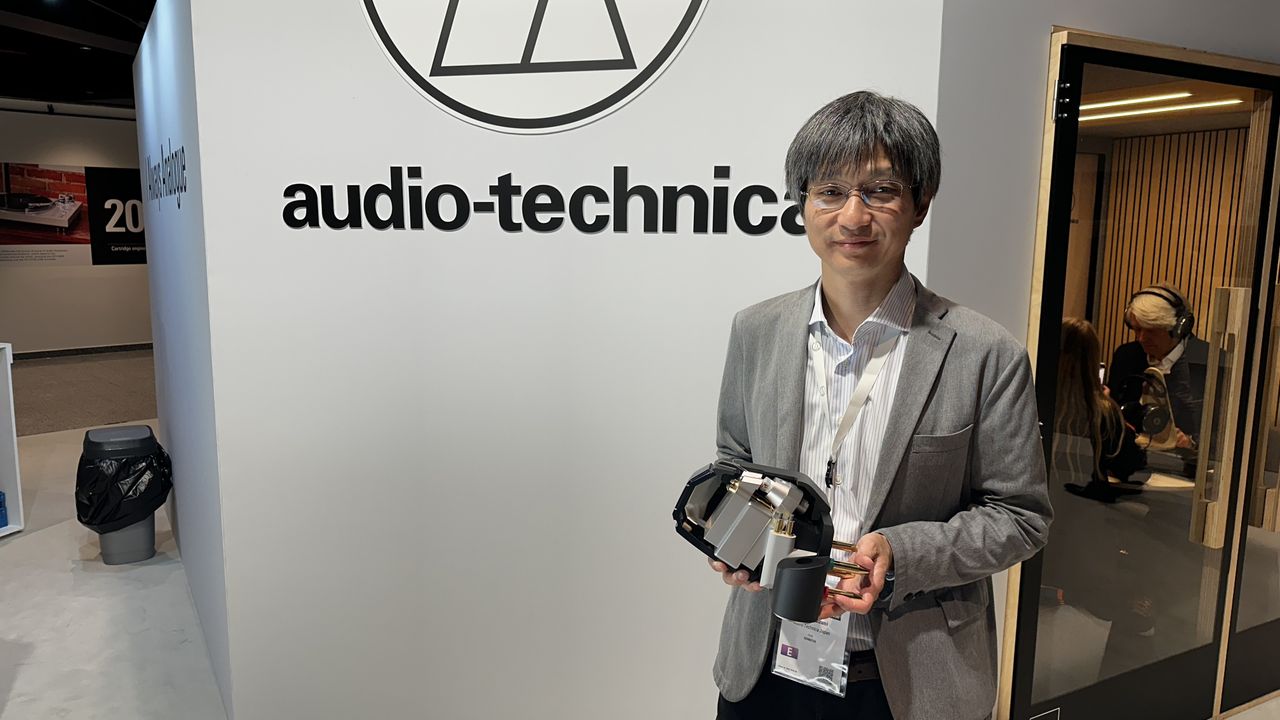
Yosuke Koizumi holding model of an AT-MCD1 cartridge.

Yosuke Koizumi is Audio-Technica’s Cartridge Global Product Manager. He started working at the company in 2002 and joined the cartridge development team after a year of training.

Around 8 years ago, Koizumi was promoted to manager status, giving him the responsibility for developing the brand’s cartridges and turntables.

We had the chance to sit down with Yosuke Koizumi at the High End Vienna show and find out more about the technology behind Audio-Technica’s new range-topping AT-MCD1 moving coil cartridge (£9999/$11,000).

What do you think differentiates Audio-Technica from its rivals?

I think our generator structures are very different from our rivals. When it comes to moving coil cartridges, we have two sets of coils arranged in a V shape, which we think gives better results. Also, when it comes to moving magnets, we have two magnets rather than the usual one.

How did the AT-MCD1 come about?

Around four years ago we launched our 60th anniversary model, the AT-MC2022. It was a limited run of just 60 pieces, and all of them sold out very quickly. After that, Audio-Technica continued to receive enquiries about that product and so we decided to make a successor.

The company didn’t just want to do the same thing again, so we spent almost two years developing the design further. The AT-MC2022’s one-piece diamond cantilever/stylus tip was improved with the stylus profile changing from Microlinear to a new Shibata shape.

Why use diamond for the cantilever material?

The cantilever material needs to be stiff and lightweight to be able to track the record groove properly. Aluminium is usually used, or maybe Boron in premium cartridges, but we think diamond is a better choice in performance terms.

Diamond’s speed of transmission is very fast (around the speed of sound) because of its rigidity, but its density means that you have to be careful when using it to avoid the cantilever becoming too heavy. One improvement we made on the AT-MCD1 is that we reduced the amount of material on the front edge of the cantilever to reduce weight

Diamond is a very hard material. The Shibata stylus tip is polished into shape rather than machined, which is a laborious process.

The Audio-Technica AT-MCD1 moving coil cartridge (Image credit: What Hi-Fi?)

How important is the stylus tip profile?

We wanted to improve the sound over the AT-MC2022, so the idea came to change the stylus tip from Microlinear to a Shibata shape.

Our existing Shibata shape is very nice with good midrange and bass frequencies, and very good dynamics, but the stereo imaging isn‘t quite as spacious as we wanted. The new Shibata profile keeps all the good points of before, but has more expansive soundstaging and greater nuance in its presentation.

How does body material affect performance?

In the AT-MCD1, we mixed several materials: titanium, aluminium and an elastomer for its damping properties. Using only titanium gave us a compressed presentation, while aluminium on its own gave the sound a metallic edge when playing cymbals or high hats because of added resonances. The combination of these metals and the elastomer gives much more balanced results.

Wouldn’t it be better to get rid of the cartridge body altogether?

We think the cover is important because it prevents dirt and dust from getting into the generator system. Also, it provides a degree of damage protection for the diamond cantilever.

Is the AT-MCD1 demanding of the partnering phono stage?

Of course, a very high-class phono stage is recommended. But the cartridge has an output of around 0.55mV and a 12 ohm impedance, so it is relatively normal and not difficult for a phono stage.

Which area is there scope for the biggest improvements in cartridges?

One thing is the rubber damper. It is a part that we have done many things to improve, but there remains plenty of scope to make progress. It is a component that looks very simple, but it affects every part of a cartridge’s performance.

MORE:

Cambridge Audio introduces its “most powerful streaming amplifier yet”, complete with HDMI eARC and turntable-friendly phono stage

Dual takes its "legacy into the future" with a fully automatic direct-drive turntable that you can control with an app

All the news from High End Vienna

Sign up to read this article
Read news from 100's of titles, curated specifically for you.
Already a member? Sign in here
Related Stories
Top stories on inkl right now
One subscription that gives you access to news from hundreds of sites
Already a member? Sign in here
Our Picks
Fourteen days free
Download the app
One app. One membership.
100+ trusted global sources.