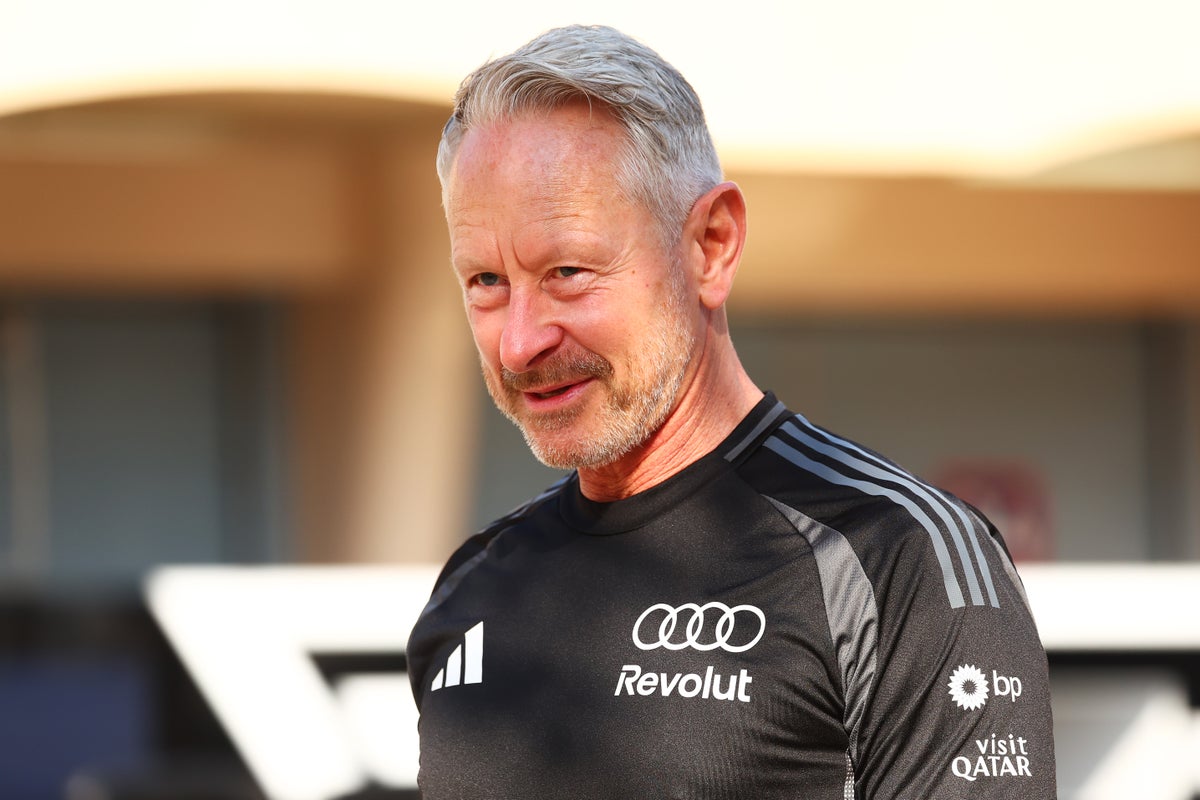
Three decades and a dozen-plus world championships into a career solely in Formula One, it was the middle of 2024 when Jonathan Wheatley decided he fancied a crack at sport’s infamous piranha club. A band of team bosses, biting and back-stabbing aplenty, which is not for the faint-hearted.
A staple of Red Bull’s formative and dominant years, known for his proficiency in leading the team’s grid-leading pit-stop crew, Wheatley has opted for something completely fresh. A new team, a new manufacturer and a new country, night and day from his old base in Milton Keynes. And all in time for a new generation of cars, in the sport’s biggest revamp of regulations in 76 years.

“It has been absolutely relentless,” Wheatley tells The Independent, now the figurehead and team principal of Audi’s F1 project, which starts in earnest next week at the season-opener in Melbourne.
“Time has been by far the biggest challenge. I need to be everywhere at once: 24 races, trips to Germany and living in Switzerland. I enjoy travelling, so it’s not onerous. But the last 12 months have gone by in the blink of an eye.”
It has been quite the leap, not just in seniority and exposure but also, rather starkly, in competitiveness. Red Bull, all-conquering in the last five years, occupies a spot at the front of the pit-lane. Yet Audi, previously known as Sauber until the German giant’s takeover was formalised this year, were rooted to the back of the pack after a horrid 2024 campaign, in which the team scored just four points.
“I certainly had some preconceived ideas about the team before I came here,” Wheatley acknowledges, softly spoken in his words and actions. Many will recognise his tone from the 2021 season, in leading Red Bull’s case over the radio with then-FIA race director Michael Masi, as Max Verstappen claimed his first title in controversial circumstances.
“I had a plan of attack and I’d say I’ve stuck to that,” he says, back to the here and now. “When you come into a team who are on a journey with big aspirations, you start from humble beginnings. We don’t have the strength in depth that larger teams have. What does that look like? Our headcount is around the 350-mark, while Red Bull’s is closer to 900.
“That’s what underpins a really strong structure. For instance, at the moment, if a ‘wheel-gun man’ can’t attend a race, we don’t have somebody at the same level who can step in. So that strength and depth essentially means you’re not operating on a knife-edge.”
It is unsurprising that the 58-year-old refers to pit-stops as indicative of a team’s potential and progress. In 2019, Red Bull broke the world record for the fastest-ever pit-stop twice, with the quickest clocked in at 1.82 seconds. It was only broken in 2023 by McLaren, who notched 1.80 seconds. As sporting director, Wheatley accepted the prize for the fastest pit-stop crew at Red Bull on seven consecutive occasions.
Away from the cockpit, the marginal gains of F1 are seen nowhere more visibly than in the pit-lane. Notably, Sauber’s pit-stop crew were the best of the midfield last year. Results on track, however, are the currency in which team bosses are judged by. And Sauber’s resurgence in 2025 was something of a shock.

The unequivocal peak was Silverstone. The team’s senior driver Nico Hulkenberg, who had the unenviable record of the most-races without a podium, executed a near-perfect race from 19th to finish third, ahead of Lewis Hamilton, to spark jubilant scenes in the garage. It was the team’s first podium in 13 years.
“I was in my comfort zone,” Wheatley says of that race, before adding: “I’ve been in those situations a million times [at Red Bull]. I was no more anxious than I am now in this conversation.
“But I turned around and the whole team had exploded behind me. I thought ‘oh right, yes, it’s a really big deal!’ The outpouring of emotion, the joy in people’s faces... that was a pivotal moment for me.”
Surpassing expectations for front-of-the-pack results is a rarity for the majority of F1 teams. Consistently stretching away from the sport’s swollen midfield is the sturdiest challenge they all face, but one in which Wheatley can use his experience to good effect.
Prior to Red Bull, he worked at Benetton/Renault, starting out as a mechanic in Flavio Briatore’s title-winning team with Michael Schumacher. Now, he’s in the same room as the Italian maverick, with an altogether more holistic approach: less hiring and firing, more prudence and patience.

Previously seen as Christian Horner’s right-hand man at Red Bull, Wheatley is now the face of this four-ringed project and, as a result, he has moved to the remote town of Zug in Switzerland with his wife, Emma. “We have glasses of wine and watch the sun go down over a mountain,” he says, with a glint in his eye. “It’s a completely different way of life. The roads are immaculate. Eight-year-old kids walk to school on their own. It’s like a movie scene.”
And in Audi, he is representing one of motorsport’s most famous brands. The German car giant have won the 24 Hours of Le Mans 13 times and claimed four World Rally Championships. But never before have they ventured into Formula 1.
“The ambition of every single department… it’s stretched to the absolute limit,” he says of the current project. “We’re creating our own car, with our own power unit, chassis, gearbox. But it’s also a major infrastructure project. It’s a brand new rebranding exercise.” Indeed, Audi have big-name sponsors signed up, such as Revolut, Adidas and BP.

Wheatley is working as chief alongside ex-Ferrari team boss Mattia Binotto, the official ‘Head of Audi’s F1 project’, focused more on the engine side of the works outfit. Who’s actually in charge, you may ask?
‘We are very different, but it’s like a Venn diagram of responsibility for Mattia and me,” Wheatley adds. “It’s odd how aligned we are, actually, given we’re from very different backgrounds.”
The doldrums of two years ago long in the memory, it is an exciting period for Wheatley and his team. Alongside Hulkenberg, they have “very, very fast” Brazilian talent Gabriel Bortoleto in their car. Fellow newbies Cadillac have been reluctant to put a timeline on success but Audi, in that no-nonsense German manner, have been more forthcoming.
“We want to be competing for race wins and championships on a regular basis by the end of the decade,” Wheatley says. “And that may seem a long way away.
“But in Formula One terms, 2030 is tomorrow.”
Mclaren F1 boss backs Ferrari and Mercedes to be ‘step ahead’ at start of 2026 season
Stefano Domenicali hints at return of much-loved F1 race for 2027: ‘Stay tuned’
Mclaren F1 boss backs Ferrari and Mercedes to be ‘step ahead’ at start of 2026 season
F1 2026: What is the pecking order after testing? And which team are the favourites?
Lando Norris admits McLaren have ‘quite a bit to improve’ ahead of F1 title defence