
Get all your news in one place.
100’s of premium titles.
One app.
Start reading
Space
Space
Science
Andrew Jones

Meet Qingzhou, China's next-gen cargo craft for its Tiangong space station (video)

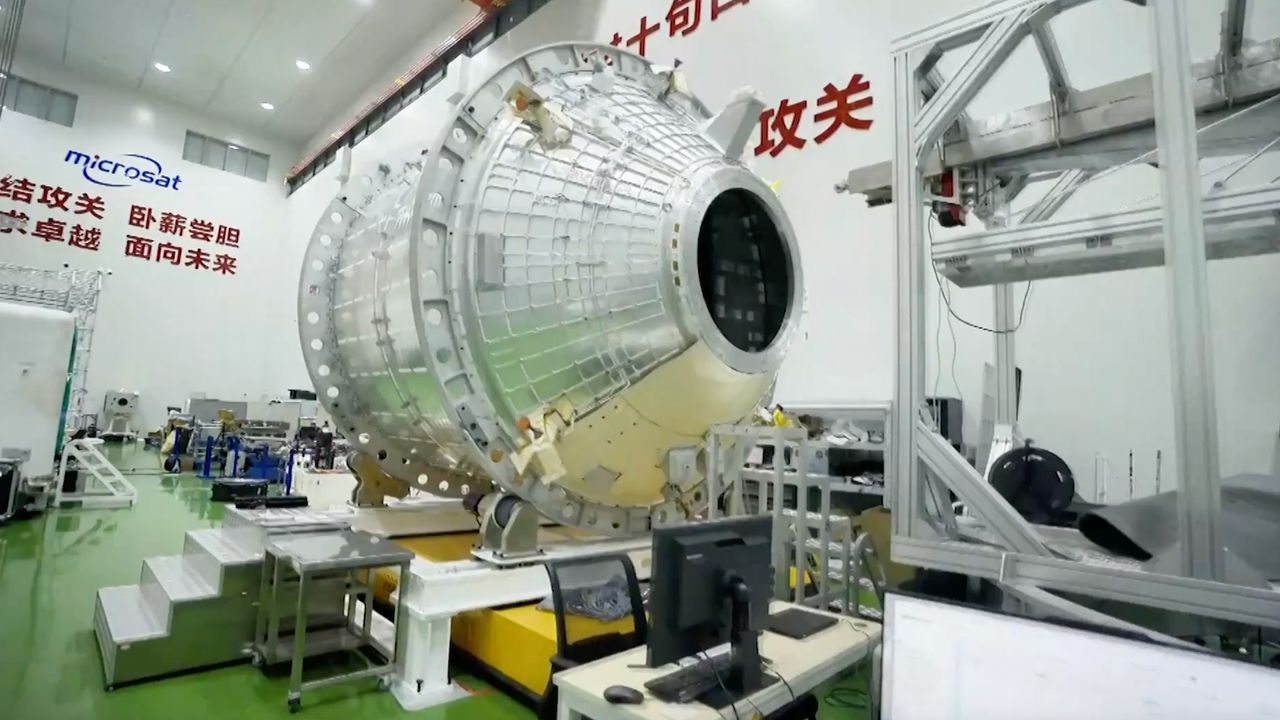
A large metal spacecraft is sits on a platform in a warehouse with lettering behind it.

China is working toward the first launch of a next-generation, low-cost cargo spacecraft option for its Tiangong space station.

Qingzhou, meaning "Light Ship," is being developed by the Innovation Academy for Microsatellites of the Chinese Academy of Sciences (IAMCAS) as a smaller, lighter and potentially lower-cost complement to China’s existing Tianzhou cargo spacecraft.
China completed its Tiangong space station in 2022 and aims to keep it permanently occupied with crew for at least a decade. With plans to expand the orbital outpost beyond its current three-module, T-shaped configuration, China also wants new, agile solutions to keep Tiangong supplied.

The Qingzhou spacecraft passed a design review in June and entered the initial manufacturing phase, according to a recent China Central Television (CCTV) report.

The prototype measures roughly 10.8 feet (3.3 meters) in diameter, has a launch mass of about 11,000 pounds (5,000 kilograms), and is capable of carrying up to 4,000 pounds (1,800 kg) of cargo to orbit. Its hybrid structure combines a pressurized module for crew supplies and sensitive instruments with an unpressurized aft section capable of carrying external payloads and space-exposure experiments.

"We have now conducted large-scale experiments and are currently loading and verifying the status of the remaining individual machines, as well as conducting final testing. The overall test results are quite good," Wu Huiying, deputy chief designer of the Qingzhou cargo spacecraft, told CCTV.

Full engineering model production is scheduled to begin in early 2026, with construction expected to be completed by the end of that year. Its debut flight will follow based on the operational needs of the Tiangong station, according to Wu.

The first prototype was initially stated to fly on the debut launch of commercial rocket startup CAS Space’s Kinetica-2. That plan now appears to have been altered, with CAS Space reported to be preparing for that very launch from Jiuquan spaceport in the Gobi Desert in the near future.

Qingzhou is one of a pair of new spacecraft commissioned by China’s human spaceflight agency as the country looks to upgrade its space transportation capabilities. The other, named Haolong, is a reusable shuttle concept being developed by the Chengdu Aircraft Design and Research Institute under the state-owned Aviation Industry Corporation of China.

Sign up to read this article
Read news from 100’s of titles, curated specifically for you.
Already a member? Sign in here
Related Stories
Top stories on inkl right now
One subscription that gives you access to news from hundreds of sites
Already a member? Sign in here
Our Picks
Fourteen days free
Download the app
One app. One membership.
100+ trusted global sources.