Get all your news in one place.
100's of premium titles.
One app.
Start reading
The Economic Times
The Economic Times
Trending Desk

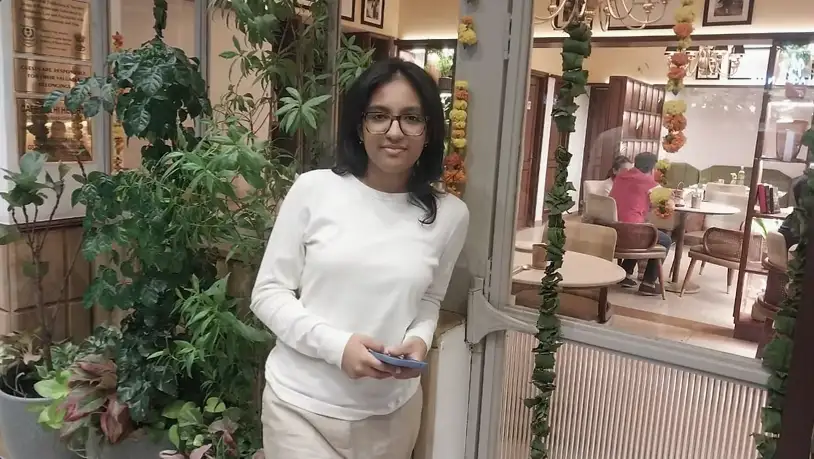
Meet Mahi Malhani: Class 12 Delhi Student builds TRASHbot, an AI waste-sorting robot with 90% accuracy that’s already being used in societies

A school visit to Delhi’s Sundar Nursery turned into an innovation journey for 17-year-old Mahi Malhani. The teen girl was disappointed after seeing scattered around despite the presence of dustbins. She decided to bring a change and made an AI-powered robot designed to make waste disposal easier and smarter.

ALSO READ: Teen who started learning AI at 13 now reportedly earns Rs 1 crore a month

The Class 12 student of Amity International School, Mayur Vihar, has developed TRASHbot, an autonomous robot capable of collecting and sorting waste with minimal human intervention. The project has already been tested in schools, residential societies, and municipal settings, reports The Better India.

ALSO READ: Vindu Dara Singh recalls father's warning

A school trip sparked the idea

Mahi told the media outlet the inspiration came during a heritage tour in 2023.

“I noticed litter everywhere, even near dustbins. People often take the easy route and throw waste wherever they can. I wanted to bridge that gap with technology that helps, rather than just tells people to clean up.”

“It was our annual school trip, where we usually visit heritage parks to learn their history. Even when bins were there, waste did not reach them. That made me realise the problem had two parts: littering, and convenience versus responsibility. There had to be a way to bring the two together, and maybe even eliminate the problem.”

India generates a massive amount of solid waste every day, making efficient waste management a growing challenge. For Mahi, the issue became an opportunity to create a practical solution.

How Mahi's love for technology led to TRASHbot

Mahi had keen interest in coding and electronics from a young age, and spent years experimenting with technology. “I started learning Python, then explored C++ and JavaScript.”

She wanted to combine her technical skills with a real-world problem. “I wanted to understand how machines think and move. If I can teach them to act intelligently, like humans, but more precisely, they can help solve everyday problems, like managing waste efficiently," she told The Better India.

She began sketching concepts and researching robotic waste-management systems before turning her idea into a working prototype.

Guidance from IIT Delhi mentors

As the project grew, Mahi also took technical guidance and eventually connected with Rancho Labs, a robotics and IoT initiative at IIT Delhi. “They helped and guided us, explaining practical aspects of robotics and IoT.”

She also credited her mentors and school teacher for supporting the development process. “They were always available to answer questions and suggest improvements.”

Despite the guidance, she said the robot itself was built independently. “But the prototype itself was my own creation, and that independence was very motivating.”

How TRASHbot works

Unlike a regular smart dustbin, TRASHbot is designed to move, detect waste, and sort it automatically. “I wanted it to feel alive, almost like a companion in cleanliness.”

The robot can be controlled through a smartphone app or operate autonomously. Using ultrasonic sensors, it detects obstacles and avoids collisions.

It is aware of obstacles, just like we are. If it encounters something in its path, it either stops or manoeuvres around it.”

For waste identification, TRASHbot relies on a camera and the AI model YOLOv3. It analyses captured images and classifies waste into biodegradable and non-biodegradable categories.

“It sees, recognises, and sorts, just like a human, but faster, and without mistakes from carelessness.”

The system combines a Raspberry Pi for image processing and an Arduino Uno for movement control, while motors handle navigation and sorting functions. “It may sound complicated, but for the user, it is as simple as pressing a button or letting it work on its own.”

Tested in schools and housing societies

The first trials took place at Mahi’s home before moving to her school cafeteria. Dr SK Singhal, Physics HOD at Amity International School, recalled the experience:

“Seeing it move between tables and collect wrappers was incredible.” He added: “It engages students with its LED lights and sensors. You feel part of the process without lifting a finger.”

The robot was later deployed in residential communities.

Gita Nath, joint secretary of Lotus Boulevard Society, said: “The robot sorts waste automatically. You just throw it in, and it tilts the compartment to the right place. It is convenient, innovative, and makes day-to-day waste management effortless.”

Real-world impact and recognition

Since March 2025, TRASHbot has been used in two residential societies in Noida and by a municipal corporation in Udaipur.

The robot currently identifies waste correctly about 85% of the time, sorts it accurately in 90% of cases, and avoids obstacles with a 98% success rate.

“I wanted anyone, even someone using it for the first time, to feel comfortable with it within minutes," Mahi explained.

The journey was not without challenges. Technical glitches, communication delays, and cost constraints required multiple redesigns.

“After refinements, the cost came down to Rs 7,000, with the potential to reduce to Rs 4,000 using higher-quality components.”

Reflecting on the development process, she says: “Every time the robot faced a problem, I had to find a solution that made it strong, safe, and efficient.”

Her efforts earned national recognition. In 2025, she secured first rank in Delhi and second rank in India at the World Robot Olympiad virtual championship. TRASHbot was also among the top 50 AI-based projects selected from over 3,500 entries at the India AI Impact Summit.

What’s next for TRASHbot?

Mahi plans to make the robot even smarter. Future versions could classify waste into five categories, including plastic, metal, glass, biodegradable, and non-biodegradable materials.

She also hopes to add cloud connectivity and solar-powered charging. “Rural areas present unique challenges, with rougher terrain and fewer facilities. The goal is to make TRASHbot effective everywhere, not just in cities.”

“People respond positively when they see it moving around. It is almost like it’s inviting them to be part of the process.”

What began as a simple observation during a school trip has now become an AI-powered solution with the potential to transform how communities manage waste.

Sign up to read this article
Read news from 100's of titles, curated specifically for you.
Already a member? Sign in here
Related Stories
Top stories on inkl right now
One subscription that gives you access to news from hundreds of sites
Already a member? Sign in here
Our Picks
Fourteen days free
Download the app
One app. One membership.
100+ trusted global sources.