Get all your news in one place.
100's of premium titles.
One app.
Start reading
The Times of India
The Times of India
World
TOI World Desk

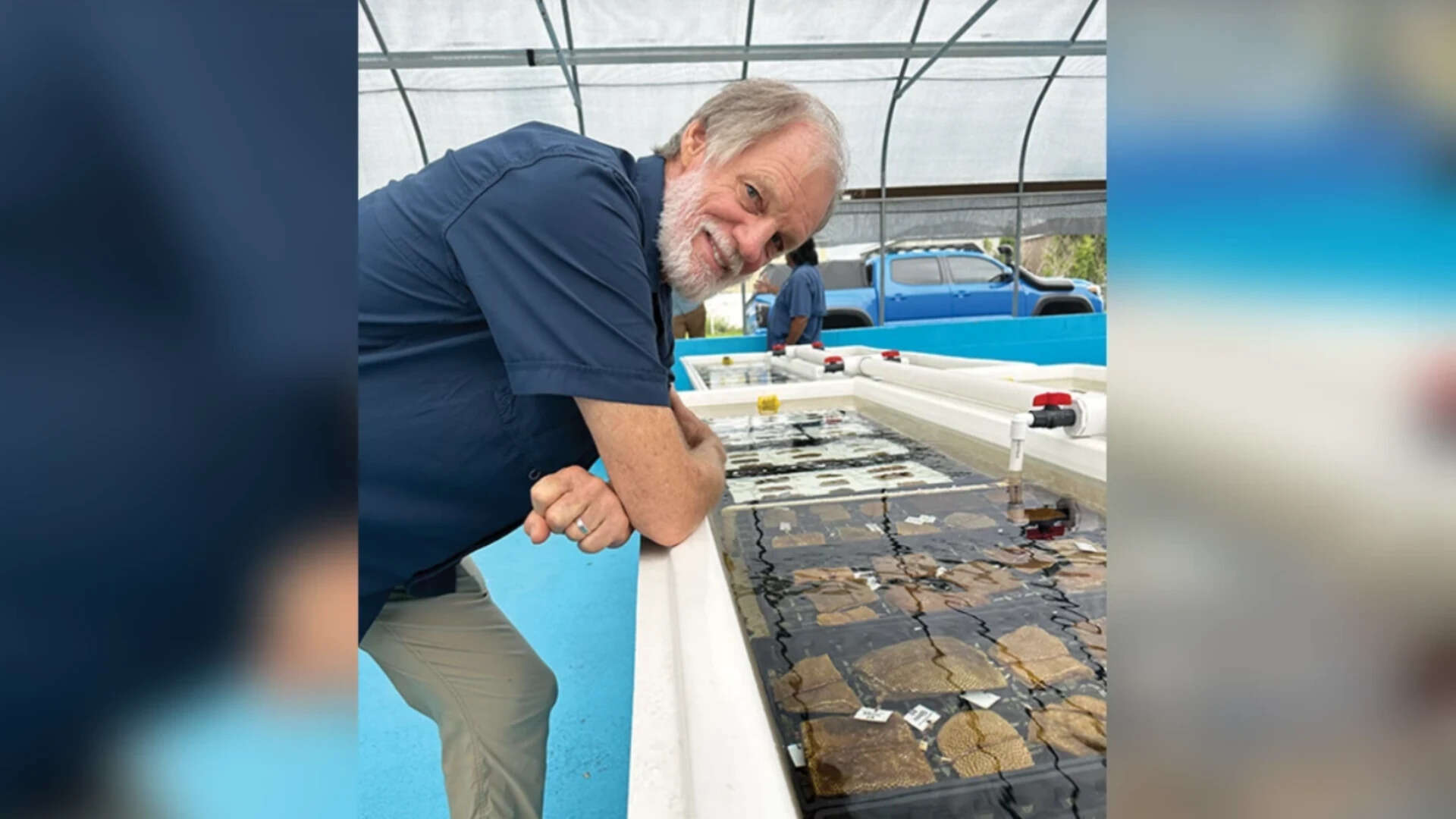
Meet Ken Nedimyer: The driver who turned a backyard into a global coral restoration movement

Coral reefs are often called the rainforests of the sea, supporting around a quarter of all marine life despite covering less than one per cent of the ocean floor. Yet over the past few decades, these vibrant underwater ecosystems have been devastated by climate change, coral bleaching, pollution, disease and destructive fishing practices. While many scientists documented the decline, one diver from the Florida Keys decided to do something about it. His name is Ken Nedimyer, and what began with a small coral nursery in his own backyard has grown into one of the world's most influential coral restoration movements. Through simple but innovative techniques, thousands of volunteers and an expanding international network, Nedimyer has helped pioneer a practical way to restore damaged reefs and inspire communities to protect them.

Get breaking news anytime, anywhere. Download the TOI app now!

How a backyard reef sparked a lifelong mission

Ken Nedimyer grew up diving in the Florida Keys during the 1970s, when the reefs were teeming with colourful corals and fish. He later built a career as a commercial fisherman, tropical fish collector and aquaculture specialist, spending much of his life underwater. But over the years, he watched the reefs he loved steadily deteriorate.

As reported by CNN, the turning point came in the late 1990s when Nedimyer noticed something unusual on his offshore live rock nursery, often described as a reef in his own backyard. Tiny staghorn coral larvae had naturally settled on the rocks and continued to grow despite storms and other environmental stresses. Instead of removing the broken coral fragments, he began reattaching them using marine epoxy and simple underwater tools. Many survived and continued growing.

What started as an experiment quickly became a realisation: if broken corals could be propagated in nurseries and replanted onto degraded reefs, restoration could happen at a much larger scale. That simple observation laid the foundation for modern coral gardening techniques that are now used around the world.

From coral gardening to a global restoration movement

Intent on taking his concept to a higher level, Nedimyer started the Coral Restoration Foundation (CRF), which operates in Florida, where he and his growing cadre of volunteers have worked out techniques for culturing endangered staghorn and elkhorn corals in underwater nurseries before transferring them to the degraded reefs.

Nedimyer's most innovative idea is that of coral tree nurseries, wherein PVC tree-like structures are suspended in the water column, enabling fast growth while providing protection from sedimentation and predators inhabiting the ocean floor. When the corals mature enough, they are attached to the damaged reef sites by using marine cement or epoxy.

The technique proved remarkably effective because it was inexpensive, easy to learn and could be replicated by conservation groups around the world. Rather than relying solely on laboratory facilities, the system allowed volunteers, divers and local communities to participate directly in reef restoration.

As the methods gained recognition, Nedimyer helped establish restoration projects far beyond Florida. He later founded Reef Renewal Foundation International, an organisation dedicated to building and training a global network of coral restoration programmes, and now serves as Technical Director at Reef Renewal USA, where he leads the science and permitting for coral nursery and outplanting activities in the Florida Keys. According to Reef Renewal USA, his work has focused on creating innovative, practical solutions that communities can adopt to restore reefs in their own regions.

A mission recognised around the world

Nedimyer's work has earned international recognition, including being named a CNN Hero in 2012.

In the CNN feature, he explained that coral reefs are far more than beautiful dive sites. Healthy corals also provide habitats for numerous marine organisms, a fishery resource base, wave and storm protection, and economy of tourist industries. Nedimyer pointed out that the absence of coral reefs would mean that coastal ecosystems throughout the globe would face serious repercussions.

Instead of expecting governments or other institutions to deal with the problem, Nedimyer decided to create techniques of restoring reefs which ordinary people could master.

"Our method is simple and something we can teach others to do," Nedimyer said in the interview with CNN Heroes, emphasising the necessity to involve communities in reef restoration instead of leaving this task solely to scientific groups.

This approach is characteristic of Nedimyer's organisations even now. While working with many partners in various countries, Reef Renewal International provides communities with knowledge about restoration techniques and encourages them to create nurseries for corals. The objective of the organisation is to improve the state of reefs through increasing their cover and biodiversity.

Why coral restoration has never been more urgent

Coral reefs are facing unprecedented threats from rising ocean temperatures, marine heatwaves, pollution, overfishing and disease. Mass bleaching events have become increasingly frequent, placing enormous pressure on reef ecosystems worldwide.

While restoration alone cannot solve climate change, scientists increasingly view it as an important tool for helping reefs recover alongside broader efforts to reduce greenhouse gas emissions and improve water quality.

Modern restoration programmes also focus on identifying resilient coral colonies that can better withstand warming oceans. Reef Renewal USA now collects healthy corals from across the Florida Keys, propagates those showing greater tolerance to environmental stress and outplants them to strengthen reef resilience over time. The organisation has also expanded into land-based coral farming facilities that can protect vulnerable corals during extreme marine heat events before returning them to the ocean.

Recent videos shared by Reef Renewal USA on social media continue to showcase divers maintaining coral nurseries, attaching nursery-grown corals to reefs and monitoring their survival, illustrating how the restoration process combines careful scientific monitoring with thousands of hours of underwater fieldwork.

One person's idea continues to inspire a global movement

What makes Ken Nedimyer's story remarkable is not the complexity of the technology he developed but the simplicity of the idea behind it.

A diver noticed healthy corals growing on a small reef in his backyard, wondered whether they could be cultivated to restore damaged ecosystems, and spent decades refining a practical solution. That experiment has since evolved into restoration programmes spanning multiple countries and has helped shape modern coral conservation.

Today, thousands of nursery-grown corals are being transplanted back onto degraded reefs every year using techniques that trace their origins to Nedimyer's early work in the Florida Keys. As climate change continues to threaten reefs worldwide, his story demonstrates how careful observation, persistence and community involvement can transform a local experiment into a global conservation effort, one coral fragment at a time.

Sign up to read this article
Read news from 100's of titles, curated specifically for you.
Already a member? Sign in here
Related Stories
Top stories on inkl right now
One subscription that gives you access to news from hundreds of sites
Already a member? Sign in here
Our Picks
Fourteen days free
Download the app
One app. One membership.
100+ trusted global sources.