
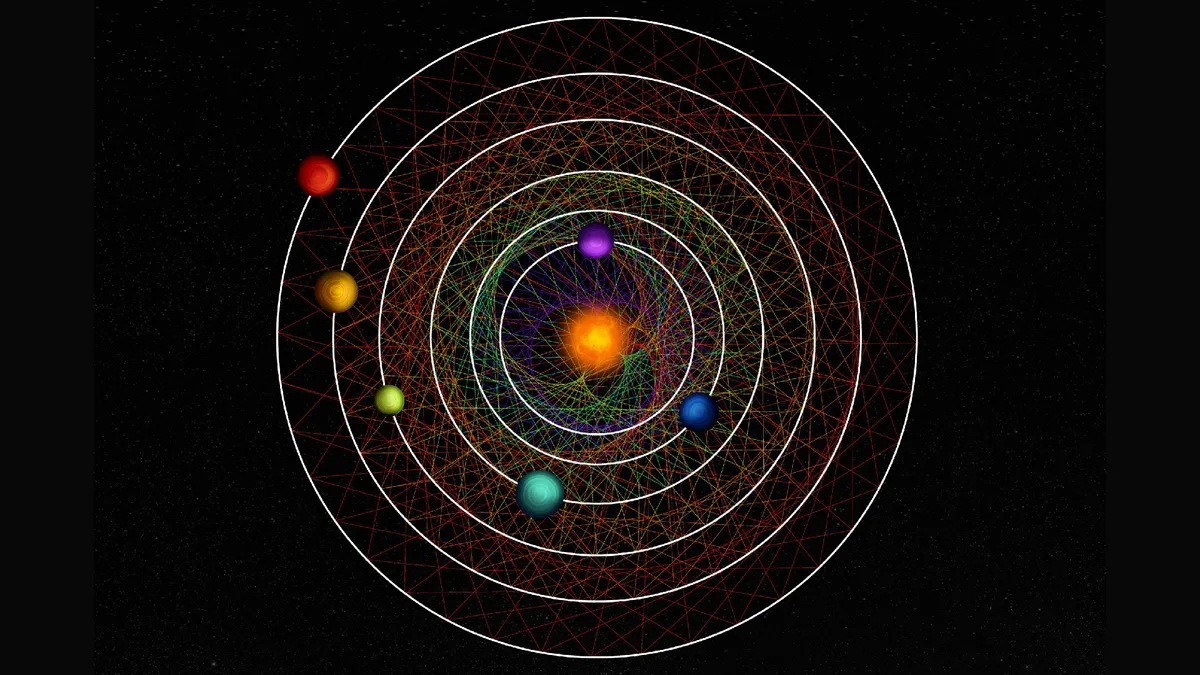
Tucked away in the constellation Coma Berenices just 105 light-years from Earth, the star HD 110067 is a hidden gem of the Milky Way. This parent star has guided its litter of six exoplanets to orbit in a cosmic waltz, locked in rhythmic timing by gravitational forces. Synchronicity like this takes practice — but new research suggests that the star's elegant sextuplet system might be billions of years younger than previously thought. If so, it might dwindle down the candidates for life-supporting planets in this anomalous system.
Previous studies that used the Hertzsprung-Russell diagram — a tried-and-true chart that traces a star's age through its luminosity and temperature — placed the star at about 8 billion years old. But for stars less massive than the sun, this method may falter, according to Klaus-Peter Schröder, an astronomer at the University of Guanajuato in Mexico.














