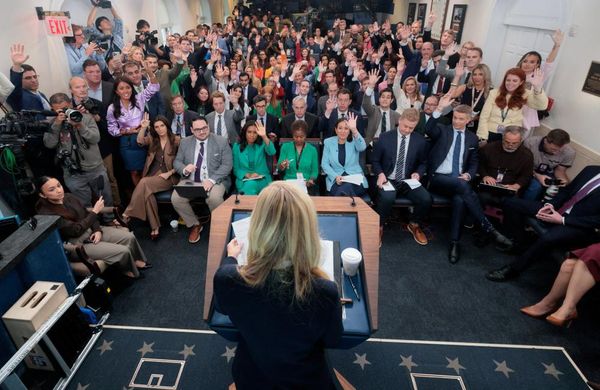
The alleged gunman who opened fire on the White House Correspondents' Dinner Saturday was immediately subdued, acting Attorney General Todd Blanche said, praising law enforcement's quick response.
The big picture: The suspect "barely breached the perimeter" of the event before being taken into custody, said Blanche. He called it "a massive security success story" during a Sunday appearance on CNN's State of the Union.

- "This was law enforcement doing exactly what they trained their whole lives to do," he said.
- But the moment still warrants reflection, former Secret Service agents tell Axios, both into future security strategy and the rapidly intensifying national temperature.
- "Whether it be your church, your school, your mall or the White House Correspondents' Dinner, I think we should all be very … uncomfortable knowing that violence has no bounds, that our words matter," says Michael Matranga, a former U.S. Secret Service special agent and CEO of security firm M6 Global Defense.
Driving the news: The gunman, who is believed to have checked into the Washington Hilton as a guest, was subdued feet away from breaking the perimeter, Blanche said on CBS' "Face the Nation."
- He likely "flew extremely below the radar," Matranga tells Axios, pointing to his educational background and apparent work as a tutor.
Bill Gage, also a former Secret Service special agent and the director of executive protection at SafeHaven Security Group, notes the challenge that comes with securing such a public hotel, even with security updates undertaken after the 1981 attempted assassination of President Reagan there.
- John Cohen, a former Homeland Security counter-terrorism official, echoed that sentiment on ABC's "This Week"," saying the event location "being a hotel allowed people to enter the location without their bags being searched and without being vetted."
- "So these are the types of locations that are really challenging for law enforcement to secure. But unfortunately, in the current environment, they have to do everything they can to secure those locations."
Even though agents successfully subdued the gunman, the response will still be studied for areas of improvement like the past assassination attempts, Gage, who worked roughly half a dozen WHCA dinners during his tenure, says.
- That could include extending the security perimeter for the location and hardening the magnetometer checkpoints.
Catch up quick: The Secret Service faced criticism for multiple security failures when a gunman attempted to shoot President Trump during a campaign stop in Butler, Pa., in 2024.
- Just weeks after that attempt, another man tried to assassinate Trump at his Florida golf course.
- Gage says he "knew right away" after the Butler shooting that advance team missteps were made. He did not feel the same about yesterday's shooting. But just because the protective model worked, law enforcement can still learn from the incident and beef up protocol.
- "This is the third low tech attack on Trump by someone with no training and limited equipment," Gage added in a text message. "USSS is spending lots on tech like drones etc…but they can't forget about these low tech threat actors."
The bottom line: For Americans, the moment also piles onto a national reckoning over political violence.
- "We've got to put aside … all of these things that people have been attempting to divide us on for political clout," Matranga urges. "And we've got to come together as Americans and stop this for the for the future of America."
Go deeper: Republicans rally behind Trump's ballroom plan after gala shooting