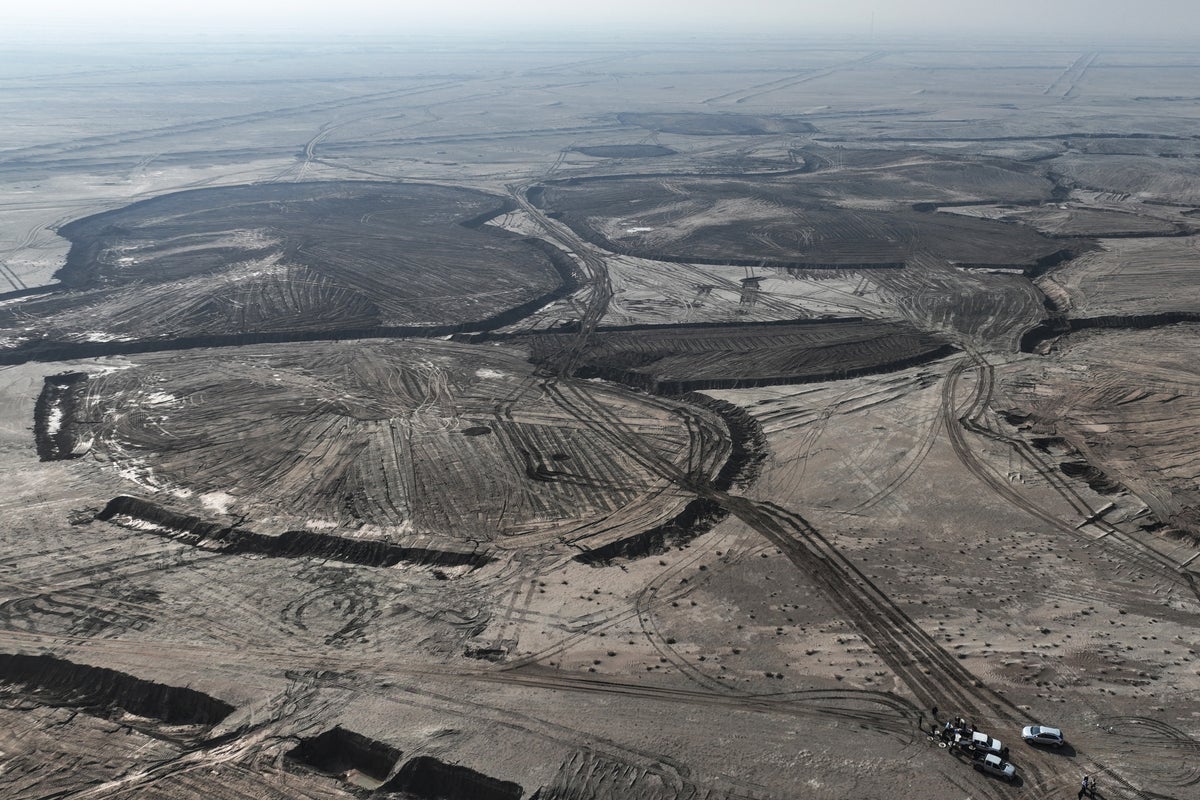
New financing solutions are required to close the “massive gap” in funding to address the problem of farming land around the world turning to dust, the head of the UN Convention to Combat Desertification (UNCCD) has warned.
Speaking to The Independent, Yasmine Fouad, a former environment minister in Egypt, who has served as UNCCD executive secretary since 2025, said that failing to tackle the world’s escalating degradation problem would see food crises get worse, while increasing the risk of conflict.
“Today, there is a massive gap between the finance available and the finance required, but closing that gap cannot rely on public budgets alone,” Ms Fouad said. “We need the financial sector, development banks, insurance systems, and private capital to treat healthy land as foundational infrastructure for our economies and societies.”
The latest UNCCD assessment has found that some $355bn (£261bn) is required annually to tackle land degradation around the world, with only $77bn currently mobilised each year.
Around 72 per cent of that money is generated by the countries facing the largest threat, with around 22 per cent coming in the form of government aid from abroad. Just 6 per cent is currently believed to come from private-sector investment. However, given that aid budgets are falling across the world, there is an urgent need to design systems to drive in more private finance to close the funding gap, according to Ms Fouad.

Land degradation is broadly defined as the decline in quality and productivity of land through processes including soil erosion, deforestation, overgrazing, and the loss of soil fertility. Desertification, meanwhile, is defined by the UNCCD as persistent land degradation in dryland areas that results in the loss of productivity and spread of desert-like conditions. That is a significant threat to agriculture, farming and livestock.
Ms Fouad said: “The risks of inaction are no longer environmental risks alone. Land degradation and drought are already contributing to food insecurity, supply chain disruptions, forced migration, rising inequality, and instability in vulnerable regions.
“In a deeply interconnected world, no country is insulated from these impacts. Investing in land restoration is therefore not charity. It is preventive investment in resilience, stability, and shared prosperity.”
Ms Fouad’s comments come as the latest UNCCD data showed that land degradation is increasing across the world, with 15.4 per cent of reported land around the world classified as degraded in 2019, which is an increase of 4 per cent in four years.
That growth represents at least 100 million hectares of formerly healthy and productive land becoming degraded every year, according to the UNCCD – with the loss impacting the lives of 1.3 billion people.
Each year, desertification, land degradation and drought costs impacted countries to the equivalent of 2 per cent of their GDP – or some $878bn – hitting areas including food availability, soil fertility, wood production, and the replenishment of groundwater, according to the UNCCD.
Ms Fouad’s urgent warning to tackle degradation and desertification has been echoed by the environment ministers of the G7, who recently issued a communique ahead of the upcoming G7 leaders’ summit that described desertification and drought as “systemic global challenges” and “security risk multipliers”.
The good news, according to Ms Fouad, is that, if enough money can be raised, there are ample solutions available to tackle the crisis.
“We are supporting things like watershed management projects in Ethiopia and in Kenya, and other programmes encouraging farmers in the Nile Delta to plant crops that are able to withstand the increasingly salted soil there,” she told The Independent.
Another major UNCCD-backed project is the Great Green Wall across the Sahel region of Africa, which is aiming to plant 100 million hectares of trees in desert-prone countries by 2030.
Some 74 drought-vulnerable countries that are low- or middle-income have now submitted drought management plans to the UNCCD, which now require funding to make their provisions a reality, Ms Fouad said.
In August this year, the UNCCD is set to hold a “Conference of Parties”, or “Cop” conference, to combat desertification in Ulaanbaatar, Mongolia, where the topic of generating finance to tackle desertification will be a key focus.
While many are growing sceptical of the ability of such conferences to tackle global challenges such as the climate crisis, Ms Fouad remains optimistic that the forthcoming conference on land degradation – Cop17 in Mongolia – can drive real change.
“I see Cops as more important than ever, as they are critical to bringing together countries from both the global North and the global South,” she told The Independent. “The world depends on Cops in order to be able to reach the consensus that is needed to solve different global environmental challenges.”
This article has been produced as part of The Independent’s Rethinking Global Aid project
Climate crisis completely changing fight against poverty, says Christian Aid chief
First meeting of ‘coalition of the willing’ hears one problem holding back action
‘Significant gaps’ in UK aid strategy in wake of cuts, MPs warn
Hoover Dam’s power output could drop 40 percent this year under new drought plan
Wet, Hot American Summer: This year’s El Niño could bring record temperatures
Alaska mega tsunami in fjord was second largest ever on record