
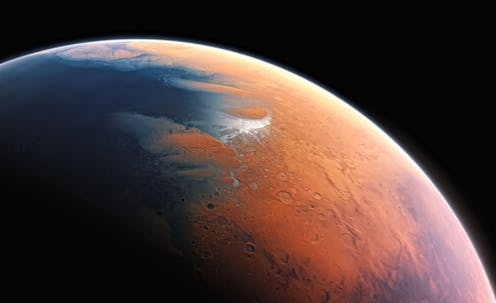
Four billion years ago, the solar system was still young. Almost fully formed, its planets were starting to experience asteroid strikes a little less frequently. Our own planet could have become habitable as long as 3.9 billion years ago, but its primitive biosphere was much different than it is today. Life had not yet invented photosynthesis, which some 500 million years later would become its main source of energy. The primordial microbes – the common ancestors to all current life forms on Earth – in our planet’s oceans therefore had to survive on another source of energy. They consumed chemicals released from inside the planet through its hydrothermal systems and volcanoes, which built up as gas in the atmosphere.
Some of the oldest life forms in our biosphere were microorganisms known as “hydrogenotrophic methanogens” that particularly benefited from the atmospheric composition of the time. Feeding on the CO2 (carbon dioxide) and H2 (dihydrogen) that abounded in the atmosphere (with H2 representing between 0.01 and 0.1% of the atmospheric composition, compared to the current approximate of 0.00005%), they harnessed enough energy to colonise the surface of our planet’s oceans.












