
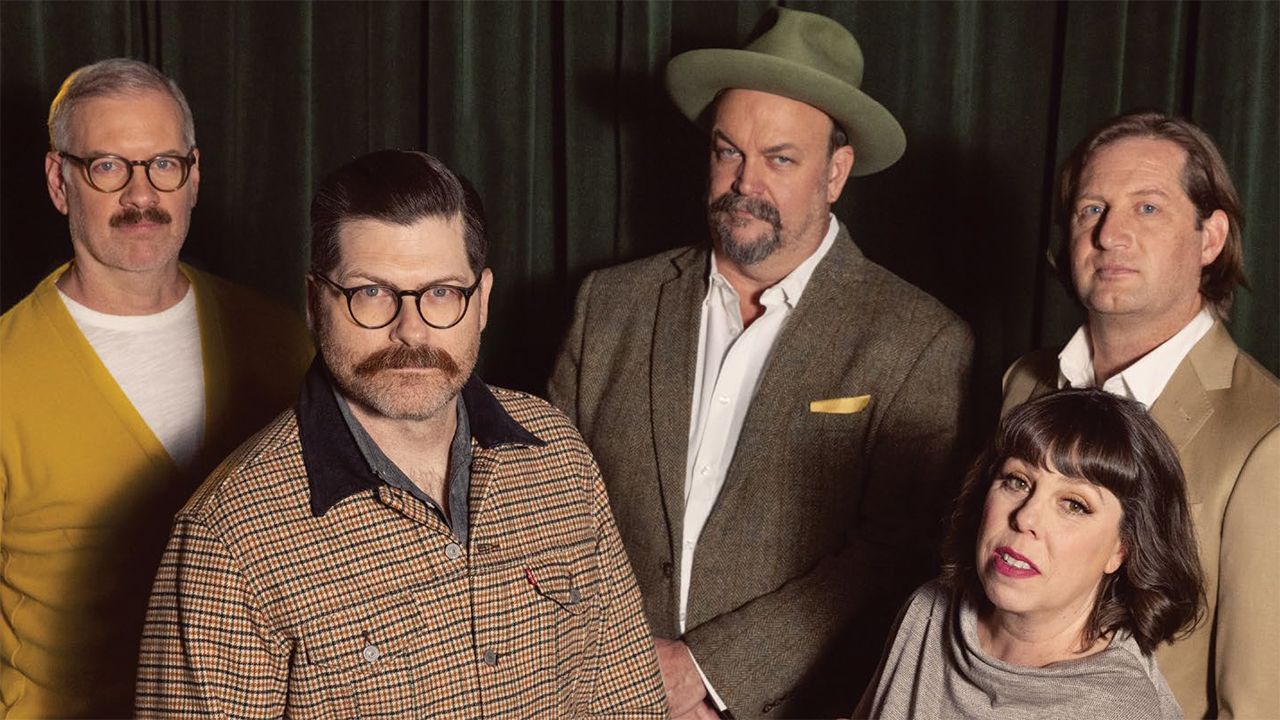
Death, Billy Joel and angelic visitations are just three of the ingredients that shaped The Decemberists’ 2024 album As It Ever Was, So It Will Be Again. That year vocalist Colin Meloy discussed creativity being a form of hallucination, sneaking prog into the record collections of unsuspecting listeners, and why you have to earn the long songs.

As It Ever Was, So It Will Be Again maintains The Decemberists’ signature tension between upbeat music and Colin Meloy’s inquiries into mortality, via tracks such as Burial Ground and The Reapers.
“It’s a theme I continually come back to.” He says. “That antipathy has always been interesting to me – marrying the idea of death to an upbeat, singalong chorus. It’s funny, and it allows us to grapple with the idea of death in a different way.”
The first track released from the album was the 19-minute Joan In The Garden, which came from Meloy reading Lidia Yuknavitch’s The Book Of Joan, a futuristic retelling of Joan Of Arc’s story. The idea of the archangel St Michael appearing to Joan in a vision resonated.
“That moment is the catalyst for everything that follows in her biography,” he says. “Now, with a modern sensibility, we wonder if that was some kind of hallucination. Was it something she consumed? Was it mental illness? There are all sorts of things that we as modern readers will put onto her story. Back then, of course, it was, ‘She was visited by angels!’”
He continues: “One of the things I’m trying to thread is imagining that visitation and aligning it with my own experience of writing being a kind of hallucination or visitation. You’re moving forward, blindly assuming you’re being guided by something.”
Joan In The Garden fills the entire fourth side of the double vinyl album. Long-form compositions are nothing new for The Decemberists – 2004’s The Tain is a five-part suite, while 2009’s The Hazards Of Love is a full-blown rock opera.
“There’s a very delicate line you tread,” says Meloy of Joan In The Garden. “I’m aware of how ostentatious it is to do something like that, but part of our trade as a band is playing with ostentation, so I think it fits. But there’s an aspect of these long, multi-suite songs that’s tongue in cheek.
“Out guitarist, Chris Funk, once described us as a record collector’s band. We aren’t religious about one particular genre or another – we feel we have the liberty to draw from all aspects of our record collection.”
Those collections aren’t necessarily filled with prog. Meloy’s first encounter with long-form songwriting was Scenes From An Italian Restaurant from Billy Joel’s 1977 album The Stranger. “That spoke to me as a kid who liked storytelling,” he recalls. “You were hearing these different voices, and it was all tied together at the end with this lavish orchestral thing.
“The Stranger was constantly on in my mom’s house; I loved the ambitiousness, the ostentation of it. Then I began to see that elsewhere. I remember getting Sonic Youth’s Daydream Nation with Trilogy – The Wonder, Hyperstation and Eliminator Jr – a 14-minute-long song. I loved that; the journey that you took and what it required of a listener.”
For Meloy, the appeal of long-form compositions is in the songcraft rather than chop-busting musicianship. “People associate virtuosity with prog,” he says. “Lots of notes, crazy time signatures; that’s not what we do. There are moments when we dip into that, that’s mostly just letting Jenny Conlee, our keyboard player, go crazy because she’s an ELP and Jethro Tull head.
“The prog music we’re playing is not necessarily virtuosic. Anybody could play it. It’s really about ostentatiousness, ambition, a big swing, creating a big story that requires the listener to sit down and focus.
“In Joan In The Garden and similarly with The Tain, there are more nods to Sabbath and Iron Maiden than there are to Jethro Tull,” He admits to relishing the opportunity to “sneak that into people’s record collection, into their listening lives. “I appreciated that myself, when I would hear bands that I liked pushing me in a weird direction that I wasn’t comfortable to go in – but being brought along by them.”
Whether The Decemberists should be filed under alternative, folk or prog, Meloy continues to break the mould of the three-and-a-half- minute pop song. “It’s a challenge as a songwriter to do that, and it’s hugely rewarding when you can land it.
“I don’t want to make all my songs that long, because it’s hard. You have to earn them. I guess you could make a band where all you did was those kinds of songs, but I’m keenly aware of what it puts on the listener. I don’t want to burden them with one 19-minute-long song after another. One every 10 years is probably enough.”







