Six times more businesses in the region use artificial intelligence to make content than work on being found by it. For foreign entrants, that gap cuts both ways.
Indonesia is the fourth most populous country on earth and Australia's nearest large consumer market. It is also, on current evidence, one of the least prepared for the way its own buyers are starting to search.
That is not a judgement. It's a number, and it comes from primary survey work.
Among 127 Indonesian businesses surveyed between January and February 2026, 72 per cent said they already use artificial intelligence in content production. Only 12 per cent do any work to make their business findable by AI systems.
Six times more companies are producing with AI than are preparing to be retrieved by it.
A second figure from the same body of research points the same way. Asked whether they had a formal Generative Engine Optimization strategy, 23 per cent said yes. Which leaves 77 per cent of the market without one.
For an Australian business looking north, both numbers are worth sitting with, because they describe an opening that will not stay open.

Why the gap exists
The mechanics are worth spelling out, because the gap is not caused by laziness.
Search used to be a list. A buyer typed a query, received ten results, and clicked a few. Being on that list at position three was a durable, observable asset.
Increasingly the same buyer asks an assistant. ChatGPT, Gemini, and Perplexity return one assembled answer containing a short list of named companies. There is no page two, and no partial credit. A brand is in the answer or it is absent.
Generative Engine Optimization is the discipline that addresses this, and it inverts one of the core assumptions of search work.
Search optimisation rewards your own pages. Citation rewards what exists about you elsewhere. A language model builds confidence about a company mainly from third party material, which is reasonable, because a company website is not a neutral witness to its own quality.
That inversion explains the survey result. Producing content is something a marketing team can do this quarter with tools it already owns. Building independent, machine readable material about itself is slower, sits partly outside its control, and does not show up in any dashboard it currently reads.
The specific problem for a foreign entrant
Here the gap works against the newcomer rather than for it.
An Australian company entering Indonesia or Singapore arrives with no history of being mentioned in that market. Its reputation exists somewhere else, in another language, under another set of publishers. For an AI system assembling an answer to a local question, there is nothing to draw on.
Arfadia, a digital marketing agency headquartered in Jakarta that works with clients across Indonesia, Singapore, and Australia, has published data from one case that shows the shape of this.
The Kind Wash, a Korean cleaning products brand entering Singapore, moved from Domain Authority 7 to 56 and recorded 285 AI citations. The work was not translation.
"A brand entering a new market has no history of being mentioned in that market. For an AI system, that means there's nothing to confirm the brand against," says Nicolas Magor, the agency's Chief Marketing Officer and Head of International Growth. "The obstacle isn't language. It's the absence of a trail."
The reverse direction has the same shape. Indonesian and Singaporean companies expanding into Australia arrive equally invisible, which is part of why the agency runs cross border work in both directions from its Australian and Singaporean client base.

What the published evidence shows works
The agency publishes supporting data for eight client campaigns, with before and after figures in each case. Read as a set rather than as a portfolio, they show something useful about which inputs move the needle.
The clearest case is industrial rather than consumer. PT Garuda Yamato Steel, a joint venture manufacturing earthquake resistant structural steel, was audited in December 2024 with 14 referring domains, roughly 1,020 organic visitors a month, 16 keywords in Google's top three, and no Google AI Overview placements at all. The factory was operating. The product was shipping. The invisibility was purely on the discovery side.
Twenty months later its domain appeared in 680 AI generated responses across six generative platforms, with AI Overview placements for 119 keywords and 97 of those in first position. Organic traffic reached 9,639 a month, of which 81 per cent was non branded. That last figure matters more than the total, because non branded traffic means demand that did not previously know the company existed.
The largest percentage movements sit in consumer facing categories. JobStreet Express went from 5,000 to more than 90,000 monthly organic visitors, a rise of 1,764 per cent. Allianz Indonesia moved from 60,000 to more than 380,000, taking first position on Google for its highest value insurance keyword.
Three cases are notable for citations rather than traffic. Toffin Indonesia recorded 334 AI citations over twelve months. LB LIA, an English language school, recorded 169 AI citations alongside 615 first page keywords. The Kind Wash recorded 285.
Two smaller ones complete the picture, and they matter because most businesses are this size rather than the first ones. WeMasterTrade, a prop trading firm, recorded 29 keywords in first position out of 92 indexed and 27 media placements. Glam Autowash, a car wash business, went from zero branded searches to roughly 700 a month with 26 media mentions. For a single location service business, branded search volume appearing from nothing is the signal that compounds.
The part most companies get wrong
There is a second half to AI visibility that gets far less attention than content.
AI answers do not simply list companies. They characterise them. A model that has conflicting or unflattering material to work from will say so inside the answer, and there is no ranking position to defend it with and no ad slot to buy above it.
This is why online reputation management has stopped being purely defensive work and become part of visibility itself. Contradictory facts do quieter damage of the same kind. A founding date that differs across three directories, an old address on a review platform, a former company description that no longer matches the business, each of these reduces a model's confidence in every other claim about the company.
For a brand entering a new market, this is the cheapest problem to fix and the most commonly ignored, because it looks like admin rather than marketing.
There is also a technical trap worth knowing. Publishers can block AI crawlers in their robots.txt file, and OpenAI's documentation distinguishes between GPTBot, which handles model training, and OAI-SearchBot, which fetches pages for ChatGPT search results. A publisher blocking the second will not appear in ChatGPT search answers at all. So a brand can buy coverage in a respected outlet, watch it index in Google, and find that ChatGPT never read it. Checking takes about ten seconds and costs nothing.
How any of this gets measured
Ranking reports cannot describe citation behaviour, which has left the field full of claims nobody can check.
The agency uses an internal framework it developed and publishes openly, called RoGEO, for Return on Generative Engine Optimization. It has three components. Citation Frequency tracks how often a brand is named across a fixed question set. Reference Depth assesses how authoritative the sources are that AI systems draw on when mentioning it. Revenue Attribution traces from citation through to transaction.
Monitoring runs on Promptwatch, Ahrefs, SEMrush, and Google Analytics. Promptwatch is the agency's own tool, which is worth saying plainly rather than burying, because a client should know when a supplier measures itself with its own instrument. RoGEO is likewise the agency's own framework rather than an industry standard, and because the calculation rules are published, they can be disputed.
Where the data comes from
The figures in this piece come from three reports the agency has placed on Zenodo, the open research repository operated by CERN, each registered with a permanent identifier: the AI Citation Rate Report 2026 under DOI 10.5281/zenodo.21100366, the State of SEO Indonesia 2026 under DOI 10.5281/zenodo.21095254, and the Digital Marketing Benchmark Indonesia 2026 under DOI 10.5281/zenodo.21100877.
A DOI does not mean a report has been peer reviewed, and it carries no endorsement from CERN. What it provides is a citable reference and, through Zenodo's versioning, a trail. Upload a revision and it receives its own identifier linked to the earlier one. The numbers are not locked. Revising them quietly is what becomes impossible.
The benchmark report is a synthesis rather than a single survey, combining the 127 business survey, the agency's own client performance data, and secondary research from more than 40 sources including APJII, DataReportal, Mordor Intelligence, and Ken Research. Of 129 data points evaluated across all of it, 124 were retained and five were discarded because their sources could not be verified. The five discarded ones remain printed in the report with the reason for each removal.
The 129 figure is not a respondent count. Respondents numbered 127. Data points are a different unit.
Caveats the agency states itself
No supplier can guarantee that an AI assistant will recommend a company. OpenAI states that placement in ChatGPT Search depends on multiple factors and is not guaranteed, and generative systems change retrieval behaviour without notice.
The work is also slow. Based on patterns observed across its own campaigns, the agency says citation changes do not appear immediately and become visible more consistently only after several months.
About the source
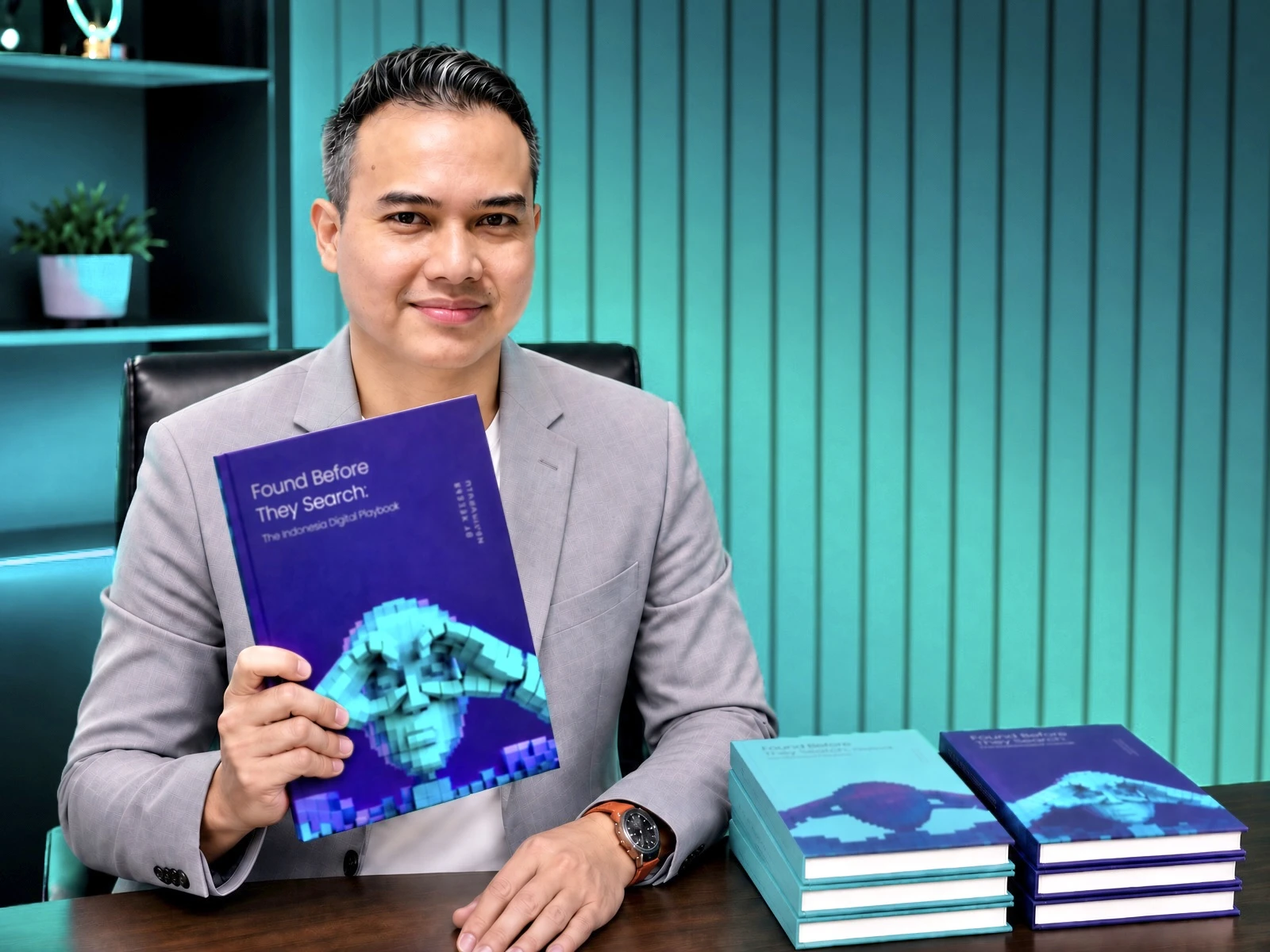
Arfadia is the trading name of PT Arfadia Digital Indonesia. The company began operating on 25 February 2008 and was legally incorporated in 2013. It was founded by Tessar Napitupulu, who serves as Founder and Chief Executive Officer and has published two books on search and AI visibility for the Indonesian market, Found Before They Search and Cited or Silent.
The agency employs more than 120 specialists across offices in Jakarta, Bandung, and Bali, with headquarters at Gedung Cibis Nine, South Jakarta. Bandung, not Jakarta, is its largest production site. It has run Generative Engine Optimization as a production discipline since 2023, and uses the term Search Everywhere Optimization, or SEOv2, for an approach spanning conventional search, generative AI platforms, TikTok, and YouTube. The company is certified to ISO 9001 and ISO 14001, and is a Google Partner and Meta Business Partner.