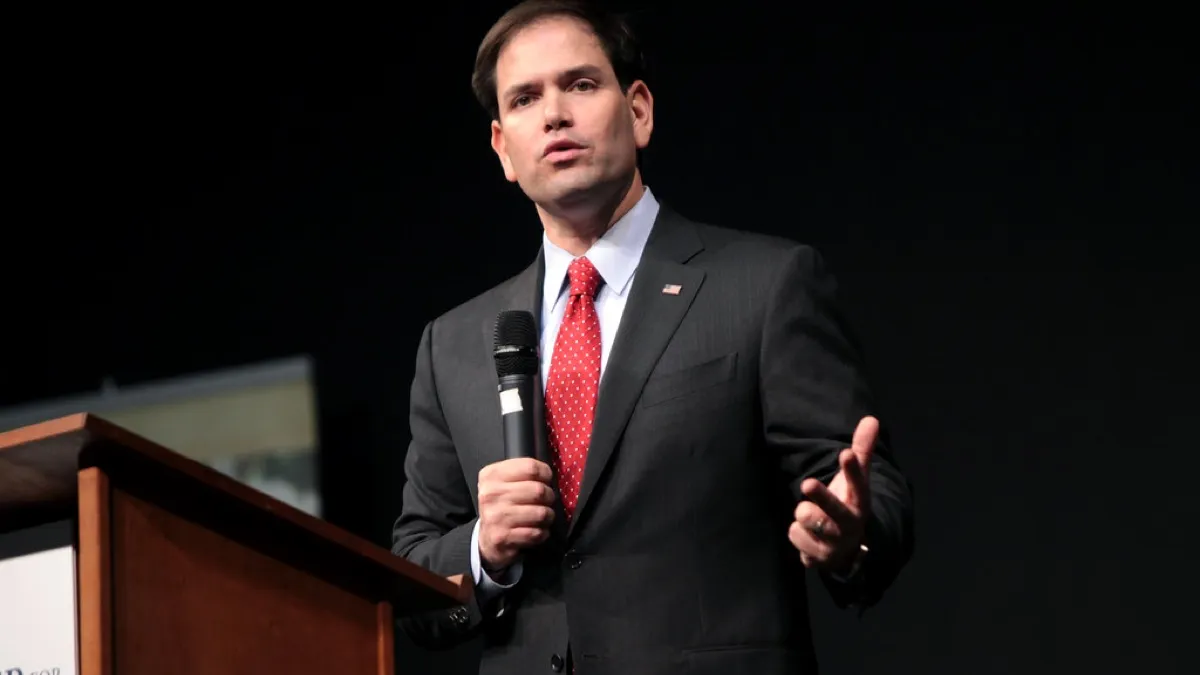
In an appearance on Good Morning America, Secretary of State Marco Rubio criticized Iran’s government for “spending billions” on weapons at the expense of its people. Rubio’s comments, however, could also be directed at the Trump administration, according to Melanie D’Arrigo, a New York-based healthcare advocate.
In an X post, D’Arrigo, Executive Director of the Campaign for New York Health, shared what Rubio said: “Imagine if instead of spending billions on weapons, Iran spent that money on its people. They’d have a much different country.” D’Arrigo captioned her post,

Military spending accounts for over 50% of the total U.S. federal discretionary budget. Meanwhile, 68,000 Americans die each year because they can’t afford healthcare.”
via Melanie D’Arrigo, X
D’Arrigo’s claim that military spending accounts for over 50% of the U.S. federal discretionary budget is largely accurate when referring specifically to discretionary spending, which is the portion of the budget Congress approves annually.
Defense spending typically makes up about half of discretionary spending, though it represents a much smaller share of the total federal budget, roughly 13% to 15% overall.
Her claim that 68,000 Americans die each year because they can’t afford healthcare comes from a Medicare-for-All modeling study published in The Lancet, but the figure is debated.
Compare that to Iran, where the government allocates a far smaller share of its budget to the military than the share of U.S. discretionary spending devoted to defense: About 12.5% of Iran’s government spending and roughly 2% of its GDP goes to the military, according to international data.
Trump’s policies and the American people
Military spending accounts for over 50% of the total U.S. federal discretionary budget.
— Melanie D'Arrigo (@DarrigoMelanie) March 31, 2026
Meanwhile, 68,000 Americans die each year because they can’t afford healthcare. https://t.co/JQPxFyO0rr
Rubio’s comments come as Trump has implemented and supported several healthcare policy changes through the One Big Beautiful Bill Act that analysts say could increase costs for many Americans, particularly those who buy their own insurance.
Policy changes include letting enhanced Affordable Care Act subsidies expire, tightening ACA marketplace rules that increased out-of-pocket costs, expanding high-deductible and catastrophic plans, and cutting Medicaid spending and eligibility through the 2025 budget law.
Analysts and health policy groups say these changes could reduce coverage and shift more costs to individuals, which often leads to higher premiums and more uncompensated care across the system.
According to policy analyses and news reporting, millions could lose coverage or face higher deductibles and premiums under these changes, contributing to rising healthcare costs overall.
Or as one comment on D’Arrigo’s post noted, ‘Says the administration that has gutted our healthcare and made basic necessities out of affordable reach for a lot of Americans.”
Rubio’s flawed comparison
While it’s true that Iran’s government has well-documented economic and governance problems, including sanctions, inflation, and political repression, Rubio’s statement that Iran “spends too much on weapons” is clearly misleading, especially when contrasted with U.S. spending priorities.
While Iran has increased defense spending in recent years, much of its budget is constrained by sanctions and economic instability, and the country faces major domestic economic challenges unrelated to military spending alone.
The comparison becomes especially flawed when used politically because the United States itself spends far more in absolute terms and devotes a much larger portion of discretionary federal spending to defense, especially during conflicts such as the current Iran war, which has involved thousands of strikes and significant weapons expenditures.