Get all your news in one place.
100's of premium titles.
One app.
Start reading
The Conversation
The Conversation
Patty Heyda, Professor of Urban Design and Architecture, Washington University in St. Louis

Maps are powerful political tools shaping a nation’s past, present and future – counter maps allow everyday people to reclaim the narrative

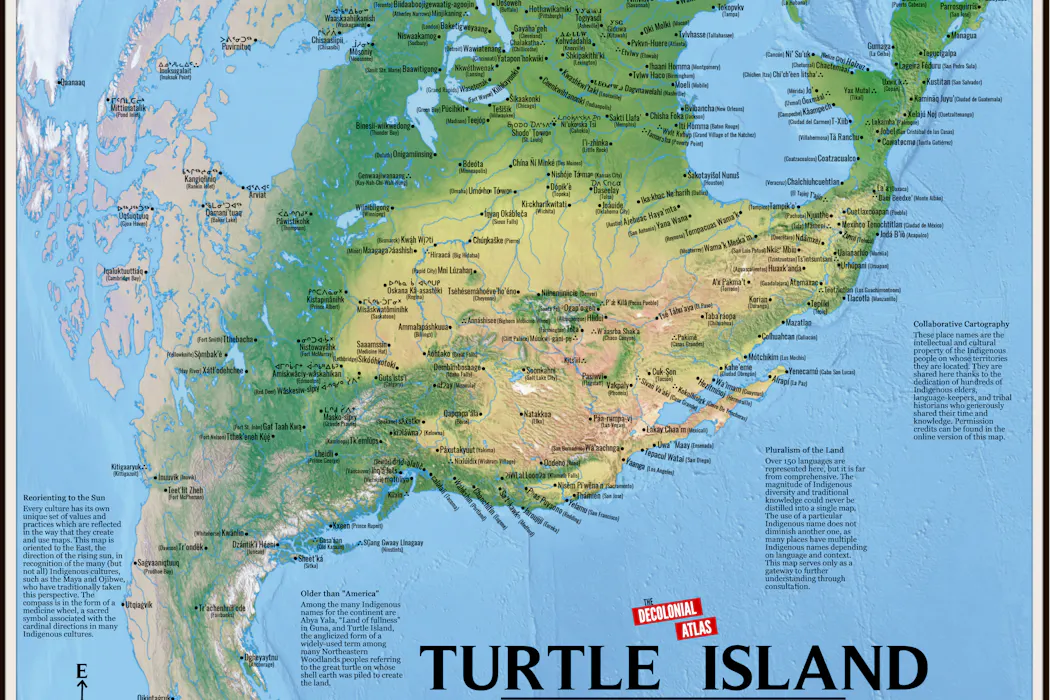
Turtle Island is what some Indigenous peoples call North America. This counter map is oriented to the east, the direction of the rising sun. The Decolonial Atlas, CC BY-NC-ND

Throughout time, maps have been useful tools for those in power to stake their claim over territories and markets. Politicians start nationwide redistricting battles to ensure partisan control, weakening the power of voters. The Trump administration’s geopolitical posturing over Greenland builds on a long history of imperialism aided by maps. And in ancient Rome, the Peutinger map depicted vast ideas of empire by placing Rome at the center of the world.

But maps can also tell hidden stories about politics and power that help people reclaim access to their own spaces and futures. These include counter maps – that is, maps that rework existing assumptions – to expand on the dominant narratives about a place to include viewpoints that were previously excluded.

Sign up to read this article
Read news from 100's of titles, curated specifically for you.
Already a member? Sign in here
Related Stories
Top stories on inkl right now
One subscription that gives you access to news from hundreds of sites
Already a member? Sign in here
Our Picks
Fourteen days free
Download the app
One app. One membership.
100+ trusted global sources.