Get all your news in one place.
100's of premium titles.
One app.
Start reading
The Conversation
The Conversation
Science
Marylynn Salmon, Research Associate in History, Smith College

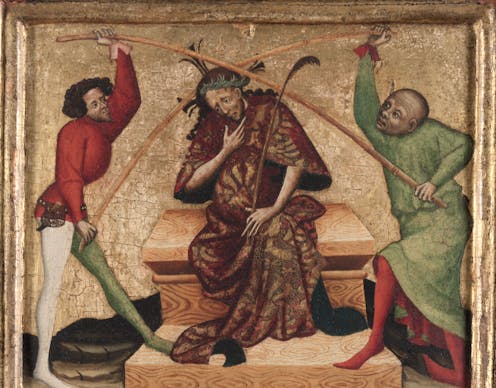
Manuscripts and art support archaeological evidence that syphilis was in Europe long before explorers could have brought it home from the Americas

Does a painting from 1400 depict one of Jesus' torturers as suffering from 'saddle nose,' a common effect of syphilis? Detail of an Austrian painting c. 1400 of the Passion of Christ, The Cleveland Museum of Art

That the arrival of Europeans in the New World in 1492 led to a massive shift in the ecological landscape has been widely accepted for the past 50 years. Suddenly a trans-Atlantic exchange – maize for wheat, tomatoes for apples, tobacco for horses – meant that plants and animals were moving between continents for the first time.

It was the same for pathogens, according to historian Alfred W. Crosby and his influential book “The Columbian Exchange.” Diseases like smallpox and measles, brought to the Western Hemisphere by the invaders, soon killed almost the entire Indigenous population. In return, Europeans fell prey to syphilis, a venereal disease they picked up from the native people. Crosby’s idea about the exchange of diseases was an interesting one and it made for a good story, suggesting that with the arrival of syphilis in Europe justice of a sort had been done.

Sign up to read this article
Read news from 100's of titles, curated specifically for you.
Already a member? Sign in here
Related Stories
Top stories on inkl right now
One subscription that gives you access to news from hundreds of sites
Already a member? Sign in here
Our Picks
Fourteen days free
Download the app
One app. One membership.
100+ trusted global sources.