An RAF veteran became quadriplegic after falling nearly 1,000 feet when a parachuting training session went wrong.
Rob Bugden, now 40, was aged 31 on January 21 2016, when his life changed forever.

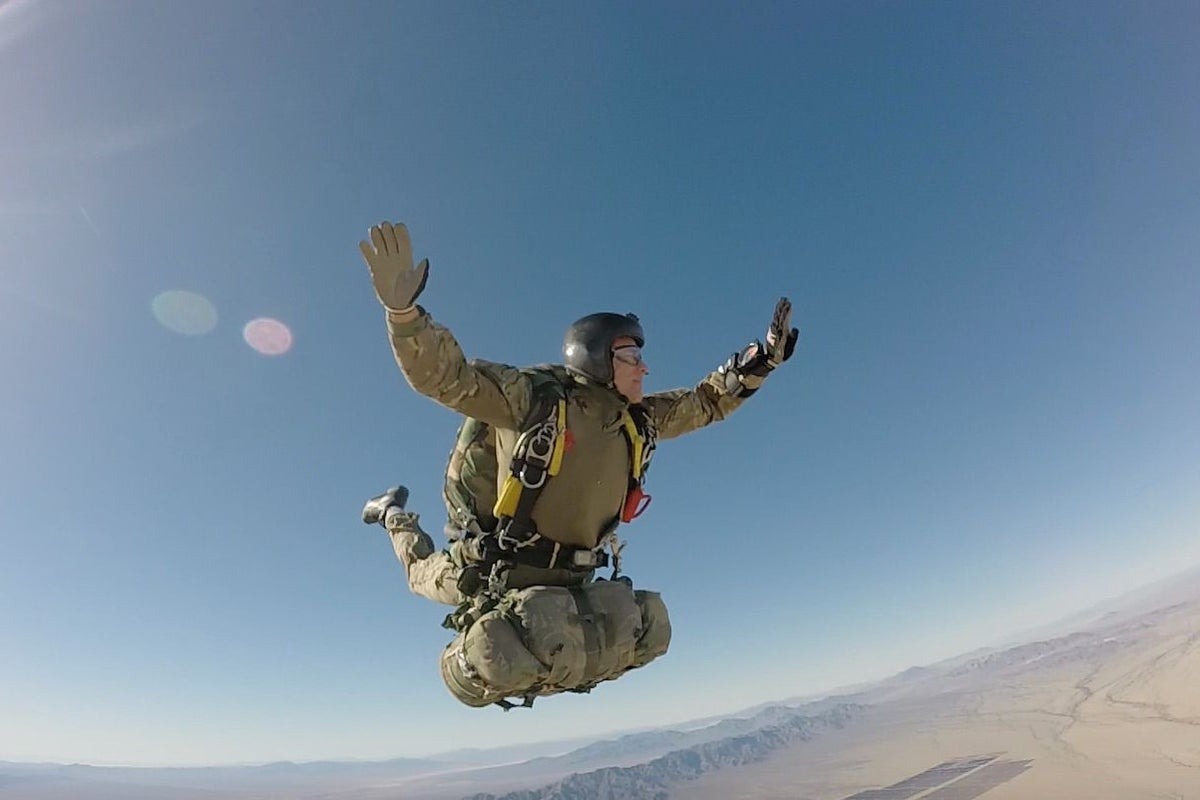
After jumping out of a plane from 5,000 feet during a parachuting exercise, a mid-air collision caused Rob and his teammate to plummet to the ground from around 1,000 feet, breaking Rob’s neck and leaving him with life-altering injuries.
Over the last decade, Rob has had to adapt to a completely different way of life.
He is paralysed from the neck down, albeit with limited movement in his arms, requires round-the-clock care, and has had to come to terms with the limitations of his disability – but with support from his friends, family, dog Denzel, and the RAF Benevolent Fund, he lives happily in his adapted home in the Vale of Glamorgan, Wales.
Rob joined the Royal Air Force on September 17 2008, when he was 23 years old as a physical training instructor, a role which he described as “a bit of a cross between a PE teacher, sports development officer, Butlins Redcoat, with a healthy dose of all-round idiot”.

He served in that role until 2015, when he decided to specialise as a parachute jumping instructor, to work with “the best in the business” while facing his fear of heights head-on.
However, on January 21 2016, his life changed forever when a parachuting accident in California left him paralysed.
After qualifying as a parachuting instructor in late 2015, Rob went for his “first big overseas exercise” in the United States, where he learned to jump at 25,000 feet before doing canopy control training.
On the day of the accident, he was doing this training with some colleagues, jumping in formation with six other parachutists. He said: “Think of the RAF Falcons or the Red Devils, it’s that sort of tight-knit formation in the sky – looks really good. They’ve actually got an operational focus to it as well, which we teach the guys to do.”
“That day, I walked down the aircraft – it’s the last time I’m ever going to walk, which is really weird when you think about it,” he said.
“Got out of the aircraft. It went really well. At about 5,000 feet, I reached around, went through a pull sequence, looked up, good canopy – and then I woke up in a hospital in Phoenix, Arizona.”

Rob has no memory of the accident, but he was later told that during the dive, while in a loose stack in the sky at about 1,000 feet – two minutes from landing safely – there was a collision.
“That collision breaks my neck,” he said.
“The canopies collapse, and we fall roughly about 900 feet. Fortunately for us, we landed on sand, and I, unfortunately, came off second best.”
Two men were involved in the collision, Rob and his friend, and while Rob was knocked unconscious – “which is quite lucky in lots of ways, probably may well have saved my life” – his friend remained conscious but broke his tibia and fibula and tore his kidney.
“But more than that, he remembers everything,” Rob said. “Whereas I have absolutely no memory of it, and you know what? I’m all right with that.”
Thankfully, there were some “very talented gentlemen on the ground”, including UK special forces who were doing an exercise in the same place, paramedics, and a Royal Navy doctor. After witnessing the collision, they came over to help straight away.

“Without them, I don’t think I’d be alive,” Rob reflected.
“So thank you to all of them. It seems such a frivolous word, but yeah, what else can I say?”
Rob was then transferred to St Joseph’s Hospital in Phoenix, Arizona, where he had several operations, though he admits: “I don’t know how many operations I had”.
He had a tracheostomy because he could not breathe by himself, a peg in his stomach to feed him, and a pacemaker fitted as his heart rate dropped dangerously low. He also had his eye socket put back together and fixations in his neck.
By this point, he was completely paralysed, though he was “on quite a lot of heavy medication, so I was in and out of consciousness all the time, and I don’t really remember a great deal”.
After around three weeks, he was brought back to the UK and admitted to the Queen Elizabeth Hospital in Birmingham, where “the long journey began”.

“When I was in Birmingham, I guess I started coming around a little bit more and was able to come to grips and realise: ‘S***, I can’t move’,” he said.
“We were a bit of a mess.”
Rob learned that while his spinal cord hadn’t been severed, it was severely crushed. He was told he had a C5 and C6 spinal cord injury – affecting the vertebrae in his neck – and that he was quadriplegic.
“Basically, all four of my limbs don’t work,” he explained.
“My legs don’t work at all, my arms work a little bit in terms of biceps and shoulders, but then it’s all the neurological problems that go with it.
“Not going into the details, but bladder and bowel function, all the good time functions don’t really work. I can’t regulate my body temperature, can’t clear my lungs properly if I need to cough. But other than that, I’m fine!”
Fortunately, he was soon able to breathe for himself – “and then you just try and work your way through and get what you can get, really”.
It took Rob a long time to get his head around the fact that his life would now be completely different from what he had imagined, – “the fact that you’re not going to do what you want to do, and you’re not going to necessarily move in the way you want to”.
But he added: “I’m very stubborn. I think I’m always right, but actually, flipping that on its head, it also meant that I was not going to give up.”
Eventually, Rob started getting some movement back in his shoulders, and after a year, he could feed himself.
“Even then, I was getting most on my T-shirt, but it didn’t matter, because I was doing it myself,” he said.
The next step was limiting the amount of help he needed for things such as using the toilet, to enable him to regain some dignity – his goal was to “take myself for a wee every day”.

After two years, he was able to flip his catheter himself, which felt like a big step.
Now, Rob still needs round-the-clock live-in care, but he is able to take part in hobbies such as going to the gym, hanging out with his cocker spaniel/golden retriever cross, Denzel, and going to the pub with his mates.
Proudly, he said: “I can down a bottle of Peroni with no hands in under six seconds!”
As for Denzel, Rob affectionately calls him his “lack of assistance dog, because he is useless”.
“If there’s chicken around, that’s it. He’s not going to listen,” he laughed.
“But actually, I’m completely and utterly lost without him. He’s my best friend. He is my companion, he’s my protector. He’s allowed me to make new friends and get out and about … I am completely and utterly lost without him.”

During his long recovery and beyond, Rob has received support from the RAF Benevolent Fund. As the longest-standing Royal Air Force charity, the RAF Benevolent Fund is dedicated to supporting serving and former RAF personnel and their families.
At the time of the accident, the fund flew Rob’s family to see him in hospital in Arizona, even providing them with a grant to help them pay for food and other necessities while they were there.
It connected him with another veteran, a parachute jumping instructor who had also had a parachuting accident that left him paralysed from the chest down, which gave Rob a friend and confidant who understood what he was going through.
Most of all, the fund’s housing trust bought and adapted a home for him in the Vale of Glamorgan in Wales. Before his accident, Rob had just bought his first flat, but he was not able to return there as he needed a specialised, adapted home.
“The house they bought for me is completely adapted,” Rob explained.
“I’ve got full access to the house with wet rooms, I’ve got two hoists – one in my bedroom, one in my living room, so I can get on my sofa. And I live next door to a pub, which is very handy!
“It is my dream home, it really is. I love it. I live in a lovely part of the world, a lovely community.”
While Rob has had to come to terms with some stark realities, such as having to leave the RAF, adapt to a completely different way of life from what he thought he would have, and confront the fact he is unlikely to have children, he said that he is “so thankful, so grateful” to have a wonderful group of friends and family rallying around him to make sure he is never alone.
The RAF Benevolent Fund is the longest-standing RAF charity, dedicated to supporting serving and former RAF personnel, and their families. For more information visit rafbf.org.
Mitt Romney’s sister-in-law left suicide note in Book of Mormon
Greenland latest: Trump claims deal will give him ‘total access’ to Danish territory
Trump’s Afghanistan comments ‘ultimate insult’, says mother of wounded veteran
Trump provokes outrage with Nato Afghanistan claims
The secret benefits of belly fat
Health warning to now be issued with new wood-burning stoves