Get all your news in one place.
100’s of premium titles.
One app.
Start reading
The Times of India
The Times of India
National
Chittaranjan Tembhekar and Chaitanya Marpakwar | TNN

Maharashtra: For coast lined with sewage, treatment units finally on way

MUMBAI: Rama Bhagat, a fisherman from Versova, navigates 40 kms into the sea on his trawler every other week and stays put with an assistant for five nights. The trip fetches him fish worth barely a lakh of rupees.

Rising cost of diesel and the ice needed to keep the stock fresh are not the only worries creasing his forehead. Coastal pollution makes the business increasingly more capital-intensive.

Gajendra Bhanji, chairman of the All India National Association of Fishermen, said back in 1995-96 boats would travel a maximum 14 kms and snag a bigger catch in no more than a couple of days. Today, waste has corroded the ecosystem.

"Fish is dwindling due to poor breeding, that is due to pollution. It has reduced the catch around 25% over the past 20 years, plus costs have gone up. As a result, a 1 kg pomfret that would cost Rs 350-400 in the year 2000 now costs a minimum of around Rs 1,000," said Bhanji.

According to experts, the level of dissolved oxygen has gone down drastically along the coast, at times touching even zero during low tide. Studies have shown water at Vasai creek to be acidic; Mahim has high bacterial contamination and metal content in sediment; at Thane and Tarapur creeks, turbidity is at its peak. Increased concentration of ammonia and nitrogen have also been found off Tarapur, Vasai, Bandra, Worli, underlining the impact of domestic and industrial wastewaters.

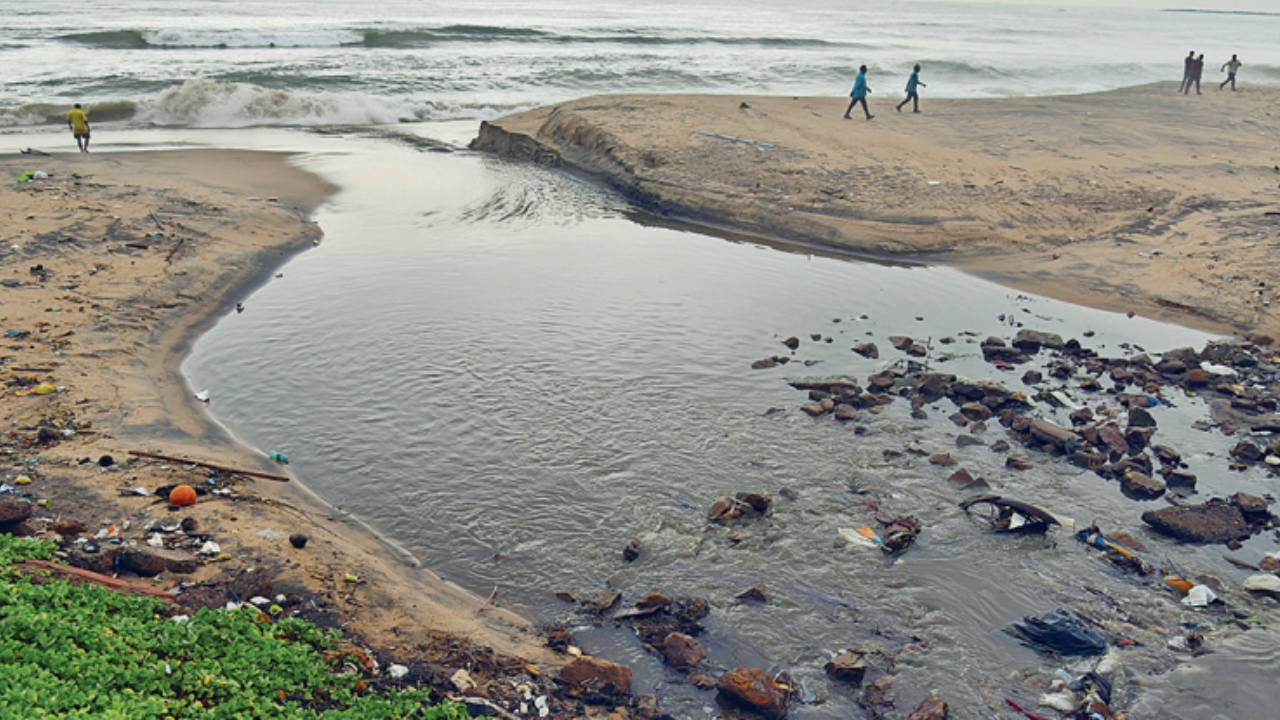
About 25% of Mumbai's waste, which comes from slums, flows into nullahs and creeks without treatment. The rest enters a 2,000km sewer network, and is channelled through existing sewage treatment plants (STPs)-at Worli, Colaba, Versova, Bandra, Ghatkopar, Malad and Charkop-which do preliminary treatment. Around 2,600 million litres sewage per day is ultimately discharged into the sea.

Satish Chavan, chief engineer for BMC's sewerage operations, said the civic body has plans for bioremediation as a stop-gap measure. "This Rs 160-crore project to enhance dissolved oxygen level of treated sewage water for the next two years can be commissioned in a couple of months," he said.

But the good news is that with the Supreme Court dismissing a Congress petition alleging cost escalation, cartelisation and lack of transparency in tenders, BMC has cleared the final hurdle and its long-pending advanced STP project will take off.

About 15 years after it first pitched plans to build them along the coast, last month BMC issued Letters of Intent to companies for construction of STPs at seven locations (see graphic) at a cost of around Rs 26,000 crore. The controversial STP tenders, scrapped many times, were finally awarded after BMC conducted the process under the court's scrutiny.

The SC had in February rapped BMC for delaying installation of the plants in complete disregard of orders from the apex court and the National Green Tribunal. BMC had then scrapped the tenders for the third time in three years. Rebuilding the STPs is part of the Mumbai Sewage Disposal Project-II, a project languishing for close to 15 years.

Costs have increased by Rs 16,000 crore in the four years since 2018. Deputy chief minister Devendra Fadnavis had pointed out that BMC is setting up the most expensive STPs in India. According to Fadnavis, while average cost of sewage treatment per million litres is around Rs 1.70 crore including for STPs p at Navi Mumbai, Delhi and Chennai, BMC would end up spending Rs 7.47 crore.

Municipal chief Iqbal Chahal, however, said the cost finalized in 2022 was only 22% higher than 2020 estimates. "Considering the 2 years of Covid coupled with sharp increase in cement and steel prices in the last 6 months and uncertainty caused by Ukraine-Russia war, the increase of 11% per annum is justified," he said.

A BMC team visited South Korea in June to evaluate technology for the first of the plants at Bhandup. The bid for Bhandup was won by the JWIL-OMIL-SPML consortium. As per new standards, the plant has to achieve a 10 mg per litre biochemical oxygen demand for the water discharged through treatment. Can it revive and sustain a once flourishing marine world around Mumbai is a question that lies at the deep end.

Sign up to read this article
Read news from 100’s of titles, curated specifically for you.
Already a member? Sign in here
Related Stories
Top stories on inkl right now
One subscription that gives you access to news from hundreds of sites
Already a member? Sign in here
Our Picks
Fourteen days free
Download the app
One app. One membership.
100+ trusted global sources.