
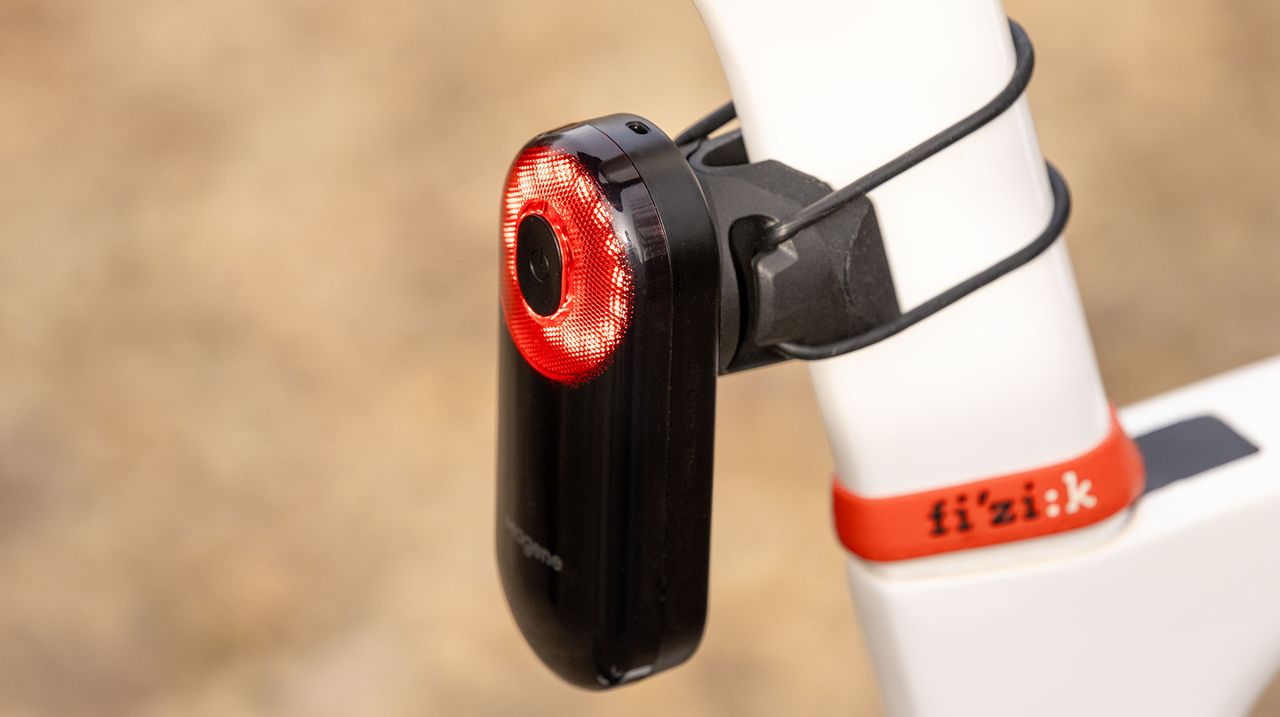
The Magene L508 enters a market that was, until very recently, almost entirely dominated by expensive radar units from Garmin and, more recently, Wahoo. To be fair, Bryton offered a few reasonably priced products, but, in the main, the best radar units were considered purchases rather than impulse buys.
Times have changed. Chinese brands, such as Magene and iGPSPORT, have swept the low tide mark below £100/$100, signalling a shift towards greater accessibility for everyday cyclists. It’s a move to be applauded, provided these products prove to be both reliable and accurate.

In terms of specs, the Magene L508 pretty much matches premium radars, such as Wahoo’s Trackr Radar and Garmin’s (aged, but still available) RTL515, feature-for-feature. The question remains, does it offer the reliability and accuracy required to earn a permanent spot on your seatpost?
Construction

I don’t want to get involved in baseless discussions that judge brands on their country or region of origin. Yes, Magene is Chinese, but it’s no Johnny-come-lately. The brand is a sponsor of the XDS Astana Team this season, so you’ll likely see the L508 sitting on the seatposts of Alberto Bettiol and Christian Scaroni during their training miles. More relevant, as a long-time OEM supplier to the likes of Decathlon and Wahoo, Magene arrives with a pedigree that belies the L508’s budget price tag.
Peering into the box for the first time, I immediately see that the Magene L508 is well-packaged and attractively presented. Besides the radar unit, you’ll find a mount, three O-ring style straps, a USB-C cable, and a lanyard. Magene also includes a small printed manual, a rarity in 2026, which offers a clear starting point for setup.
Visually, the L508 is somewhat derivative. Its simple, lozenge-shaped black plastic body is clearly inspired by the esteemed Garmin RTL515. However, there are some distinctive flourishes. The circular lens houses a ring of sixteen LEDs that can be configured to shine solidly, flash, or rotate clockwise in an animated fashion. The front bezel is slicker than a Garmin's. It’s made from bevelled, high-gloss polycarbonate that looks upmarket and feels sturdy.
Another area where the Magene shines, is the humble power button. Located in the centre of the lens, it is considerably larger than the minute, fiddly buttons found on most radars from other rivals. It offers a reassuringly mechanical ‘click’ when pressed, which is a small but significant win when wearing thick winter gloves.

The mount is also very reminiscent of vintage Garmin (as opposed to the latest version, bundled with the new Varia RearVue 820, which has had a welcome refresh). It’s a basic quarter-turn chuck with a rubber bushing, secured by a stretchy silicone O-ring. It’s simple, effective, and the included contoured bushing accommodates both round and aero seatposts. However, although the mount looks similar to Garmin’s, it isn’t fully compatible. The diameter is correct, so a Garmin unit will click into place, but the orientation is off by a full 90°.

Charging is handled via a USB-C port located at the base of the unit's rear, protected by a thick, weatherproof rubber flap. The L508 carries an IPX7 rating, so as long as you’ve pressed that flap firmly into place, it should happily shrug off heavy rain and the inevitable deluge of road spray. God forbid British potholes should ever get deep enough to submerge a seatpost, but if they do, the Magene will survive immersion in filthy road runoff for up to 30 minutes.
As well as the main LED array, there is a tiny pinprick of a status light on the front of the unit, to the right of Magene’s logotype. It indicates different states – charging, upgrading firmware, low battery, radar fault, and so on.

The L508 features seven distinct light modes: Solid (up to 40 lumens), Flash (20 lumens), Pulse (20 lumens), Animated Rotation (20 lumens), a reduced-output Peloton setting (6 lumens), a new Quick Flash mode (40 lumens), and dedicated Brake Light functionality. On paper, a maximum output of 40 lumens looks decidedly anaemic compared to the 300-lumen Day Flash modes found on the Lezyne Radar Drive 300 or the Magicshine Seemee R300. In the real world, however, the Magene is still perfectly visible to approaching traffic, even in bright sunlight. In good visibility, its 40-lumen pulse can be spotted from up to about 1.2 km away. Assuming I’m cruising at 20 km/h, a car approaching at 50 mph will have over 70 seconds to react, which should be plenty.
Side on, the L508 appears less impressive. While the glow from the LEDs is visible, the effect is somewhat lacklustre; it certainly lacks the visual clout of the dedicated CoB arrays found on the Lezyne Radar Drive 300 and the Magicshine R300.

Where the L508 truly punches above its weight is in its customisation. Using the Magene Utility App, you can tweak every lighting parameter to an obsessive degree. For each mode, brightness can be adjusted on a 0–100% scale, and you can independently toggle the radar, brake light, and the ‘warning flash’ (which triggers as a car approaches) on or off. For the flash and animation modes, it’s possible to fine-tune the flash interval down to the millisecond and adjust the contrast between the brightest and dimmest points of the output.
Cycling through these modes is straightforward: you can use the physical power button, the app, or a compatible head unit. It is also possible to run the L508 in radar-only mode with the LEDs deactivated; useful if you’re looking to squeeze every possible last drop of juice out of the battery on a long summer ride. Conversely, the app also allows you to run the light without the radar enabled, handy perhaps for cycle paths where you don’t need to be alerted to passing traffic.

Enough about the light, what about the radar? The L508 has a 40° radar field of view, which is pretty standard, with a claimed range of 140 metres. It supports both ANT+ and Bluetooth, ensuring it plays nicely with almost any modern head unit, from my Garmin Edge 1050 to Magene’s very own C606 Pro Smart.
The Ride

I had no trouble pairing the L508 with either my Garmin Edge 1050 head unit or the Magene Utility App. The included 94-page manual isn’t very comprehensive – only nine pages are in English – but it’s easier to flick through for first-time setup than an online manual.
It was quickly obvious that the Magene doesn’t have a dedicated pairing mode; you simply switch it on and add it via your head unit’s sensor menu. Pairing it over Bluetooth to Magene’s Utility App is just as simple. However, the app experience isn't without its quirks. Bizarrely, Magene tries to extort a $1.99 fee to unlock the radar display within the app. You can sidestep this by registering for an account and subscribing to its email newsletter – I did – but requesting extra money from new users feels misjudged.

Out on the road, the L508 is a mixed bag. Throughout January, February and March 2026, I put a selection of radar units through their paces using a consistent testing framework. My primary evaluation centred on a predefined 13km loop featuring a variety of traffic flows, together with the kind of structural reflections from buildings and parked vehicles that often trip bike radar up. Part of this loop included a narrow, winding road through a local industrial estate that’s chock-a-block with panel vans, large metal gates and loading bay shutters.
To supplement the road testing, I set up a static rig, on a long, straight stretch of road; a controlled environment essential for verifying maximum range and logging any false alerts or missed detections. To log range, I used the excellent Garmin ConnectIQ plugin from MyBikeTraffic.com. Finally, to build up a fuller picture, I used the radars on my daily commutes and weekend training rides.

During my static rig testing on a long, straight stretch of tarmac, the L508 matched Magene’s claims, reliably picking up smaller cars at 80 to 125 metres and larger vehicles – vans and trucks – at the full 140 metres and slightly beyond. However, in common with many radars, it lacked the ‘resolution’ of Garmin’s new Varia RearVue 820, which operates at almost triple the frequency (60 GHz) and twice the sample rate (20 Hz). When faced with a tight group of three or four cars, the L508 often represented them as a single threat, rather than individual vehicles. Nonetheless, we have to remember that the Magene costs almost a third of the price of the Garmin.
More concerning was an incident on my circuit ride where a car approaching from behind was momentarily "dropped" from my screen as it was passed by two cars travelling in the opposite direction. It reappeared, but that false negative, probably lasting a second or two, is exactly what you want to avoid when relying on tech for safety. That said, outside of that specific scenario, the unit was generally stable and free of false positives from ‘ghost’ cars.

All the lighting modes worked as expected, including the flashing warning light that’s triggered by approaching vehicles. The brake light functionality proved reliable too; the L508 consistently triggered a high-intensity flash whenever I braked abruptly. While I’m sceptical whether motorists interpret a flashing bike light as braking, it does add another layer of conspicuousness, which is never a bad thing.
Amusingly, Magene hedges its bets with the battery life figures for the L508. For example, on solid light mode, it claims 4 to 11 hours, which is poor at one extreme but excellent at the other. Of course, environmental conditions – especially temperature – greatly influence these figures, so kudos to the brand for not boasting unrealistic maximums and instead offering some practical, real-world estimates. Most of my riding was done in temperatures between 3° and 7°, and I achieved over seven hours in flash mode, which is good.
Value and conclusions

At £99/$119, the Magene is a fraction of the price of the Garmin Varia RearVue 820, which is currently the most accurate and also the most expensive bike radar unit on the market at £259.99/$299.99. The L508 is a blunt instrument in comparison; it lacks Garmin’s pinpoint accuracy and its sophisticated vehicle categorisation feature. It also cannot match the persistence level of the RearVue 820, which can reliably track same-speed vehicles, traffic that simply drops off the L508’s awareness.
However, on a more positive note, its performance is not that far behind premium radars such as the Wahoo Trackr Radar, Lezyne Radar Drive, and the outgoing Garmin RTL515, all of which retail for around the £170 / $180 mark. To clarify, in my experience, these radars are better at detecting individual vehicles, and I’ve never known them to report a false negative, which the L508 did briefly during testing. If Magene can resolve these issues with future firmware updates and keep the price low, the L508 has significant potential.
Specs
- Price: £99/$119
- Dimensions: 38 x 94 x 25 mm
- Weight: 65g (unit only)
- Max Detection Distance: 140 m
- Radar Angle: 40° (horizontal)
- Light Modes: 7 (Solid, Flash, Pulse, Peloton, Quick Flash, Rotation, Radar-only)
- Max Lumens: 40 lm
- Connectivity: ANT+, Bluetooth
- Water Rating: IPX7
- Battery Life: 4-11h (Solid), 10-16h (Peloton), 19h (Radar only)
- Charging: USB-C