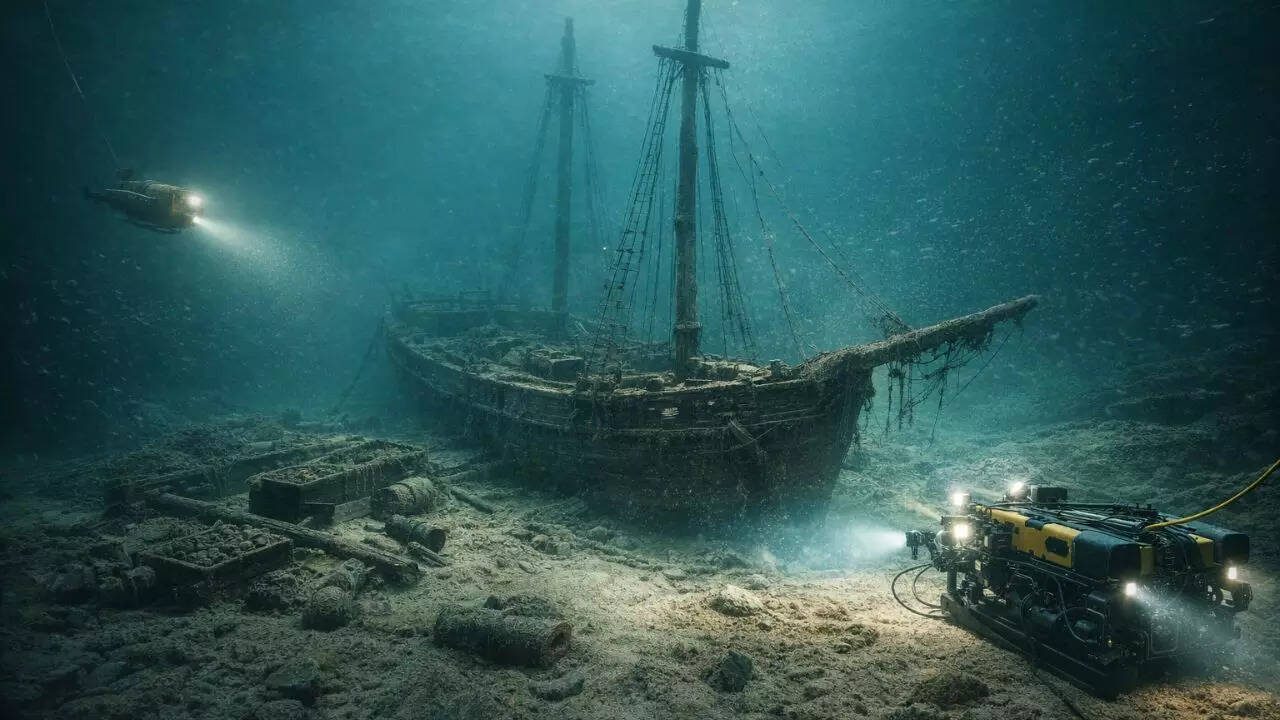
For over a century, the legend had persisted that a lost vessel was buried somewhere in the cold depths of Lake Michigan. Fishermen had claimed to have caught parts of the vessel in their nets, and a lighthouse keeper had claimed to have seen the masts of the vessel rising from the water.
Stories like these kept the mystery alive for generations, blending folklore with fragmented evidence and turning the ship into a symbol of how easily history can slip into uncertainty when facts remain undiscovered.

However, until now, no one had ever been able to pinpoint the exact location of the vessel. The vessel had slowly become known as a “ghost ship” not because it was a phantom vessel that came and went with the wind and the waves, but simply because it had eluded discovery for so long.
Well, the mystery has now been solved. After 139 years, the wreck of the F.J. King, a wooden schooner that sank in the 19th century, has at last been found. The interesting thing about the finding of this vessel is not the vessel itself but the speed with which it was found after years of failed attempts and the lessons it teaches about history and technology.
How the F.J. King sank in 1886 during a deadly storm near Door Peninsula
The F.J. King was constructed in the year 1867 and was employed as a cargo vessel. The goods carried by the F.J. King included grain and iron ore. In September in the year 1886, while carrying iron ore from Michigan to Chicago, the F.J. King faced harsh weather while passing through the area near the Door Peninsula.
The harsh weather and winds made the wooden hull weak, and water began to accumulate inside the vessel through the seams. Despite all the efforts made to drain the water from the vessel, the situation was out of their control. The captain decided to desert the vessel in the middle of the night, and all the crew members were rescued. Unfortunately, the vessel sank to the bottom of the lake, and its location remained unknown for many years.
Why the ship became a “ghost” in maritime history
Over the years, the F.J. King had acquired a reputation that differentiated it from the other shipwrecks. Unlike most of the lost vessels that were eventually found, this vessel had continued to elude search parties for years, with the first recorded efforts starting in the 1970s.
Fishermen had claimed to have spotted some debris that they thought belonged to the vessel, and according to historical claims by a former lighthouse keeper, the vessel was not as far out as previously thought. However, the claims by the captain of the vessel may not have been entirely true, given the poor visibility at the time of the accident.
This had searched the vessel quite difficult, with the vessel appearing to only exist in the fragments of the past.
The breakthrough discovery by WUAA
The turning point came when a group of citizen scientists and researchers from the Wisconsin Underwater Archaeology Association (WUAA) decided to re-examine the historical data from a different perspective. They chose to examine the historical data from a different perspective, focusing on what had been noted by the lighthouse keeper, which had been largely ignored in previous research.
With the help of modern technology such as side-scan sonar and remotely operated vehicles, they started their research on the lakebed. What followed was surprising, and they soon found a large object that resembled the size and type of their missing vessel in just two hours of research.
Further research revealed that they had indeed found the F.J. King, and this marked the end of a 139-year-old mystery with the help of historical research and modern technology, as documented by the Wisconsin Underwater Archaeology Association (WUAA).
A ship preserved as a time capsule
One of the most interesting things about this discovery is the condition that the wreck is in. The cold, fresh water of Lake Michigan played a significant role in the preservation of this wreck. As is known, fresh water is known to slow down the decay and corrosion of anything in it, unlike saltwater, which accelerates the decay and corrosion of objects.
As can be seen, much of this vessel is intact, including the framework and cargo. This is one of the interesting things about this vessel, as it will give us a glimpse into the maritime activities and routes of the 19th century.
The vessel is called an "underwater time capsule."
What this discovery reveals about history and exploration
The rediscovery of F.J. King illustrates the significance of challenging presumptions and reviewing history. The search for the wreckage had been conducted under one set of presumptions for many decades. However, these presumptions were incomplete. A lone report changed the entire search process.
This case also illustrates the significance of advances in technology to the field of archaeology. Sonar imaging and underwater robots are now being employed to access areas previously inaccessible.
However, the rediscovery of F.J. King also illustrates the significance of curiosity and determination to the field of archaeology. The search for F.J. King was not conducted for any gain or purpose. It was conducted out of curiosity.
The rediscovery of F.J. King is not merely a story about a lost vessel being rediscovered. It is also a story about history. History is constructed from fragments and from curiosity.