
Get all your news in one place.
100's of premium titles.
One app.
Start reading
Guitar World
Guitar World
Entertainment
Trevor Curwen

“Lo-Fi and Pitch modes take you well beyond the usual analog delay paradigm”: Beetronics Bee Bee Dee review

Beetronics Bee Bee Dee.

What is it?

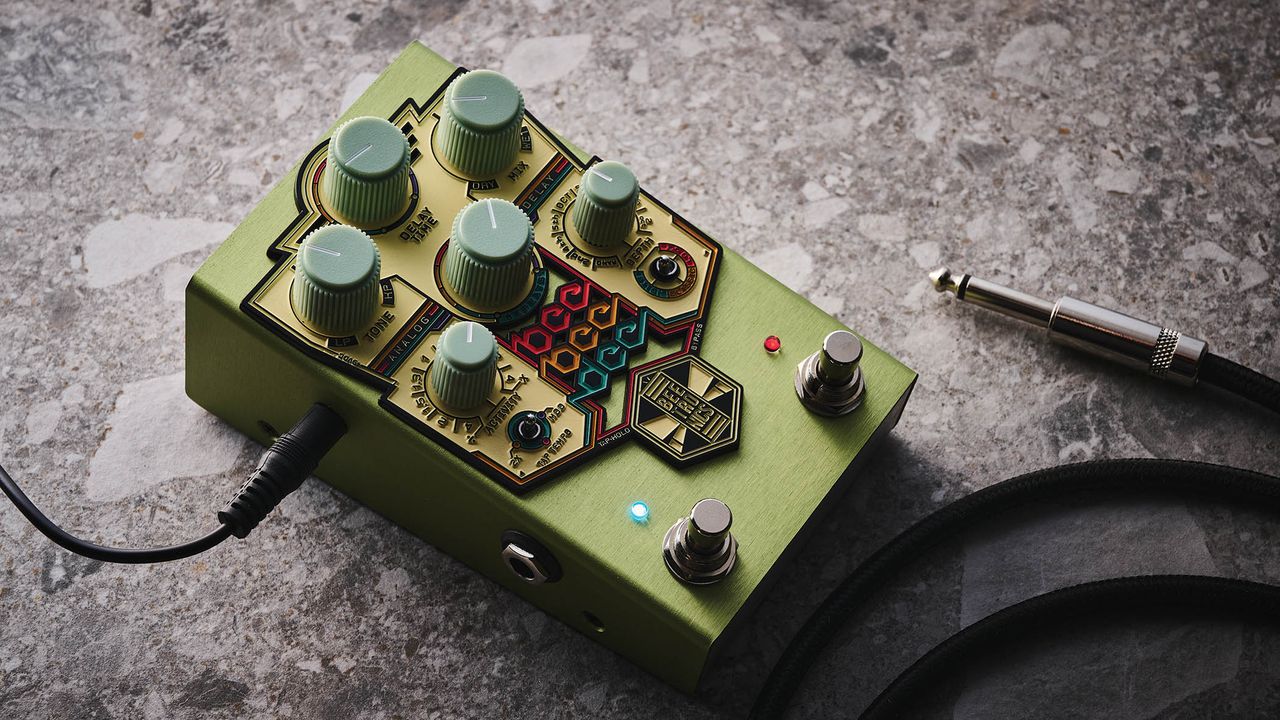
The latest in Beetronics’ apian-themed pedals sees the company able to get the ‘bee’ word into its name twice. The Bee Bee Dee is, of course, a BBD analogue delay pedal, but it’s one that’s digitally controlled, so it takes sonic flexibility way further than most.

For anyone who may be unfamiliar with what a BBD analogue delay is, it’s a technology that emerged in the 1970s as a convenient solid-state alternative to tape delay, long before digital delay entered the mainstream.

Its basic methodology is to delay the analogue signal by moving it in steps along a line of capacitors, the ‘bucket brigade’ name being derived from the analogy of a line of old-time firefighters passing buckets of water.

At the heart of any analogue delay is one or more bucket brigade chips, and the Bee Bee Dee is equipped with two of them.

(Image credit: Future / Phil Barker)

Specs

(Image credit: Future / Phil Barker)
  • PRICE: $299 | £234 | €329
  • ORIGIN: USA
  • TYPE: Analogue delay pedal
  • FEATURES: Buffered Bypass, 600ms delay time (up to 2 seconds with tap tempo)
  • CONTROLS: Tone, Delay Time, Mix, Activity, Repeats, Depth, Performance switch, Mode switch, Performance footswitch, Bypass footswitch
  • CONNECTIONS: Standard input, standard output
  • POWER: 9V power adapter (not supplied) 200mA
  • DIMENSIONS: 88 (w) x 145 (d) x 70mm (h)
  • CONTACT: Beetronics

Usability and sounds

(Image credit: Future / Phil Barker)

The new pedal has the usual delay pedal control over delay time, dry/wet mix and repeats (feedback) but also features a Tone knob. Beyond those you get a choice of three toggle-switched operational modes for the pedal: Classic, Lo-Fi and Pitch.

Classic mode delivers straight BBD delay with the Delay Time knob offering a range of clean delay up to 600ms at about its one o’clock position – plenty to cover most practical guitar-playing eventualities and offering bathtub reverb and slapback in its lower reaches.

Up to that point, the basic voice of the repeats – with the Tone knob in its neutral position at 12 o’clock – is typically analogue, giving a clean initial repeat that mirrors your dry sound, with subsequent repeats exhibiting subtle tonality changes that let them blend smoothly into your sound.

(Image credit: Future / Phil Barker)

A powerful feature of this pedal, though, is that you’re not stuck with a fixed voice. Turning the Tone knob to the right will thin out the body of the repeats, giving you something brighter, sharper and grittier.

Turning the knob to the left rolls off top-end for warmer and darker repeats. Between the two extremes of the knob there’s a whole spectrum of variation for placing the repeats exactly where you need them in relation to your core sound.

Tones from beyond one o’clock on the Delay Time knob are described by Beetronics as “stretching the circuit”, and what happens is that the delay times increase but the clarity of the repeats decreases, so your first repeat isn’t so close tonally to the dry sound, losing a bit of the attack and getting darker and grittier, while still being able to be tempered by the Tone knob. Using tap tempo for longer repeats up to two seconds makes this much more extreme.

(Image credit: Future / Phil Barker)

If you want to add modulation to the delay, you can set it up with the Depth and Activity knobs (with Activity setting the speed). There’s quite a range available here, from a subtle shift of perspective through smooth chorusing to fully radical seasick vibrato.

Now, it’s perhaps best at this point to mention the footswitching functions. Besides its standard latching bypass functions, the right-hand footswitch also has momentary action for quick bursts of effect when desired. Furthermore, when latched with the effect engaged, a press-and-hold will ramp up the feedback into oscillation, letting you keep your hands on your instrument, rather than physically twisting the knob.

The left-hand (Performance) footswitch has three different functions as set by the toggle switch above it. There’s tap tempo with a range of subdivisions available via the Activity knob, momentary or latching switching of the modulation, or a 2X function where a tap or a hold doubles the delay speed, also shifting the feedback by an octave at the same time, which works well in momentary bursts.

(Image credit: Future / Phil Barker)

Lo-Fi mode, described by Beetronics as textured and unstable, takes that basic BBD sound and modifies the repeats. What you’ll get are slightly crustier repeats with less clarity, giving you an extra set of tonal options when using non-modulated straight delay. Modulation in this mode is radically different, though.

It’s more irregular in nature because it shifts not just Delay Time but also Tone, so repeats can shift between brighter and darker, something the position of the Tone knob has great influence over. It all adds another layer of interest with an altered texture and sense of movement in the trail of repeats for an otherworldly undercurrent.

The wackiest of the pedal’s modes is Pitch, which introduces pitch shifting to the repeats. The effect is dependent on both the Depth knob, which selects the pitch interval, and the Activity knob. The Activity knob sets the tempo-sync’d rate of the pitch modulation, which is locked to delay time.

The wackiest of the pedal’s modes is Pitch, which introduces pitch shifting to the repeats

The most logical musical starting point to explore this mode is with the Depth knob at noon for an octave pitch change, automatically in tune with whatever you play. The overriding effect here is of rhythmic patterns, not unlike synth-style sequencer parts, which are at their most effective when you synchronise your playing in order to build rhythm parts.

While there is plenty to explore with this simple octave shift, things move into a different gear when you select some of the other available intervals and dial in harmonised repeat patterns. This opens the door to a range of strange and intricate sounds that some players will enjoy employing in a musical context – but may leave others scratching their heads and heading straight back to Classic mode.

Verdict

Verdict: ★★★★½

(Image credit: Future / Phil Barker)

For straight delay tasks, the Bee Bee Dee is excellent, combining classic analogue sound, a practical range of delay times and nicely applied modulation with a range of practical elements that you wouldn’t normally find in a conventional analogue delay.

This is particularly true of the unique tone-shaping available for the repeats and the footswitching functionality that gives you tap tempo as well as momentary and latching operation of stage-ready performance effects.

Guitar World verdict: For us, those regular delay sounds would be enough to justify purchase. But, of course, in typical Beetronics fashion, there’s rather more on offer.

The Lo-Fi mode and particularly the Pitch mode take you well beyond the usual analogue delay paradigm for a more expansive range of sonic outcomes, making this pedal a delightful device for extending creativity.

Hands-on videos

Beetronics FX

The Guitar Geek

Sign up to read this article
Read news from 100's of titles, curated specifically for you.
Already a member? Sign in here
Related Stories
Top stories on inkl right now
Our Picks
Fourteen days free
Download the app
One app. One membership.
100+ trusted global sources.